


Filippo Cademartiri: Mandatory Reading for Anyone Who Mistakes Expertise for Certainty
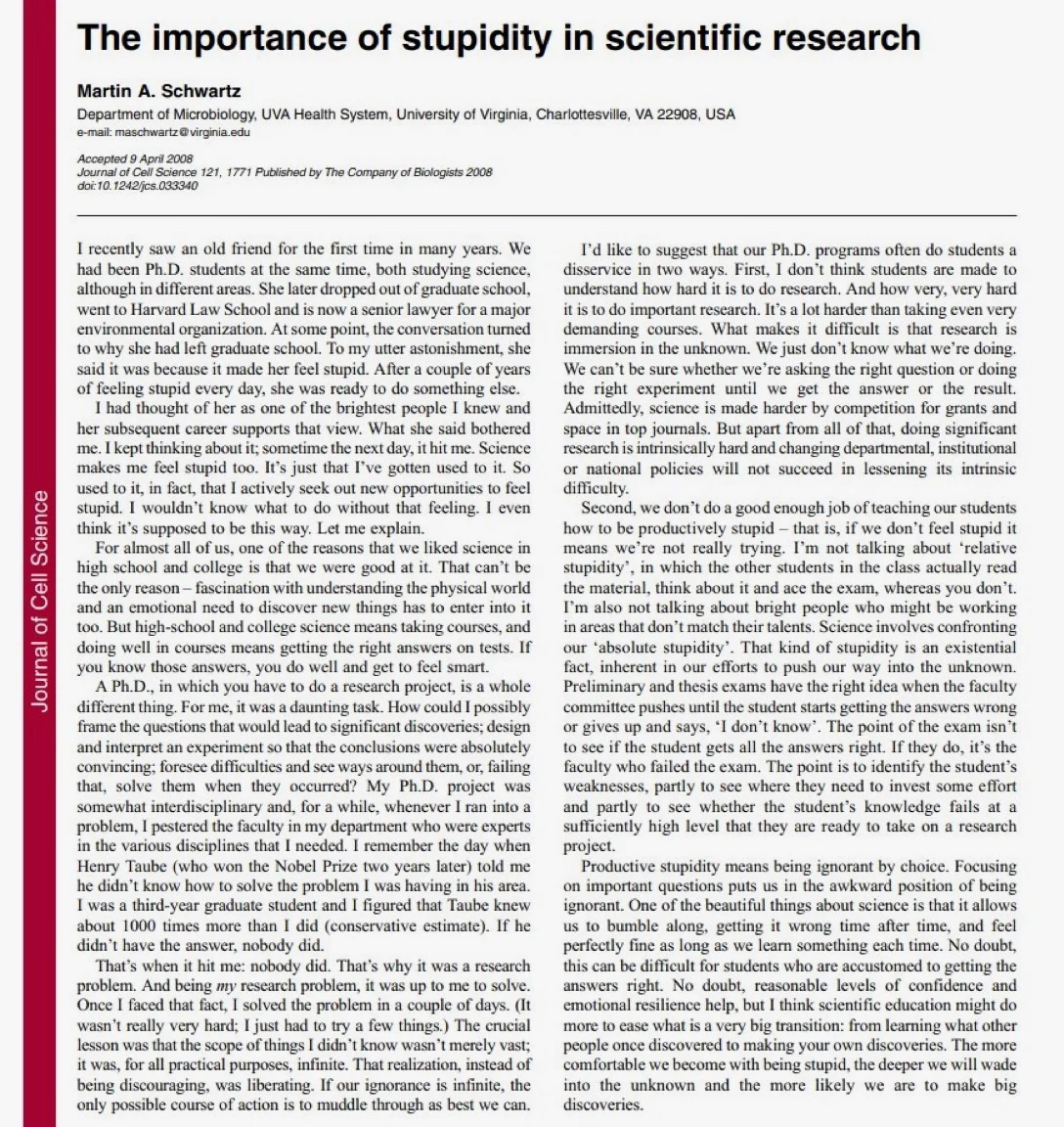
Filippo Cademartiri, Consultant Advanced Cardiovascular Imaging at UPMC Salvator Mundi International Hospital, shared a post on X about an article by Martin Schwartz, published in Journal of Cell Science, adding:
“This article should be mandatory reading for every medical student, PhD candidate, researcher – and honestly, for anyone who mistakes expertise for certainty.
‘The importance of stupidity in scientific research’ sounds provocative, almost offensive.
But Martin Schwartz is not glorifying incompetence.
He is describing the real operating system of discovery.
Science is not built on knowing.
Science is built on tolerating not knowing.
That distinction matters.
Most of education rewards correctness.
School teaches us to answer.
Exams reward speed, certainty, and precision.
You feel intelligent when you get things right.
Research is the opposite.
Real research begins exactly where competence ends – at the frontier where nobody knows the answer, including the people you thought must know.
That moment is psychologically brutal.
You ask the expert.
The expert shrugs.
You assume you’re missing something.
Then you realize: no – this is the work.
You are not failing.
You are standing at the actual boundary of knowledge.
That feeling – ‘I must be stupid’ – is often not a sign of inadequacy.
It is often the first sign that you are finally asking an important question.
Medicine struggles with this.
We train doctors to avoid uncertainty, to fear being wrong, to perform confidence.
But the best clinicians and the best scientists know how to sit inside ambiguity without collapsing into fake certainty.
This is why AI in medicine also deserves caution.
Systems trained only to reproduce established answers may become extraordinarily good at passing exams while being terrible at discovering what matters next.
Guideline intelligence is not the same as scientific intelligence.
Discovery requires productive stupidity:
- the willingness to stay with the uncomfortable
- to look ignorant
- to ask naïve questions
- to be wrong repeatedly without protecting your ego
Most people want the authority of expertise.
Very few want the humiliation required to earn it.
But progress lives there.
- Not in certainty.
- Not in performance.
- Not in sounding smart.
In the quiet discipline of saying: ‘I don’t know… yet.’
And continuing anyway.”
Title: The importance of stupidity in scientific research
Authors: Martin A Schwartz
Stay updated on all scientific advances with Hemostasis Today.
-
Sep 30, 2026, 01:52Javed Anees: DADA2 – When a Young Stroke Is More Than a Stroke
-
Sep 30, 2026, 01:51How a Venous Thrombus Becomes Revascularized – ISTH
-
Sep 29, 2026, 22:45Victor Agunyego: Paracetamol – The Most Common Drug We Underestimate
-
Sep 29, 2026, 22:42Nova Sinclair: Advancing the Future of Hematology – Meet Our 2027 Organizing Committee
-
Sep 29, 2026, 22:41Lorenz Räber: Intracoronary Imaging in PCI – Why, When, How, and Which Modality?
-
Sep 29, 2026, 22:31Selma Turkovic: Pleased to Deliver the Opening Presentation at Kingston Hospital
-
Sep 29, 2026, 22:31Miguel Teran: Ultrasound and Simulation in Arterial Blood Sampling
-
Sep 29, 2026, 22:28Mohammad Refaei: Navigating Your Career in Hematology From Training to Practice
-
Sep 29, 2026, 22:27Matteo Foschi: 10 Clinical Pearls for Antithrombotic Therapy in Secondary Stroke Prevention