

Deepak Yadav: What If the Way We Classify Stroke Tissue Is Too Simplistic for Modern Stroke Care?
Deepak Yadav, Consultant and Assistant Professor of Neurology at Amrita Hospital, shared on LinkedIn about a recent article by Umberto Pensato et al, published in Stroke:
”’What if the way we classify stroke tissue is too simplistic for modern stroke care?’
For years, acute ischemic stroke has been taught as a binary battle:
- Core equals dead tissue
- Penumbra equals salvageable tissue
But real brains don’t behave in binaries.
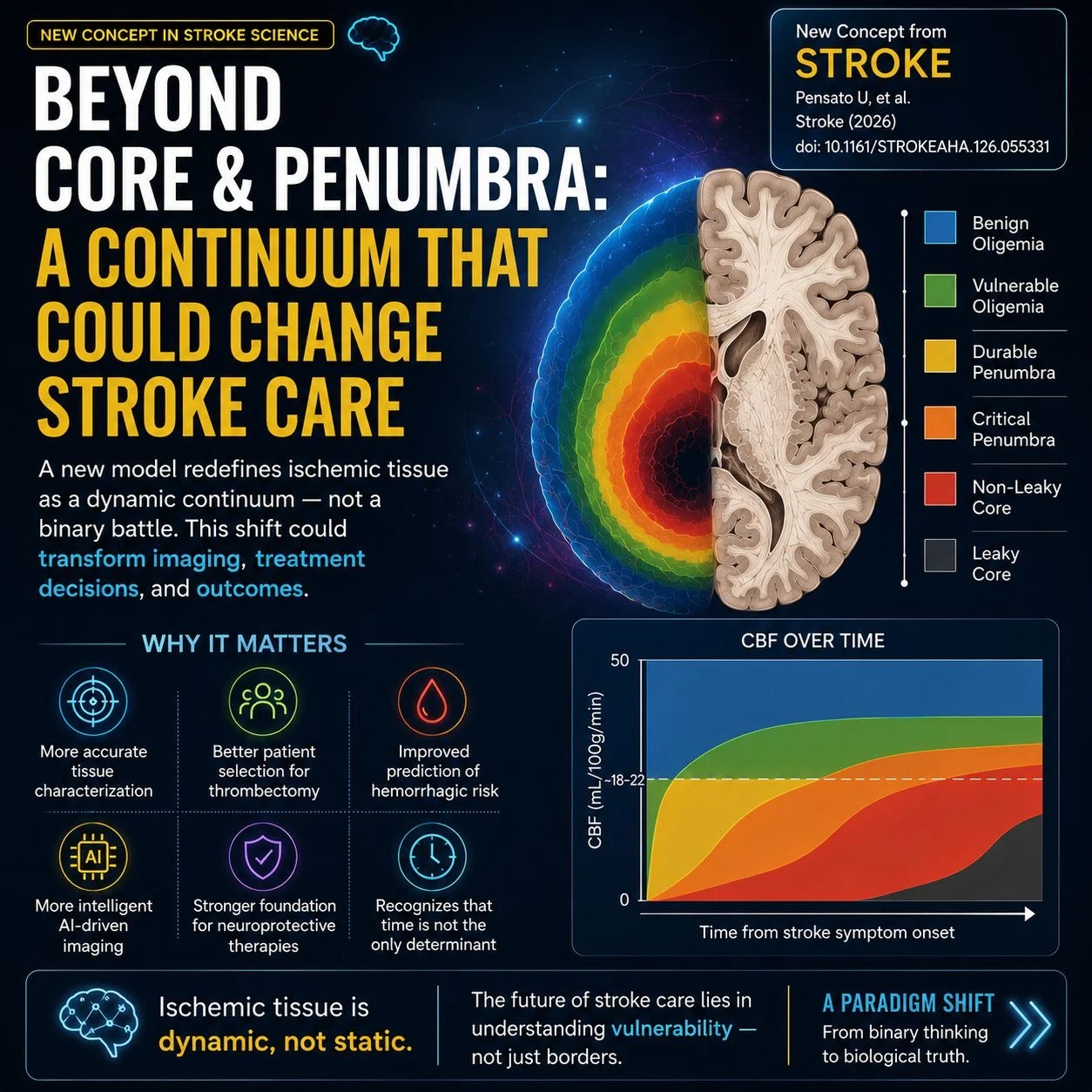
A new concept published in Stroke challenges the traditional ‘core vs penumbra’ model and proposes a continuum of ischemic injury instead.
The proposed spectrum:
- Benign oligemia
- Vulnerable oligemia
- Durable penumbra
- Critical penumbra
- Non-leaky core
- Leaky core
Why does this matter?
Because two patients with the same perfusion scan may have completely different tissue fate, hemorrhagic risk, and response to reperfusion therapy.
This shifts stroke thinking from:
‘Dead vs alive tissue’
to:
‘Degrees of tissue vulnerability over time’
That perspective could fundamentally change:
- How we interpret perfusion imaging
- How we select thrombectomy candidates
- How we estimate hemorrhagic transformation risk
- How AI-based stroke software classifies tissue
- How future neuroprotective therapies are targeted
The most powerful idea from this paper:
Ischemic tissue is dynamic, not static.
- Some ‘core’ may still be recoverable.
- Some ‘penumbra’ may already be biologically doomed.
And perhaps most importantly: Time alone is not the only determinant anymore.
Collateral status, metabolism, BBB integrity, inflammation, and tissue resilience may matter just as much as the clock.
As neurologists, we may be entering an era where stroke imaging evolves from:
Anatomical snapshots
to:
Biological tissue characterization.
That could redefine acute stroke decision-making over the next decade.
Reference:
Pensato U, Ospel JM, Ganesh A, et al.
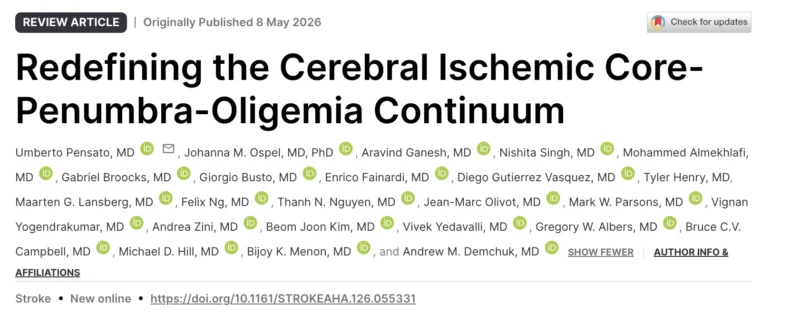
‘Redefining the Cerebral Ischemic Core–Penumbra–Oligemia Continuum.”’
Title: Redefining the Cerebral Ischemic Core-Penumbra-Oligemia Continuum
Authors: Umberto Pensato, Johanna M. Ospel, Aravind Ganesh, Nishita Singh, Mohammed Almekhlafi, Gabriel Broocks, Giorgio Busto, Enrico Fainardi, Diego Gutierrez Vasquez, Tyler Henry, Maarten G. Lansberg, Felix Ng, Thanh N. Nguyen, Jean-Marc Olivot, Mark W. Parsons, Vignan Yogendrakumar, Andrea Zini, Beom Joon Kim, Vivek Yedavalli, Gregory W. Albers, Bruce C. V. Campbell, Michael D. Hill, Bijoy K. Menon, Andrew M. Demchuk
Stay updated on all scientific advances with Hemostasis Today.
-
Oct 5, 2026, 22:55Steve Humphreys: A Big Thank You to BSHT for Providing Me With a Recent Skills Exchange Award
-
Oct 5, 2026, 22:52William McKeown: Great to Be in Istanbul for the Opening of the EHC 2026
-
Oct 5, 2026, 22:48Laura Quintas Lorenzo: A New Approach to Healthcare for von Willebrand Disease at EHC 2026
-
Oct 5, 2026, 22:46Anas Zayad: Pleased to Share Our New Review on Thrombosis in SCD and Beta Thalassemia
-
Oct 5, 2026, 22:44Cihan Ay: Honouring Eric Kandel and Eugene Braunwald at the Medical University of Vienna
-
Oct 5, 2026, 22:42Heather L. Gornik: Testing for Aortic and Arterial Thrombosis at VSS 2026
-
Oct 5, 2026, 22:34Hasan Abbas Zaheer: Honoured to Have Co-Authored One of the Four Reviews in The Lancet Thalassemia Series
-
Oct 5, 2026, 22:34Kamyar Shameli: Understanding the Coagulation Cascade – How Anticoagulants Prevent Blood Clots
-
Oct 5, 2026, 22:31Risika Samanta: Pediatric ITP in a 12-year-old – An Atypical Presentation without a Viral Prodrome