

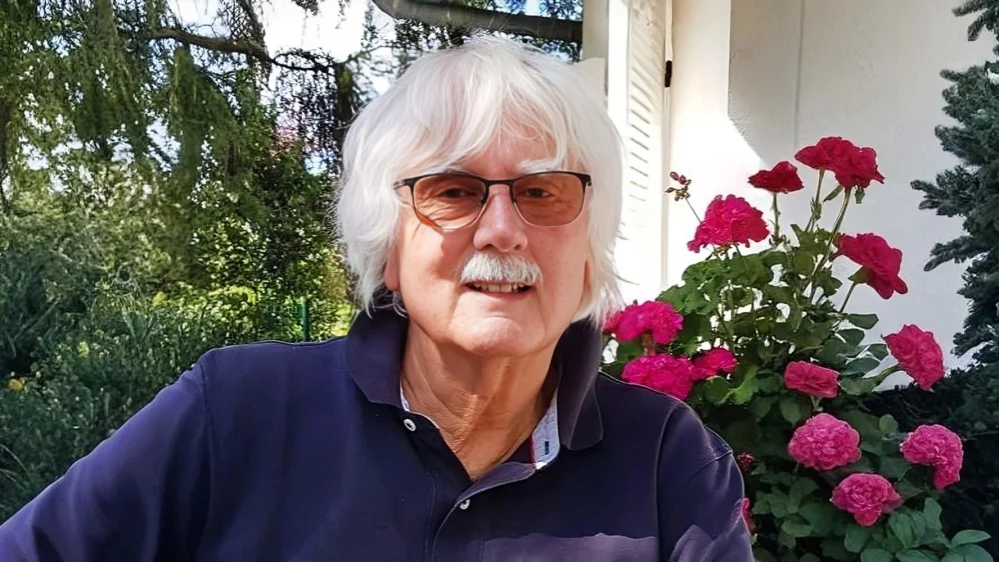
Alan Nurden: How the Interaction Between VWF and the aIIbβ3 Integrin in Platelets Consolidates Thrombi
Alan Nurden, Emeritus Research Director at CNRS, Co-Founder of the French National Reference Centre for Inherited Platelet Disorders (CRPP), shared a post on LinkedIn about a recent article by Qizhen Shi et al., published in Haematologica, adding:
“This fascinating manuscript from Qizhen Shi and her colleagues from Milwaukee shows how the interaction between von Willebrand factor (VWF) and the aIIbβ3 integrin in platelets consolidates thrombi formed under flow on collagen and prevents embolization.
The manuscript highlights a novel ELISA-style assay in which they use the purified aIIbβ3 headpiece as substrate for VWF.
Enigmatically, the headpiece binds VWF directly whereas the complex on the unstimulated platelet is restrained and does not, implying perhaps that the isolated headpiece is activated.
The authors used their test to study the interaction between aIIbβ3 and VWF in the blood of a large series of well-characterized von Willebrand disease (VWD) patients of all types from the Zimmerman project and importantly revealed a new subspecies of VWD where patients carried the C1-domain p.C2464R variant that prevented the binding of VWF to aIIbβ3.
They went on to confirm the clinical importance of this interaction with respect to bleeding or thromboembolism risk using various mouse models including mice where the VWF C1-domain RGDS sequence known to mediate the binding to aIIbβ3, was changed to RGES, a sequence unable to bind the integrin.
Also included in the mouse models were mice lacking fibrinogen.
The battery of the methods used itself makes the manuscript interesting reading.
To be brief, the results showed how the VWF-aIIbβ3 interaction was essential for stabilizing the platelet plug, a function that was not compensated for by fibrinogen.
The study made me recall some of the initial pioneer papers on the interaction between VWF and aIIbβ3 on platelets and featuring Zaverio Ruggeri, Ed Plow, June Wencel-Drake and Mark Ginsburg, whose work has been confirmed by this new study.
With regard to the novel assay described here, in all probability the larger multimers of VWF would bind preferentially as they would interact with multiple headpieces.
Interestingly, in terms of my interest in the inherited platelet disorder, Glanzmann thrombasthenia, where platelets lack aIIbβ3, the absence of this interaction with VWF would probably mean that thrombi that do form through alternative pathways (i.e. GPVI and fibrin) would add to their instability.”
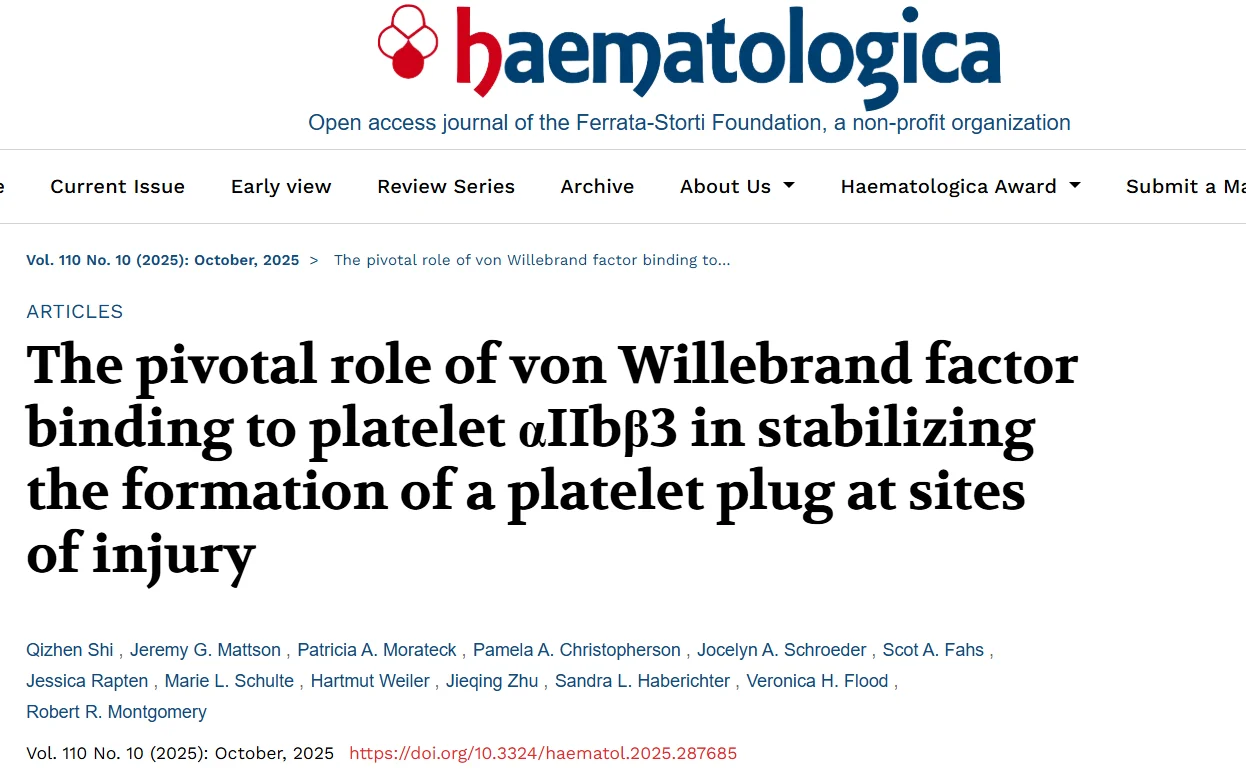
Title: The pivotal role of von Willebrand factor binding to platelet αIIbβ3 in stabilizing the formation of a platelet plug at sites of injury
Authors: Qizhen Shi, Jeremy G. Mattson, Patricia A. Morateck, Pamela A. Christopherson, Jocelyn A. Schroeder, Scot A. Fahs, Jessica Rapten, Marie L. Schulte, Hartmut Weiler, Jieqing Zhu, Sandra L. Haberichter, Veronica H. Flood, Robert R. Montgomery
Stay updated on all scientific advances with Hemostasis Today.
-
Oct 10, 2026, 17:58Archo Farzana Batool: Exploring Medical Writing Through an Article on Iron Deficiency Anemia
-
Oct 10, 2026, 17:53Assessing Frailty in Adults With Hemophilia – JTH
-
Oct 10, 2026, 17:52Fatma Sadeghi: Reducing Maternal Health Inequalities Through Nursing Advocacy
-
Oct 10, 2026, 17:50Grzegorz Hensler: How Apheresis Transformed Blood Cell Separation and Collection
-
Oct 10, 2026, 17:47Hemant K Sharma: Japan’s Universal Artificial Blood Research – A Potential Breakthrough in Transfusion Medicine
-
Oct 10, 2026, 17:40John Strouse: Learning About Bleeding Disorders and Sickle Cell Disease at FWGBD
-
Oct 10, 2026, 17:34Mae Caime: Speaking at the Annual Women’s Retreat for the Hemophilia Community in Florida
-
Oct 10, 2026, 17:30Chokri Ben Lamine: PNH beyond the Textbook Triad
-
Oct 10, 2026, 17:29Ruah Alyamany: Thrombosis and Anticoagulation in Hematological Malignancies at SOHO KSA 2026