


Tareq Abadl/LinkedIn
May 20, 2026, 08:03
Tareq Abadl: Exploring the Clinical Power of Serum Protein Electrophoresis
Tareq Abadl, Medical Lab Specialist, shared a post on LinkedIn:
“Serum Protein Electrophoresis – The Electric Separation of Serum Proteins
‘The serum we see in the lab isn’t just a yellow liquid… it’s a whole world of proteins, each with its own role and unique fingerprint.
The technique that reveals this fingerprint is called Serum Protein Electrophoresis.’
Sample Handling:
- The serum must be properly separated after centrifugation, ensuring no hemolysis or lipemia.
- Store the sample at 4°C until analysis; if delayed, freeze it.
- Load the sample precisely using a micropipette with a loading buffer to ensure proper migration.
- The technician must wear gloves and work under sterile conditions to avoid contamination.
Step-by-Step Procedure:
- Prepare a protein gel (Agarose or Cellulose acetate).
- Load the serum into the wells.
- Apply an electric field – proteins move according to size and charge.
- After separation, perform staining to visualize the bands.
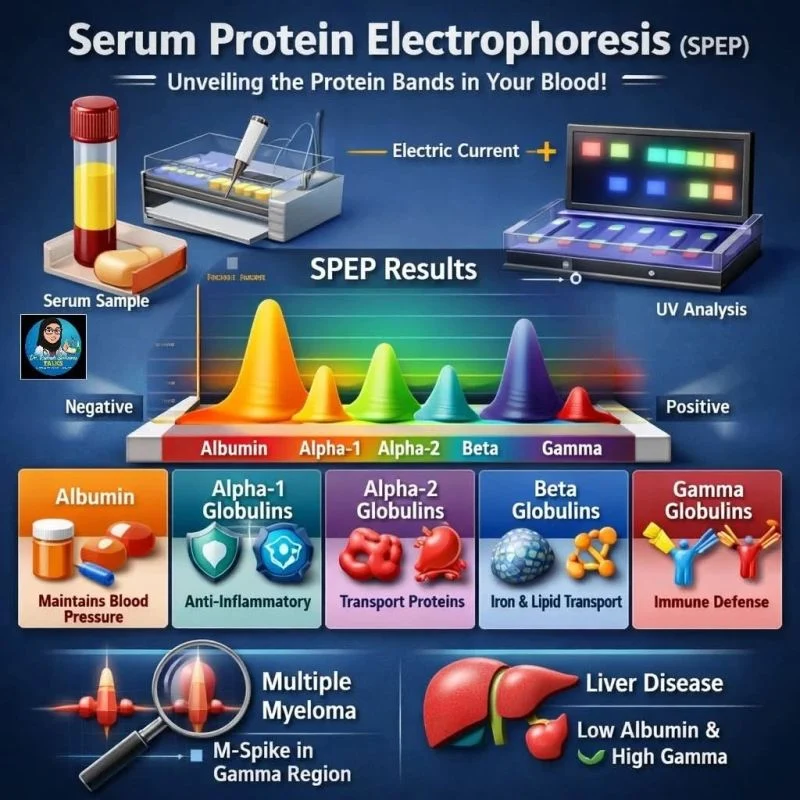
- The result appears as a curve or bands, each representing a specific protein fraction.
Main Regions in SPEP:
- Albumin – Maintains blood pressure and transports substances.
- Alpha-1 globulins – Includes Alpha-1 antitrypsin.
- Alpha-2 globulins – Includes Haptoglobin and Ceruloplasmin.
- Beta globulins – Responsible for iron and lipid transport.
- Gamma globulins – Contain antibodies that protect against infections.
Clinical Applications:
- Diagnosis of hematologic and immune disorders.
- Monitoring liver and kidney diseases.
- Detecting tumors such as Multiple Myeloma (appears as an M-spike in the Gamma region).
- Assessing protein deficiency or excess.
- Tracking treatment response in chronic diseases.
- Evaluating protein loss in urine (Nephrotic syndrome).
- Monitoring bone marrow or liver transplant patients.
Possible Errors:
- Hemolyzed sample – distorted results.
- Old or incorrect buffer – weak separation.
- Overloaded sample – unclear bands.
- Poor storage – protein degradation.
- Contamination – double or false bands.
- Misinterpretation without clinical correlation – diagnostic errors.
Modern Advances:
- Automated systems converting curves into precise digital data.
- Combining SPEP with Immunofixation Electrophoresis to identify antibody types.
- Applications in Personalized Medicine for tailored treatments.
- Using Capillary Electrophoresis for higher accuracy and speed.
- Integrating results with immunoglobulin quantification for clearer interpretation.
Real-Life Examples:
- Multiple Myeloma: M-spike in the Gamma region — key diagnostic clue.
- Chronic Liver Disease: Low Albumin with high Gamma globulins.
- Chronic Infection: Gradual rise in Gamma region due to antibodies.
- Treatment Monitoring: Post-chemotherapy reduction in M-spike indicates recovery.
- Nephrotic Syndrome: Marked drop in Albumin with elevated Alpha-2 globulins.”
Other posts featuring Tareq Abadl on Hemostasis Today.
-
Oct 6, 2026, 12:39Sarah Garvey: Putting The Patient Experience At The Heart Of VTE Care
-
Oct 6, 2026, 12:33Platelets Without Donors: Can Freeze-Dried Artificial Platelets Transform Trauma Care?
-
Oct 6, 2026, 12:03Louise St. Germain Bannon: Supporting the World Thrombosis Day
-
Oct 6, 2026, 11:39Joining the Hemophilia and Bleeding Disorders Community at the EHC 2026 – WFH
-
Oct 6, 2026, 10:56Moustafa Abdou: LE Cells and the Early Diagnosis of Lupus
-
Oct 6, 2026, 10:35Caitlin Raymond: Understanding IgA Deficiency and Anaphylaxis Risk
-
Oct 6, 2026, 10:15Zeeshan Ali Baig: AI-Designed Peptide for Rare Bleeding Disorder
-
Oct 6, 2026, 10:12Srivatsan Rangachari: Stem Cell Transplant for 12-Year-Old with Fanconi Anaemia
-
Oct 6, 2026, 09:56Anitha Narayanamurthy: A Possible Missing Link in Unexplained Blood Test Abnormalities