


Megan Griffiths: Advancing the Understanding of Risk and Outcomes in Pulmonary Hypertension
Megan Griffiths, Assistant Professor of Pediatrics at University of Texas Southwestern Medical Center, shared Raymond L. Benza‘s a post on LinkedIn:
“It’s such a privilege to work with Raymond L. Benza to advance the understanding of risk and outcomes in pulmonary hypertension.
This paper highlights an important question for the pulmonary hypertension community – what does low risk mean?
What should be our goal outcomes and what are our targets for therapy?
It’s been so great to learn from Charles Fauvel, Raymond L. Benza, Sandeep Sahay.
Next step!
Let’s think about defining outcomes and pushing the boundaries for the best pulmonary hypertension care for kids!”
Raymond L. Benza, Professor of Medicine at Eastern Virginia Medical School, shared a post on LinkedIn about a recent article he and his collegues co-authored, published in JACC: Heart Failure, adding:
“I am incredibly proud to share this publication and what it represents for our field.
This work is more than a manuscript—it reflects a collective belief that we can and should do better for patients with pulmonary arterial hypertension (PAH). It challenges us to rethink long-held definitions and push toward goals that truly matter.
Raising the bar for ‘low risk’ in pulmonary arterial hypertension (PAH)
For years, ‘low risk’ in PAH has been defined primarily by short-term mortality – less than 5% at 1 year. But as therapies improve, it’s time to ask an important question:
Is that definition still enough for our patients?
In our recent work captured in fauvel-et-al-2026-refining-the-definition-for-low-risk-in-pulmonary-arterial-hypertension, we propose a more ambitious, patient-centered framework – one that goes beyond survival alone.
Key shift:
- Extend low-risk mortality to 3 years (less than 5%)
- Incorporate morbidity, including risk of clinical worsening less than 10% at 1 year
Why this matters:
A ‘low-risk’ label today can still mask meaningful disease burden
Patients continue to experience clinical worsening and hospitalizations, impacting quality of life and long-term outcomes [fauvel-et-…pertension]
Patients care deeply about how they live, not just how long they live
This work is among the first to embed both morbidity and mortality into a unified definition of low risk, setting a higher—and more meaningful—treatment goal. [fauvel-et-…pertension]
A special acknowledgment to Dr. Charles Fauvel, whose exceptional leadership and persistence were instrumental in bringing this work across the finish line.
We also extend our sincere thanks to the PHORA investigators, whose collaborative effort made this manuscript possible, and to the NHLBI and FDA for their critical support—particularly in enabling harmonization of patient-level data across multiple trials, a cornerstone of this analysis. [fauvel-et-…pertension]
The takeaway:
As the therapeutic landscape evolves, so must our expectations.
‘Low risk’ should reflect not just longevity—but quality of life and durability of stability.
Call to action:
We encourage clinicians, researchers, and stakeholders across the PAH community to consider how we can adopt, validate, and operationalize a more stringent low-risk target in practice.
How should this influence treatment escalation strategies?
What additional data are needed to support real-world implementation?
And how can we align on goals that truly matter to patients?
Let’s continue the conversation—and work together to redefine success in PAH.”
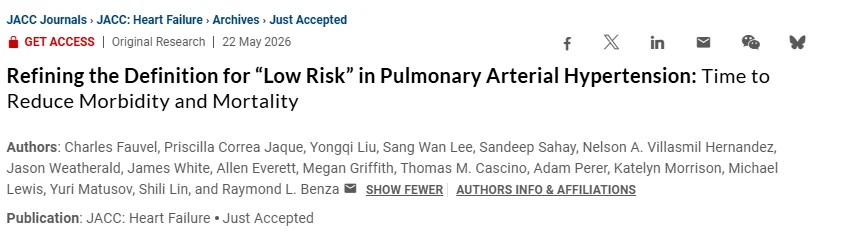
Title: Refining the Definition for “Low Risk” in Pulmonary Arterial Hypertension: Time to Reduce Morbidity and Mortality
Authors: Charles Fauvel, Priscilla Correa Jaque, Yongqi Liu, Sang Wan Lee, Sandeep Sahay, Nelson A. Villasmil Hernandez, Jason Weatherald, James White, Allen Everett, Megan Griffith, Thomas M. Cascino, Adam Perer, Katelyn Morrison, Michael Lewis, Yuri Matusov, Shili Lin, Raymond L. Benza
Stay upadated on all scientific advances with Hemostasis Today.
-
Oct 10, 2026, 02:38Brianne D.: Sex Differences in RIPK1 Signaling Following Intracerebral Hemorrhage
-
Oct 10, 2026, 02:17Dino Mehic: Managing Heavy Menstrual Bleeding in Patients with BDUC
-
Oct 10, 2026, 00:34Raphaëlle Dodart: Discussing the Mechanisms of Menstrual Hemostasis
-
Oct 10, 2026, 00:26Barbara Adams Krolak: Discussing the Growing Need for Blood Clot Prevention in Asia
-
Oct 9, 2026, 23:59Ana Pedrero Gil: Is Coagulopathy with Fibrinolysis Present in All Obstetric Hemorrhages?
-
Oct 9, 2026, 23:57Exploring the Psychosocial Needs of People with Bleeding Disorders in Kyrgyzstan – EAHAD
-
Oct 9, 2026, 23:53Bernard Slater Jr.: Serving on the Advisory Council for the NBDF West Virginia Chapter
-
Oct 9, 2026, 23:53Aurelio Maggio: Thalassemia Reports Real-Time Impact Factor Rises to 1.760
-
Oct 9, 2026, 23:52Stronger Connections, Stronger Organizations – World Federation of Hemophilia