

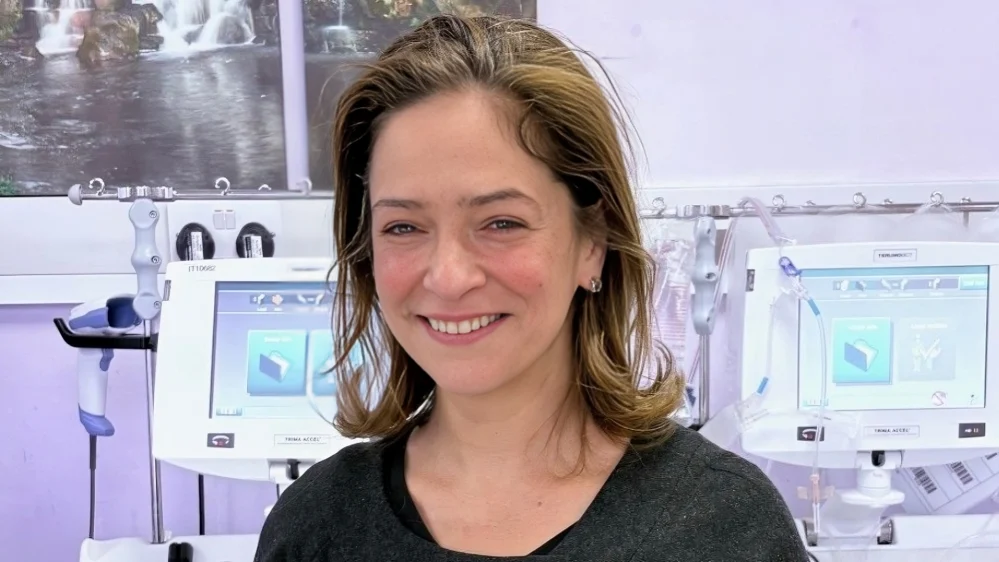
Sara Trompeter: Improving Transfusion Safety Through Advanced Blood Matching in SCD
Sara Trompeter, Consultant Haematologist and Paediatric Haematologist at University College London Hospitals NHS Foundation Trust, Consultant Haematologist at HCA Healthcare, shared NHS Blood and Transplant‘s post on LinkedIn, adding:
“Very excited to start this study with colleagues at NHS Blood and Transplant – a potential real step in improving transfusion safety.
So grateful for the support of the wider collaboration and funders.”
NHS Blood and Transplant shared a post on LinkedIn:
“NHS Blood and Transplant (NHSBT) is leading an innovative study exploring how advanced algorithms and genomic data can transform blood matching, improving both patient safety and the use of valuable donor resources.
While current transfusion practice focuses on matching major blood groups, patients who receive frequent transfusions – including many living with sickle cell disorder – may develop immune responses to less commonly matched minor blood groups. This can lead to complications, including transfusion reactions and increasing difficulty in finding compatible blood over time.
This new feasibility study introduces bloodMatcher, an advanced algorithm that uses DNA-based genotyping from both donors and patients to enable more precise matching across a broader range of blood groups. By incorporating this genomic data, the approach aims to reduce the risk of alloimmunisation and make more effective use of rare blood units.
Led by NHSBT in partnership with University College London Hospitals NHS Foundation Trust (UCLH) and the NIHR UCLH Biomedical Research Centre, the study will evaluate the algorithm in a clinical setting, supporting around 40 patients with sickle cell disorder who require regular transfusions. Importantly, all established safety protocols will remain in place, alongside additional clinical oversight.
Dr Sara Trompeter, Consultant Haematologist at NHS Blood and Transplant and UCLH, said:
‘Currently, given the numbers of units available and orders to fulfil, it’s not practical to consider many blood types – the blood types are too complex, and the number of units too numerous , for humans to compute the best unit to send.
‘This new technology hopes to reduce the potential mismatch between donor and recipient minor blood groups. Mismatches can cause the formation of a blood group antibody (alloimmunisation) which makes it hard to find blood the patient can safely receive or even severe transfusion reactions.
‘The population cohort that most struggles with the complications of alloimmunisation is the study population of interest in this study — adults with sickle cell disorder. Around 17% of adults with sickle cell are alloimmunised.
‘The new bloodMatcher algorithm will – combined with the new genomic blood data we have available– be able to select units in a faster, far more advanced way. The goal is to improve donor to patient antigen matching and thus reduce the risk of alloimmunisation and the risk of severe transfusion reactions for patients needing blood. By improving matching, we will de facto also reduce ‘waste’, caused by giving valuable rare units to people who don’t need them.’
By combining cutting-edge AI with genomic science, this research has the potential to pave the way for a larger, multi-centre trial and, ultimately, a step change in how blood is matched for patients across the NHS.”
Stay updated with Hemostasis Today.
-
Oct 12, 2026, 19:39Edward Loftus: Using Low-Dose Aspirin in Pregnant Women With IBD
-
Oct 12, 2026, 19:32Shruti Sachdeva: Strengthening the Fight against Anemia
-
Oct 12, 2026, 19:27Melissa Hollo: Treating Anemia during Pregnancy Is an Investment in Two Generations of Health
-
Oct 12, 2026, 17:53Donna Morelli: Hydroxyurea Safe and Effective for Pediatric Sickle Cell in Africa
-
Oct 12, 2026, 17:39Annie Bauzon: Differentiating Direct and Indirect Coombs Tests in Hematology
-
Oct 12, 2026, 17:15Cedric Hermans: Identifying and Diagnosing Hemophilia Carriers and Affected Females
-
Oct 12, 2026, 17:01Bianca Rocca: Evaluating Factor XI Inhibition Lessons from LIBREXIA-ACS
-
Oct 12, 2026, 13:58Francisco Chacón-Lozsán: Catastrophic Antiphospholipid Syndrome A Rapidly Progressive Multiorgan Thrombotic Emergency
-
Oct 12, 2026, 12:50Nawsherwan Mohammad: Study Examines Thrombotic Events in Patients with Polycythemia Vera in Iraq