


Reidiel Suárez Borges: Understanding the INR in Anticoagulation Management
Reidiel Suárez Borges, Medical Doctor at Het Diakonessenhuis, shared a post on LinkedIn:
“Beyond the Numbers: Understanding the INR in Anticoagulation Management
In emergency medicine and critical care, we frequently look at coagulation panels. But few metrics require as much dynamic interpretation as the INR (International Normalized Ratio).
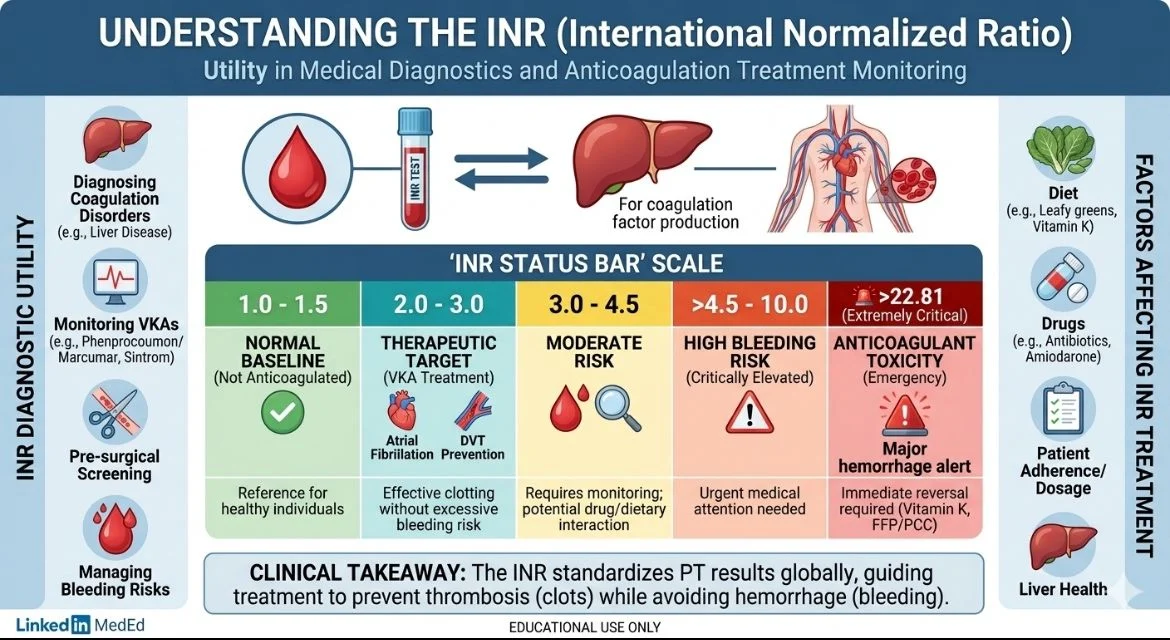
Yesterday, I managed a critical case with an INR that literally broke the laboratory’s upper limit (>22.81). It was a stark reminder of why understanding this tool is vital for patient safety.
Here is a quick breakdown of what the INR actually means, its diagnostic utility, and why it is the cornerstone of monitoring Vitamin K Antagonists (VKAs) like Phenprocoumon (Marcumar) or Acenocoumarol (Sintrom):
1.What is the INR?
The Prothrombin Time (PT) measures the extrinsic pathway of coagulation. However, because different labs use different tissue factors (thromboplastin) with varying sensitivities, raw PT seconds cannot be safely compared worldwide.
The INR was created to standardize this. It factorizes the patient’s PT against an international reference index, ensuring that an INR of 2.5 means the exact same level of anticoagulation in Suriname, the Netherlands, or anywhere else.
2.Diagnostic Utility and Therapeutic Windows:
- Normal/Baseline: Around 1.0 in a healthy individual not on anticoagulants.
- The ‘Sweet Spot’ (Target 2.0 – 3.0): For most patients with Deep Vein Thrombosis (DVT), Pulmonary Embolism, or Atrial Fibrillation, this is the therapeutic window where we prevent clots without causing major bleeds.
- High-Risk (Target 2.5 – 3.5): Often reserved for mechanical heart valves, where the thrombogenic risk is much higher.
3.The Challenges of Treatment Follow-up:
VKAs block the hepatic synthesis of Vitamin K-dependent clotting factors (II, VII, IX, X). Monitoring the INR isn’t just about a one-time check; it’s a continuous tightrope walk due to:
- Dietary Interactions: Foods rich in Vitamin K (like leafy greens) can drastically lower the INR.
- Drug Interactions: Antibiotics or amiodarone can dangerously skyrocket the INR.
- Half-life Dynamics: Long-acting drugs like Marcumar have a massive half-life. An extreme INR won’t just drop on its own overnight; it requires active, calculated reversal (Vitamin K1, FFP, or PCC) and strict clinical follow-up.
The Clinical Takeaway
A critically high INR is a medical emergency. When a patient’s coagulation profile is completely shattered (such as PT/APTT >180s), micro-bleeds (like hematuria) are early warning signs that the vascular endothelium is giving out.
As clinicians, our job isn’t just to look at the monitor and treat the number—it’s to understand the underlying pharmacology, anticipate volume tolerances (especially in elderly patients), and act before a minor bleed becomes a catastrophic event.
How often do you encounter extreme anticoagulation toxicities in your practice?”
Stay updated with Hemostasis Today.
-
Oct 20, 2026, 16:51Suzan Nakasendwa: A Growing Stroke Challenge in Uganda
-
Oct 20, 2026, 16:38Steve Moon: How Does Smoking Cessation Duration Affect Ischemic Stroke Risk
-
Oct 20, 2026, 16:25Cedrice Mentor: Reducing Platelet Wastage Through Cold Storage
-
Oct 20, 2026, 16:09Thirunavukkarasu Angappan: Can a Purified Fibrinogen Concentrate Replace Cryoprecipitate
-
Oct 20, 2026, 16:01Kalyan Roy: Platelet Conservation Through Evidence-Based Transfusion Practice
-
Oct 20, 2026, 15:28Stacy E. Croteau: 33 Countries, One Mission – Better Bleeding Disorder Care
-
Oct 20, 2026, 15:19Teresa Barnes: What Does a Pulmonary Embolism Mean for Jalen Hurts?
-
Oct 20, 2026, 15:04Laura S.: Could Speaking Up Prevent Maternal Deaths from Thrombosis?
-
Oct 20, 2026, 14:44Pete Stibbs: VTE in Professional Athletes – When Fitness Is Not Enough