


Alessandro Perrella: It is Not Only about “How High the CRP is”, but “in Which Patient” We are Measuring That Value
Alessandro Perrella, Director of the Unit of Emerging and Highly Contagious Infectious Diseases at Ospedali dei Colli, Infectious Disease Specialist at Antonio Cardarelli National Referral Hospital, shared a post on LinkedIn about a recent article he and his colleagues co-authored, published in Antibiotics, adding:
“In a panorama where we often look for a single, linear answer, this study conducted in the Department of Infectious Diseases and Emerging Infectious Diseases shows that even a key parameter like PCR and CRP can lose its meaning if we do not take into account the ‘background noise’ generated by chronic inflammatory comorbidities.
In other words, it is not only about ‘how high the CRP is’, but ‘in which patient’ we are measuring that value.
From this perspective, we developed a ‘Comorbidity Confounder Score‘ (CCS), built on physiopathological grounds, which isolates the subgroups in which CRP regains a good ability to distinguish bacterial from viral infections, while still remaining an exploratory tool that has not yet been validated for clinical use.
The paper published yesterday in Antibiotics also presents a prototype of a ‘POC‑CRP Assistant‘, a web app that automates CCS calculation and provides a contextualized interpretation of CRP values, designed to integrate with new point‑of‑care (POC) systems and ward workflows.
This is only the beginning of a journey toward integrating AI‑based tools into clinical practice, but it is important to start precisely by recognizing ‘visible’ confounders and building simple, transparent solutions that are integrated into everyday practice.
The goal is not to replace clinicians, but to support them in making more informed decisions.
A huge thank you to the entire working group, without whom all this would have been impossible: Prof. Paola Salvatore, Francesca Futura Bernardi, Pierpaolo Di Micco, Ugo Trama, Rita Boenzi, Antimo di Spirito, Claudia Tiberio, Giusy di Flumeri, Nicolina Capoluongo and Mariano Bernardo.
Stay tuned:
We will be back with new amazing AI‑based strategies in Infectious Disease.”
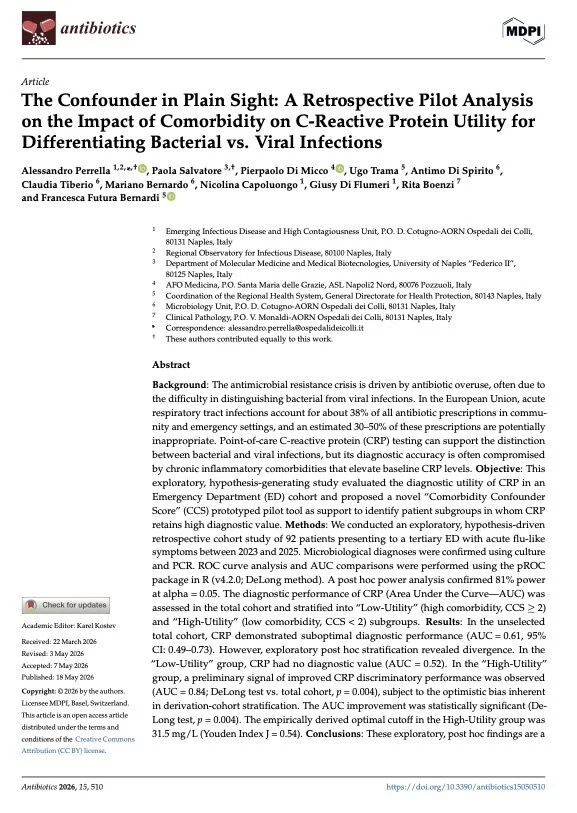
Title: The Confounder in Plain Sight: A Retrospective Pilot Analysis on the Impact of Comorbidity on C-Reactive Protein Utility for Differentiating Bacterial vs. Viral Infections
Authors: Alessandro Perrella, Paola Salvatore, Pierpaolo Di Micco, Ugo Trama, Antimo Di Spirito, Claudia Tiberio, Mariano Bernardo, Nicolina Capoluongo, Giusy Di Flumeri, Rita Boenzi, Francesca Futura Bernardi
Stay updated on all scientific advances with Hemostasis Today.
-
Oct 14, 2026, 18:20Yuria Ito: Does an MCV Below 100 Mean There Is No Vitamin B12 Deficiency?
-
Oct 14, 2026, 18:08Micheal Avoseh: Nanoparticle Research for Venous Thrombosis
-
Oct 14, 2026, 18:00A Decade of Symptoms Before a Rare Disease Diagnosis – ITP Support Association
-
Oct 14, 2026, 17:52David McIntosh: The Global Blood Shortage and the Need for Sustainable Donor Recruitment
-
Oct 14, 2026, 17:41Emmanuel J Favaloro։ October 13 is World Thrombosis Day
-
Oct 14, 2026, 17:24EHC ERIN Webinar on Fibrinogen Disorders
-
Oct 14, 2026, 16:50Peter Kouides: The Role of Multidisciplinary Networks in Women’s Hematologic Care
-
Oct 14, 2026, 16:35Thaís Leonel: Analytical Consistency as a Foundation for Evidence-Based Thrombosis Management
-
Oct 14, 2026, 16:28Christina Yiangou: Presenting the HemaFAIR Project at ASCAT 2026 in London