


Karen Phillips: Surprisingly High Cumulative Clinical Bleeding Events In Post-Ablation AF Patients
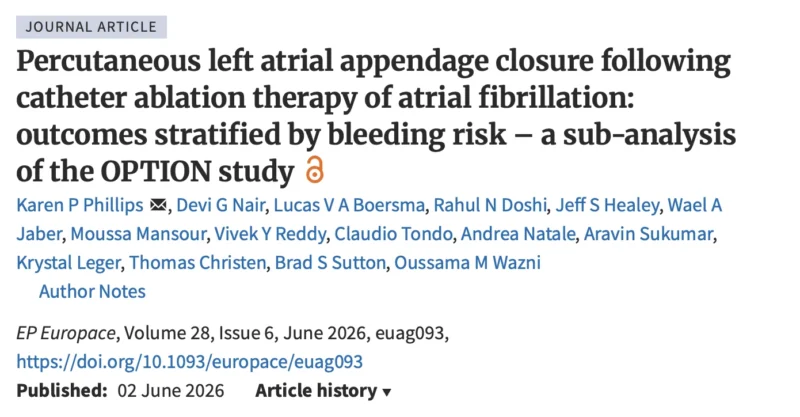
Karen Phillips, Director of Cardiology at The Brisbane AF Clinic, shared on LinkedIn about a recent article she and her colleagues co-authored, published in EP Europace, adding:
”If you prescribe or take anticoagulation for atrial fibrillation then you need to read our latest publication which analysed stroke and bleeding outcomes in a post-ablation population from the OPTION RCT stratified according to HAS-BLED bleeding risk.
In this younger population we highlight the surprisingly high cumulative clinical bleeding events over 3 years.
The outcomes tracked not only major bleeding but also any bleeding that required medical intervention.
The results lay bare why patients complain about being on anticoagulation- some of the most dramatic reductions in bleeding events were observed in patients with low risk HAS-BLED scores of 0 and 1 when they were able to stop anticoagulants after receiving a Watchman FLX LAAC device.
It’s not just patients with higher baseline bleeding risk who bleed on anticoagulation- it’s all patients.
Looking through the new lens with a fuller appreciation of cumulative bleeding issues we can now have a more frank conversation with our AF patients about what the long term risks of anticoagulation really are.”
Title: Percutaneous left atrial appendage closure following catheter ablation therapy of atrial fibrillation: outcomes stratified by bleeding risk – a sub-analysis of the OPTION study
Authors: Karen P. Phillips, Devi G. Nair, Lucas V.A. Boersma, Rahul N. Doshi, Jeff S. Healey, Wael A. Jaber, Moussa Mansour, Vivek Y. Reddy, Claudio Tondo, Andrea Natale, Aravin Sukumar, Krystal Leger, Thomas Christen, Brad S. Sutton, Oussama M. Wazni
Stay updated on all scientific advances with Hemostasis Today.
-
Oct 20, 2026, 16:51Suzan Nakasendwa: A Growing Stroke Challenge in Uganda
-
Oct 20, 2026, 16:38Steve Moon: How Does Smoking Cessation Duration Affect Ischemic Stroke Risk
-
Oct 20, 2026, 16:25Cedrice Mentor: Reducing Platelet Wastage Through Cold Storage
-
Oct 20, 2026, 16:09Thirunavukkarasu Angappan: Can a Purified Fibrinogen Concentrate Replace Cryoprecipitate
-
Oct 20, 2026, 16:01Kalyan Roy: Platelet Conservation Through Evidence-Based Transfusion Practice
-
Oct 20, 2026, 15:28Stacy E. Croteau: 33 Countries, One Mission – Better Bleeding Disorder Care
-
Oct 20, 2026, 15:19Teresa Barnes: What Does a Pulmonary Embolism Mean for Jalen Hurts?
-
Oct 20, 2026, 15:04Laura S.: Could Speaking Up Prevent Maternal Deaths from Thrombosis?
-
Oct 20, 2026, 14:44Pete Stibbs: VTE in Professional Athletes – When Fitness Is Not Enough