


Venugopalan Unni: D-Dimer and Pulmonary Embolism
Venugopalan Unni, Chairman of the Department of Emergency Medicine at Meitra Hospital, shared a post on LinkedIn:
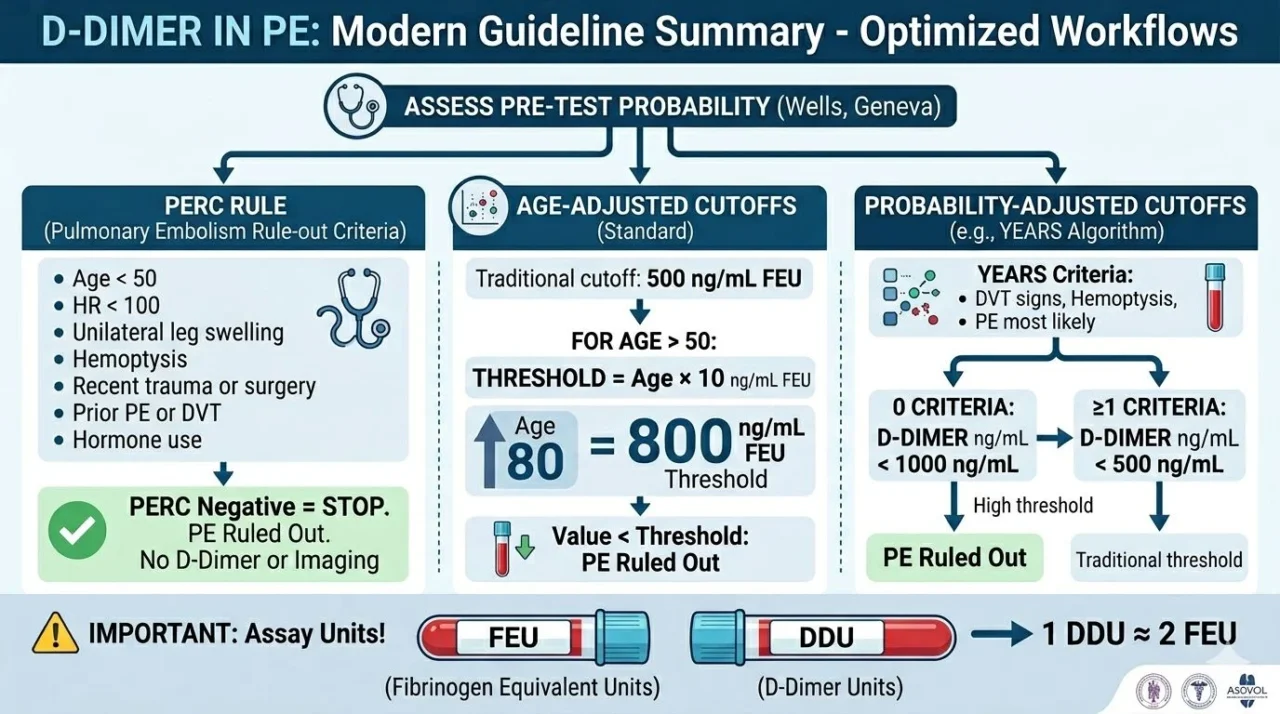
“Smart Clinical Practice: D-Dimer and Pulmonary Embolism (PE)
Are you still using a static cutoff of 500 ng/mL for D-Dimer across all your patients?
If so, you might be over-ordering CT Pulmonary Angiograms (CTPAs), exposing patients to unnecessary radiation, and increasing healthcare costs.
Modern guidelines—including the European Society of Cardiology (ESC) and the American Society of Hematology (ASH)—have moved completely away from the ‘one size fits all’ strategy.
The primary rule remains absolute: D-Dimer is a rule-out tool, not a rule-in tool.
It should only be ordered after assessing clinical pre-test probability using structured tools like the Wells Criteria or the Revised Geneva Score.
The 3 Modern Strategies to Optimize D-Dimer
1.Age-Adjusted Cutoffs
Physiological D-Dimer levels naturally rise with age, which drastically reduces the specificity of the traditional 500 ng/mL cutoff in older adults.
The Rule: For patients over 50 years old, calculate the threshold as:
Age x10 ng /ml
Example: An 80-year-old patient has a personalized rule-out threshold of 800 ng/mL, safely avoiding a negative CTPA if they fall below it.
2.Clinical Probability-Adjusted Cutoffs (The YEARS Algorithm)
- This approach ties the D-Dimer threshold directly to the presence or absence of 3 high-risk clinical criteria:
- Clinical signs of deep vein thrombosis (DVT)
- Hemoptysis (coughing up blood)
- PE as the most likely diagnosis
The Strategy: If a patient has zero YEARS criteria, the D-Dimer cutoff is safely elevated to 1,000 ng/mL to rule out PE. If \ge 1 criterion is met, the traditional 500 ng/mL threshold is used.
3. The PERC Rule (Pulmonary Embolism Rule-out Criteria)
For patients deemed low risk by clinical judgment or a Wells Score less than 2, apply the 8-point PERC rule.
If the patient meets all 8 criteria (e.g., age <50, HR <100, no hormone use, etc.), the probability of PE is already less than 1%.
The Clinical Pearl: In a PERC-negative patient, do not order a D-Dimer at all. Ordering it anyway risks a false positive, forcing an unnecessary imaging workup.
A Final Caveat on Assay Units
Always know your lab’s reporting system!
D-Dimer is reported in either c(Fibrinogen Equivalent Units) or DDU (D-Dimer Units).
A value of 400 ng/mL DDU is actually 800 ng/mL FEU.
Double-checking the units is vital to prevent catastrophic misinterpretations in acute care settings.
Let’s discuss:
How has your institution integrated age-adjusted or Years algorithms into your triage workflows?”
Stay updated with Hemostasis Today.
-
Oct 22, 2026, 10:01Matthew Hazell: AABB 2026 – Beyond the Antibody Screen in Complex Immunohematology Reference Testing
-
Oct 22, 2026, 09:54Dr. Geoffrey Barnes Highlights Blood Clot Risks Following NFL Star Jalen Hurts’ Diagnosis – ISTH
-
Oct 22, 2026, 09:45Louise St. Germain Bannon: Closing the Awareness Gap in Women’s Health and Blood Clot Risks
-
Oct 22, 2026, 09:37Raghavendra Rao: Where Does the Great Saphenous Vein Terminate? Test Your Anatomy Knowledge
-
Oct 22, 2026, 09:32Gashaw Arega Mekonnen: Expansion of Pediatric Hematology and Oncology Services in Ethiopia
-
Oct 22, 2026, 09:23World Thrombosis Day Walk on a Beautiful Morning in Auckland – THANZ
-
Oct 22, 2026, 06:43Giacomo Buso: Lifelong Carotid Risk vs. Late-Stage Trial Neutrality
-
Oct 22, 2026, 06:35Aastha Gupta: Navigating the Diagnostic Challenge of Restricted NK-Cell Repertoires in Flow Cytometry
-
Oct 22, 2026, 06:25Ahmed Alotaibi: Platelet Refractory, But HLA-negative – What Are You Missing?