


Heghine Khachatryan: What Should We Test From a Hematologic Perspective in Young Cryptogenic Stroke?
Heghine Khachatryan, Editor-in-Chief of Hemostasis Today, Head of Hemophilia and Thrombosis Center at Yeolyan Hematology and Oncology Center, shared a post on LinkedIn:
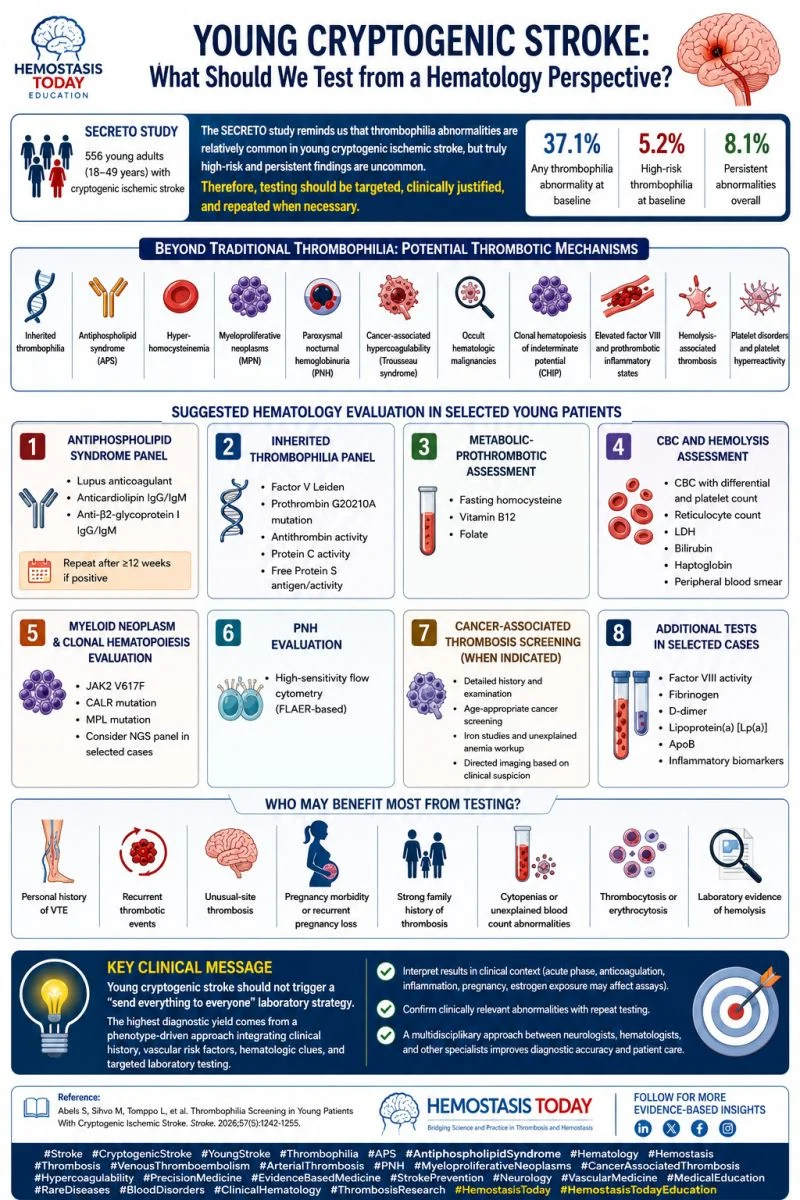
“Young Cryptogenic Stroke: What Should We Test from a Hematology Perspective?
The SECRETO study demonstrated that thrombophilia abnormalities are relatively common in young patients with cryptogenic ischemic stroke; however, truly high-risk and persistent abnormalities are uncommon.
These findings support a targeted and clinically driven approach to hematologic evaluation.
Potential hematologic contributors to young cryptogenic stroke include inherited thrombophilia, antiphospholipid syndrome, hyperhomocysteinemia, myeloproliferative neoplasms, paroxysmal nocturnal hemoglobinuria, cancer-associated hypercoagulability, clonal hematopoiesis, elevated factor VIII, hemolysis-associated thrombosis, platelet disorders, and rare fibrinolytic abnormalities.
A reasonable hematologic evaluation in selected patients may include:
- Antiphospholipid antibodies (lupus anticoagulant, anticardiolipin antibodies, anti-β2 glycoprotein I antibodies)
- Inherited thrombophilia testing (Factor V Leiden, Prothrombin G20210A, antithrombin, protein C, protein S)
- Homocysteine, vitamin B12, and folate
- Complete blood count, peripheral blood smear, reticulocytes, LDH, bilirubin, and haptoglobin
- JAK2 V617F, CALR, and MPL mutation analysis when myeloproliferative neoplasms are suspected
- High-sensitivity flow cytometry for PNH when clinically indicated
- Age-appropriate evaluation for occult malignancy
- Selected biomarkers including factor VIII, fibrinogen, D-dimer, lipoprotein(a), and ApoB
Testing is most informative in young patients with recurrent thrombosis, venous thromboembolism, unusual-site thrombosis, pregnancy morbidity, strong family history of thrombosis, unexplained cytopenias, thrombocytosis, erythrocytosis, or laboratory evidence of hemolysis.
The highest diagnostic yield comes not from indiscriminate testing but from a phenotype-driven strategy integrating clinical history, vascular risk factors, and targeted laboratory investigation.”
Other posts featuring Heghine Khachatryan on Hemostasis Today.
-
Sep 22, 2026, 04:43Michael Cahillane: Highlights From BBTS2026 in Glasgow
-
Sep 22, 2026, 04:15Wolfgang Miesbach: First AAV Gene Therapy Data in Adolescents With Haemophilia B
-
Sep 22, 2026, 04:03Emmanuel J Favaloro: 100 Years of VWD – A Special Virtual Issue
-
Sep 22, 2026, 03:31Mostafa Elshazly: How Is Humidification Used During Non Invasive Ventilation?
-
Sep 22, 2026, 03:05Sumyea Kabir: Jehovah’s Witnesses Update Their Position on Blood Components
-
Sep 22, 2026, 02:33Gerardo Moscatelli: The Spike Protein Cascade – From Endothelial Binding to Vascular Collapse
-
Sep 21, 2026, 20:56George Touma: ApoB Should Be Central to All Lipid Guidlines
-
Sep 21, 2026, 20:55Christopher Robinson: Obstetric Risks Are Seen at the Extremes of Birthweight
-
Sep 21, 2026, 20:54Emicizumab for Refractory GI Bleeding in Myeloma-Associated Acquired VWD – JTH