


Christopher Robinson: Obstetric Risks Are Seen at the Extremes of Birthweight
Christopher Robinson, Executive Chair at the Foundation for the Society for Maternal-Fetal Medicine and Associate Professor of Maternal-Fetal Medicine at the University of South Carolina, shared a post on LinkedIn about a recent article by Layla Ettinghausen and Ashley Moffett, published in American Journal Of Obstetrics And Gynecology, adding:
“AJOG Expert Review: Maternal mortality, birthweight, and immunogenetics: an evolutionary framework for obstetric risk – Obstetric risks are seen at the extremes of birthweight
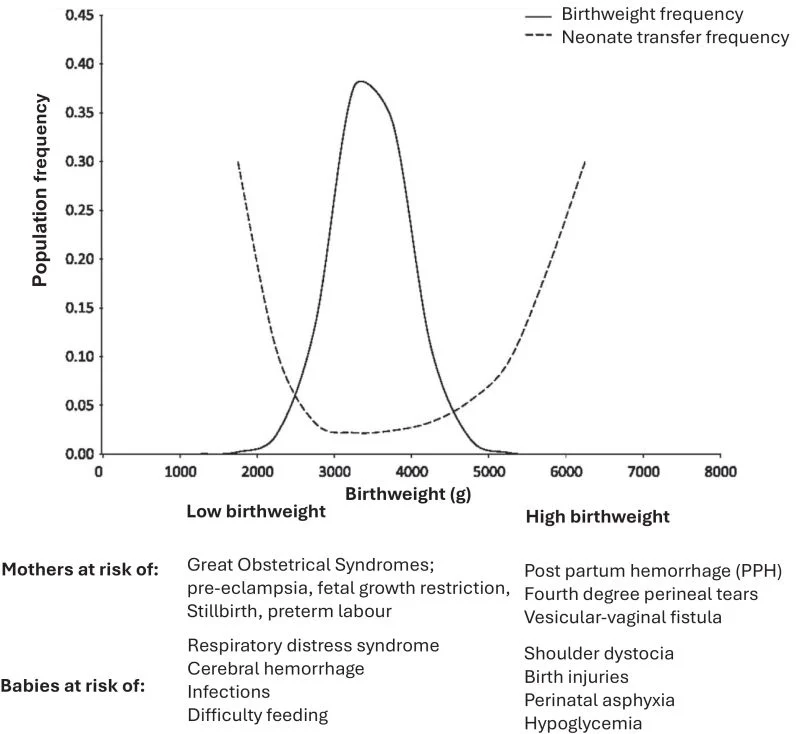
Distribution of birthweights in the Norwegian population with percentage of babies transferred to the special care baby unit for the years 1999 to 2008 (n=795,068).
Low birthweight is associated with maternal disorders of defective deep placentation (great obstetrical syndromes including preeclampsia) and increased neonatal morbidity.
High birthweight is associated with increased maternal morbidity and intrapartum complications affecting the neonate.”
Title: Maternal mortality, birthweight, and immunogenetics: an evolutionary framework for obstetric risk
Authors: Layla Ettinghausen, Ashley Moffett

Other posts featuring Christopher Robinson on Hemostasis Today.
-
Nov 9, 2026, 09:29Veronica Sanchez: A Framework for Woman’s Health
-
Nov 8, 2026, 19:31Anna Kajaste-Rudnitski: Presenting AAV-Induced p53 Signalling in Human CNS Cells at ESGCT 26
-
Nov 8, 2026, 19:29David McIntosh: Cybersecurity Matters, but Blood Availability Remains the Bigger Challenge
-
Nov 8, 2026, 19:26Wenxue Ma: An Integrative Framework for Macrophage-Mediated Therapeutic Resistance in Cancer
-
Nov 8, 2026, 19:25Yildiz Yigit: Presenting a Polycythemia Vera Case at the MPN Subcommittee Session
-
Nov 8, 2026, 18:56Denis Oduor: Strengthening the Regulation and Delivery of Blood Transfusion and Transplantation Services
-
Nov 8, 2026, 18:28Raghavendra Rao: A Narrative Review on Chronic Venous Disease during Pregnancy
-
Nov 8, 2026, 17:57Dhiren Patel: PLD1-Derived Phospholipids Regulate NAD Kinase and ROS Production in Neutrophils
-
Nov 8, 2026, 17:48Andra T.: What Causes Antiphospholipid Syndrome? – Four Steps, not One Cause