


Jonathan Douxfils: New Data on Hemostasis, VTE, and Breast Cancer to Rethink the Reference Standard
Jonathan Douxfils, Director of the Clinical Pharmacology and Toxicology Research Unit at University of Namur, Board Member of Belgian Society on Thrombosis and Haemostasis, shared on LinkedIn:
”Over the past week, I had the opportunity to deliver 3 presentations on the evolving role of natural estrogens in women’s health, with a focus on contraception, menopause, hemostasis, and breast cancer risk.
The highlight was clearly the 10th edition of FFF — Focus on Women’s Fertility — in La Rochelle.
This anniversary meeting offered an outstanding scientific programme, covering fertility, endometriosis, adenomyosis, assisted reproductive medicine, menopause, estrogens, and thromboembolic risk.
More importantly, it created the conditions for highly constructive discussions with colleagues and collaborators from multiple disciplines.
One key message of my presentations was that the choice of estrogen and progestin matters.
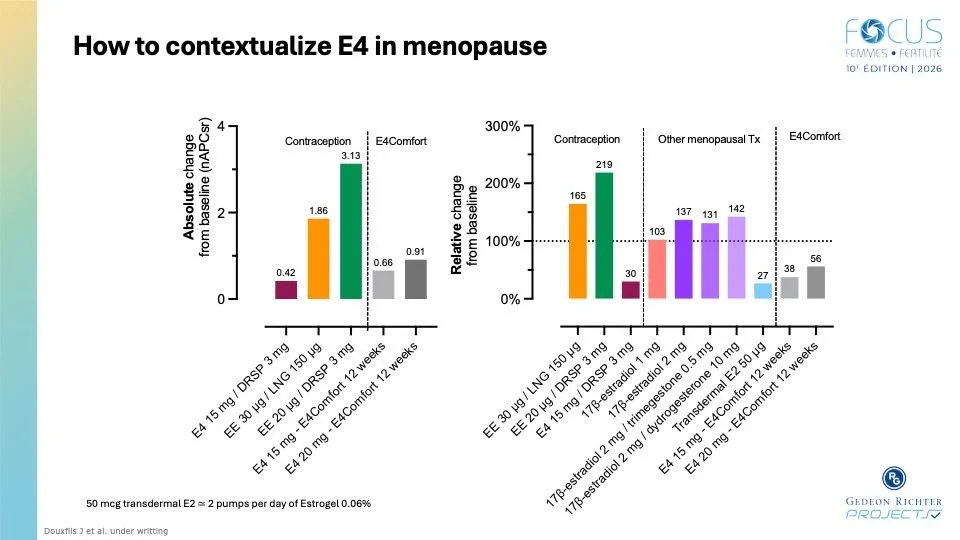
I presented recent data showing that E4 in menopause appears to have a very limited impact on the hemostatic system, with changes in our global coagulation biomarker, the normalized activated protein C sensitivity ratio (nAPCsr), that appear comparable to those observed with transdermal estradiol 50 µg, approximately equivalent to 2 pumps of Oestrogel.
This is reassuring, given the favorable thrombotic profile generally associated with transdermal estradiol in menopause.
These findings are consistent with a broader body of evidence showing a low impact of E4 on hemostasis across several settings: contraception, endometriosis, adolescence, and now menopause.
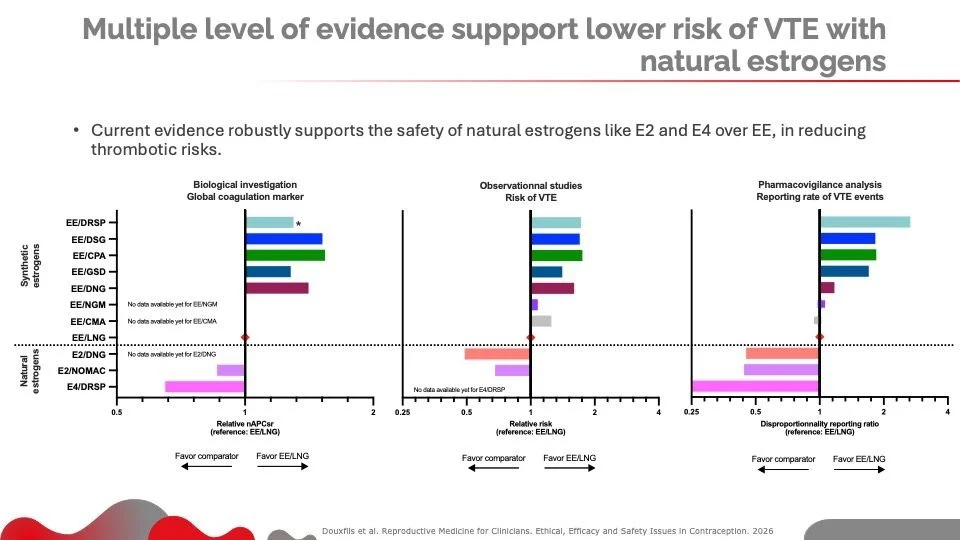
They are also aligned with lower reporting of VTE events in PhV databases, with our nAPCsr-based VTE prediction model, and with epidemiological data supporting a more favorable profile of natural versus synthetic-based formulations.
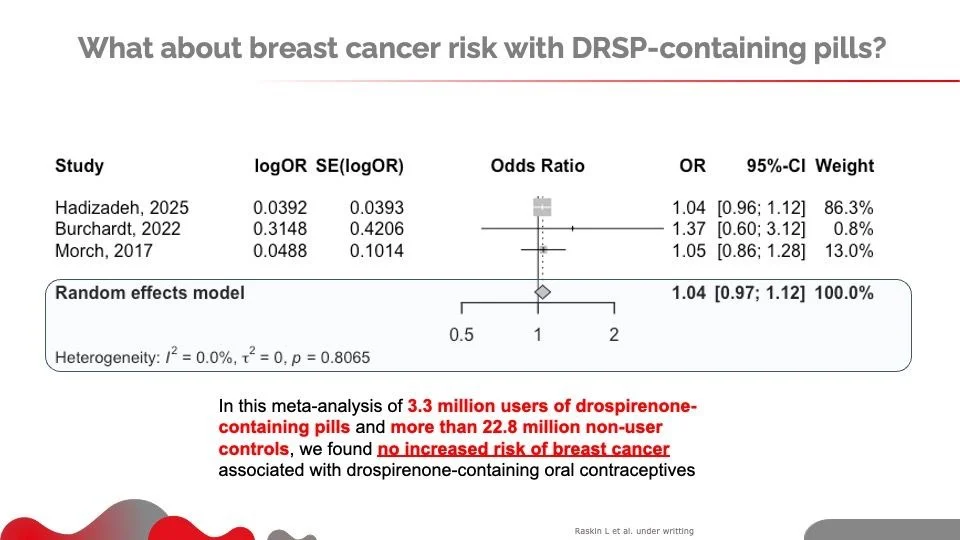
I also presented preliminary data on breast cancer risk with drospirenone-containing pills.
In an analysis including more than 3.3 million drospirenone-containing pill users and more than 22 million controls, no increased risk of breast cancer was observed.
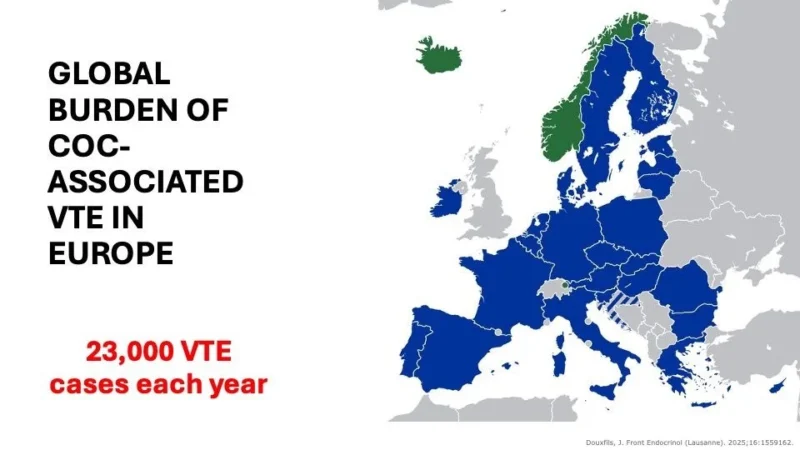
Taken together, these data are highly reassuring regarding two major concerns that have contributed to hormone hesitancy for more than a decade: venous thromboembolism and breast cancer.
The emerging message is clear:
- for VTE risk, the estrogen matters, and Natural Estrogens appear more favorable than ethinylestradiol;
- for breast cancer risk, the progestin matters, and DRSP should not be considered equivalent to 19-nortestosterone-derived progestins such as levonorgestrel or desogestrel.
This raises an important question: why do we still use EE/LNG as the default safety reference, when current evidence suggests that it may no longer represent the optimal benchmark?
Many thanks to Gedeon Richter France, Nicolas Rossignol our moderator, Bruno Bonnetain our stage manager, all speakers, and all participants for this stimulating and collegial meeting in La Rochelle.
I also would like to thank Gedeon Richter Benelux for supporting the seminars with GP and gynecologists in Wallonia and Flanders!
Science is moving.
Guidelines should move with it.”
Stay updated with Hemostasis Today.

-
Sep 15, 2026, 17:33Reza Shojaei: Blood and Plasma Donors Are Not a Production Metric
-
Sep 15, 2026, 17:32Thomas Dayspring: MHT for Vasomotor Symptoms May Also Offer Cardiovascular Benefits
-
Sep 15, 2026, 17:31Rebecca Risman: Deciphering the Mechanisms of Fibrinolysis in Contracted Clots
-
Sep 15, 2026, 17:31Clare Tower: 30 Times Higher Does Not Tell the Whole Story
-
Sep 15, 2026, 17:29Erica Wood: Looking Forward to the Webinar on Future Directions in Haemovigilance
-
Sep 15, 2026, 17:28Caitlin Raymond: Can an Antibody Screen Tell You If a Transfusion Will Actually Hurt Your Patient?
-
Sep 15, 2026, 17:28Rachel Margolis-Goodman: When Conventional Treatment Could Not, Research Found an Answer
-
Sep 15, 2026, 17:27Carly Newton: Closing the Gap in Sickle Cell Disease Readmissions
-
Sep 15, 2026, 17:26Jared Rice: Understanding Extreme Platelet Counts in Preterm Infants