


Niksa Bagheri: Key Shear Regimes and Physics Selection for Continuum Thrombosis Modeling
Niksa Bagheri, Doctoral Researcher at University of Amsterdam, shared a post on LinkedIn about a recent article she and her colleagues co-authored, published in Applied Sciences, adding:
“The final chapter of my PhD is out.
It asks a question every simulation engineer faces: which physics does a model actually need?
In thrombosis modelling, the answer mainly depends on the flow regime.
I map four shear regimes, from venous stasis to pathological stenosis, to the minimum processes a continuum model must resolve in each.
More physics is not better; the right physics is.
In the arterial regime, at a fixed inlet wall shear rate, varying only the expansion angle downstream of a constriction raised peak near-wall platelet concentration 2.5-fold.
Aggregates followed the recirculation, not the peak shear, consistent with microfluidic measurements.
The tool: a 3D finite-element model in COMSOL Multiphysics coupling Navier–Stokes–Brinkman flow, reactive transport and a level-set interface.”
Proceed to the video attached to the post.
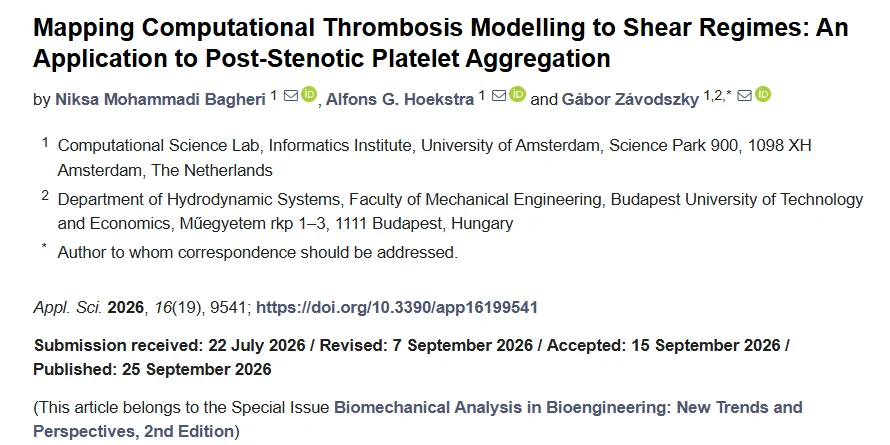
Title: Mapping Computational Thrombosis Modelling to Shear Regimes: An Application to Post-Stenotic Platelet Aggregation
Authors: Niksa Mohammadi Bagheri, Alfons G. Hoekstra, Gábor Závodszky
Stay updated on all scientific advances with Hemostasis Today.
-
Oct 31, 2026, 12:14Ghaith Abu-Zeinah: International MPN Congress Honors the Life and Legacy of MPN Pioneer Dr. Richard T. Silver
-
Oct 31, 2026, 12:11Thierry Burnouf: Taipei Medical University and University of Lille Highlight Platelet Biotherapies in SfN Neuronline
-
Oct 31, 2026, 12:07Eamon Faulkner: How Oxygen Shapes Platelet–Endothelial Interactions
-
Oct 31, 2026, 12:01Abdul Mannan: IVIG in ITP – When a Temporary Response Is a Success
-
Oct 31, 2026, 11:52Breaking the Silence Around Bleeding Disorders in Women – National Bleeding Disorders Foundation
-
Oct 31, 2026, 11:21Jim Meliezer: Aspirin May Help Prevent Recurrent Preterm Birth
-
Oct 31, 2026, 11:10Elly De Bruyn: QbD Group Quiz Supports the World Federation of Hemophilia
-
Oct 31, 2026, 11:04Abhivandan Nagia: The Expanding Clinical Pipeline in Hemophilia A
-
Oct 31, 2026, 10:54Bartosz Puła: New Advances in Hematology Featured in Acta Haematologica Polonica