


Christina (Tina) P.: Can Vitamin K Help Stabilize Your INR?
Christina (Tina) P., CEO and Co-Founder of APS Foundation of America, shared on LinkedIn about an article by Elizabeth Sconce et al, published in Blood, adding:
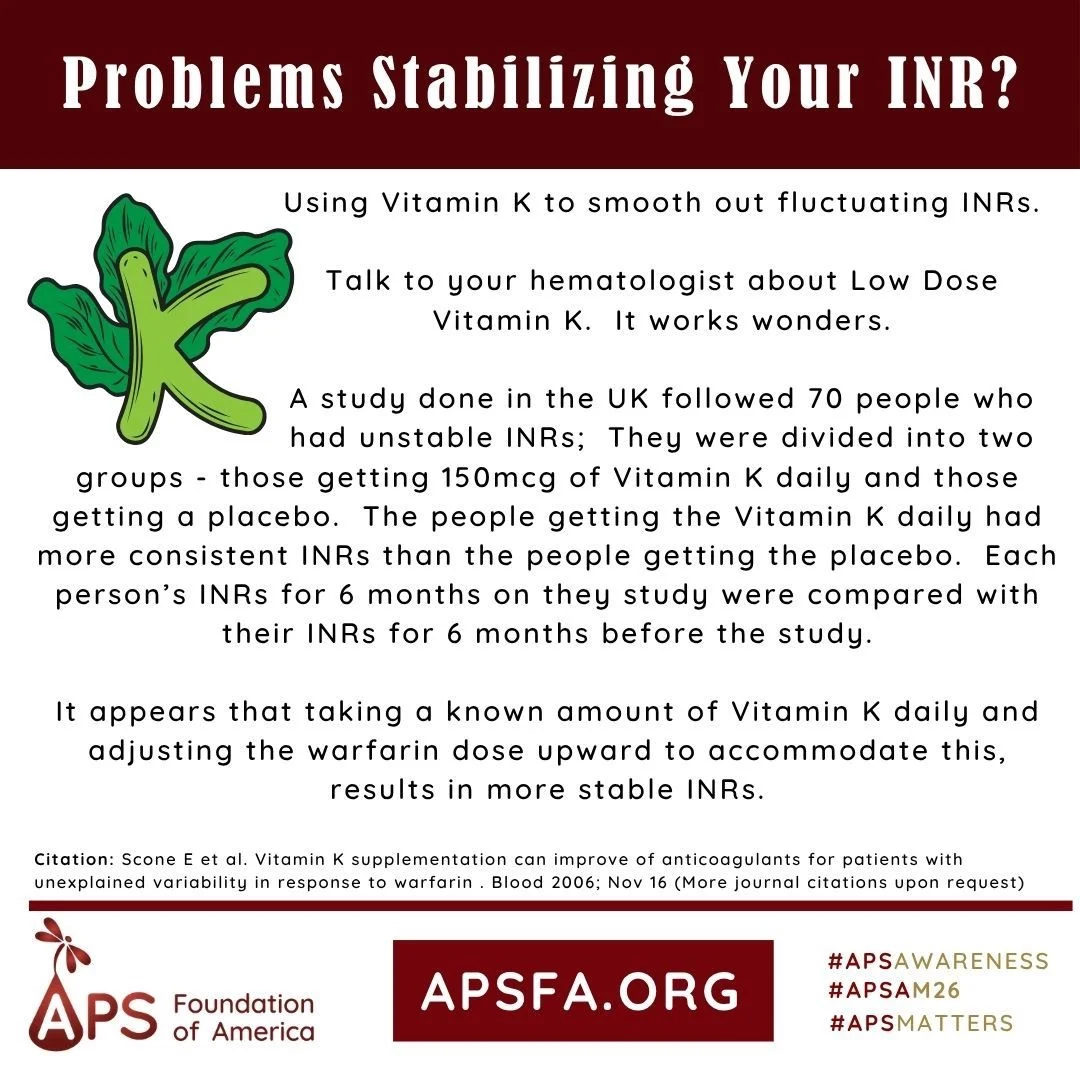
”Problems Stabilizing Your INR?: APS Awareness Month Day 16
If you walk into a dark room and switch on a 3-way light, you notice a huge increase in the amount of light.
If you switch to the next higher level, you do not notice as much change, even though the increase is the same number of watts.
A similar thing happens when someone takes tiny amounts of Vitamin K from eating vegetables.
If this person then gets a little more vitamin K1, then the INR can be thrown off.
To get around this, some warfarin managers have tested giving people a known amount of vitamin K1.
Then they assessed whether the INRs became more consistent.
This is a great paper to share with your care providers and discuss.
Many other medical journals support this same theory.
A study done in the UK followed 70 people who had unstable INRs.
They were divided into two groups – those getting 150 mcg of vitamin K1 daily and those getting a placebo.
The people getting the vitamin K1 had more consistent INRs higher than those of the people getting the placebo.
Each person’s INRs for 6 months on the study were compared with their INRs for 6 months before the study.
It appears that taking a known amount of vitamin K1 daily and adjusting the increasing the warfarin dose to accommodate these results in more stable INRs.
Reference: Sconce E. et al. Vitamin K1 supplementation can improve stability of anticoagulation for patients with unexplained variability in response to
warfarin. Citation: Blood. 2006; Nov 16.
This is a great paper to share with your care providers and discuss.
Many other medical journals support this same theory.”
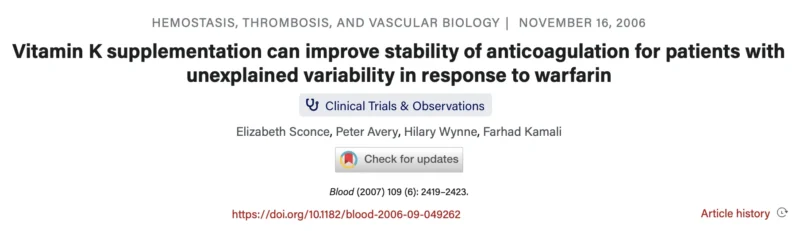
Title: Vitamin K supplementation can improve stability of anticoagulation for patients with unexplained variability in response to warfarin
Authors: Elizabeth Sconce, Peter Avery, Hilary Wynne, Farhad Kamali
Stay updated on all scientific advances with Hemostasis Today.
-
Sep 18, 2026, 16:51Adarsh Krishnan Sundara Rajan: Is VTE the Most Underdiagnosed Critical Threat in Modern Healthcare?
-
Sep 18, 2026, 16:19CRISPR and Hemophilia: The Next Frontier of In Vivo Gene Editing
-
Sep 18, 2026, 16:13Christian Irsara: PF4 Immunothrombosis Following Natural Adenovirus Infection
-
Sep 18, 2026, 16:10Leo Nicolai։ The Spleen Emerges as a Key Regulator of Thromboinflammation
-
Sep 18, 2026, 16:05Targeting Factor XI to Reduce Thrombosis Without Compromising Hemostasis – ISTH
-
Sep 18, 2026, 15:54Swapnil Pawar: Why Aren’t We Using Cryopreserved Platelets Everywhere Yet?
-
Sep 18, 2026, 15:37Abdul Mannan: Evaluating Longitudinal Platelet Trends Beyond Standard Reference Intervals
-
Sep 18, 2026, 15:30Peter A. Everts։ Platelet Phenotype May Hold the Key to More Consistent PRP Therapy
-
Sep 18, 2026, 15:25Brandon Temple: Turning Personal Experience Into Advocacy for wAIHA Research