


Ifeanyichukwu Ifechidere: The DOAC Monitoring Masterclass
Ifeanyichukwu Ifechidere, Specialist Biomedical Scientist at Sheffield Teaching Hospitals NHS Foundation Trust, shared a post on LinkedIn:
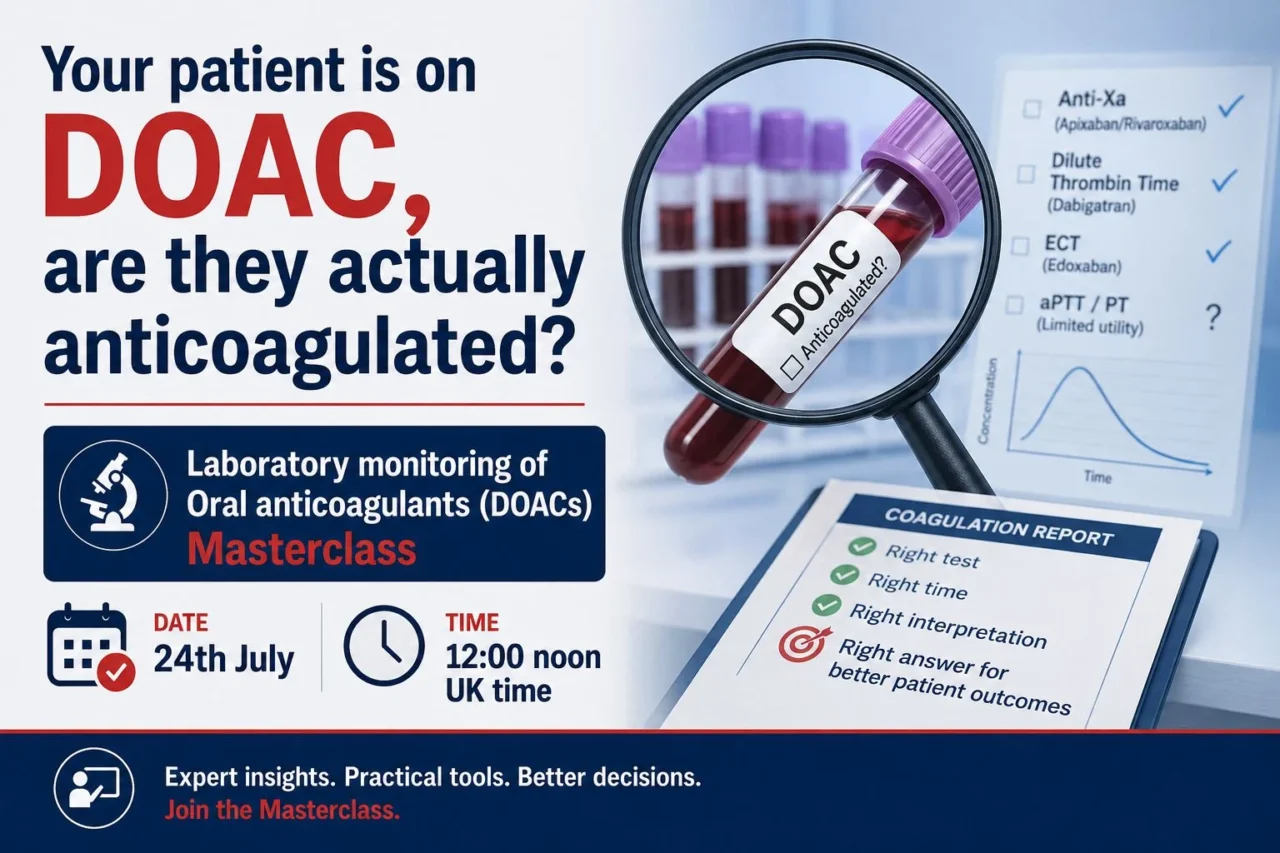
”Your patient is on a DOAC. Their PT/APTT is normal.
Are they actually anticoagulated?
If you hesitated — even for a second — this masterclass is for you.
I’m hosting a live masterclass:
- Laboratory Monitoring of Oral Anticoagulants (DOACs)
- Friday, 24th July. Time: 12 noon UK time.
For biomedical scientists, haematology trainees, haemostasis nurses and clinicians
Because here’s the truth nobody tells you in training: DOACs weren’t designed to be monitored the way warfarin was. And that gap in understanding?
It’s where diagnostic errors live.
What we’ll break down
- Why routine coagulation screens (PT/APTT) can mislead you with DOACs
- Which assays actually work — anti-Xa (calibrated vs uncalibrated), dilute thrombin time, ecarin-based assays
- How to interpret results in bleeding emergencies, pre-surgical workups, and suspected overdose
- DOAC interference in lupus anticoagulant testing — and how to avoid false positives
- Real case scenarios: the ‘normal’ coag screen that wasn’t reassuring at all
Why this matters
DOAC use is rising fast. But labs are still catching up on standardised testing protocols, and clinicians are often left guessing which assay to request — or worse, trusting the wrong one.
This masterclass exists to close that gap.
Not with theory for theory’s sake, but with practical, lab-bench-to-bedside clarity you can apply on your very next shift.
Who should attend
- Biomedical scientist students and graduates
- Biomedical scientists working in coagulation/haematology
- Haemostasis nurses and anticoagulation clinic staff
- Haematology trainees and registrars
- Anyone who’s ever stared at a DOAC patient’s coag panel and thought ‘wait, what does this actually tell me?’
Save the date: Friday, 24th July
Limited spots — spaces will fill fast, especially with clinical case discussion built in
Full details, registration link, and format (live plus Q&A) dropping soon.
Turn on notifications so you don’t miss it.
This is exactly the kind of session I wish existed when I was first navigating DOAC monitoring — clear, clinically grounded, and built for people who actually touch these samples and these patients.
Quick question before I open registration: What’s your biggest uncertainty when it comes to DOAC lab monitoring — assay selection, result interpretation, or knowing when testing is even indicated?
Drop it in the comments.
I’ll be shaping part of the Q&A around what you share.
Want early access to registration?
Comment ‘DOAC’ below and I’ll send you the link the moment it’s live.”
Find more posts featuring Ifeanyichukwu Ifechidere on Hemostasis Today.
-
Sep 17, 2026, 20:38Konstantinos Bistas: Reduced Circulating Tregs in Pediatric Chronic Neutropenia
-
Sep 17, 2026, 15:33Gopal Patidar: Honoured to Contribute to the ASFA 2026 Guidelines for Therapeutic Apheresis
-
Sep 17, 2026, 20:36Cosima C. Hoch: Developing a 3D Organotypic Co-Culture Model for Pleomorphic Adenoma
-
Sep 17, 2026, 20:19Riten Kumar: Boston Children’s Hospital Ranked No. 1 in Seven Pediatric Specialties
-
Sep 17, 2026, 20:17Katrina Snow: Whole Blood or Component Therapy – Which Would You Choose?
-
Sep 17, 2026, 16:30Daria Camilli: Empowering Bleeding Disorder Advocacy Through Health Economics
-
Sep 17, 2026, 16:17Mehran Ghasemzadeh: Platelet NK Cell Crosstalk in Advanced Coronary Artery Disease
-
Sep 17, 2026, 16:16Barbara Adams Krolak: Do GLP-1s Affect Blood Clot Risk?
-
Sep 17, 2026, 15:46Heghine Khachatryan: Clinical Context at the Core of Thrombosis and Thrombophilia Management