

Michael Makris Questions FVIII Aurora’s Potential to Transform Hemophilia A Gene Therapy
Michael Makris, Professor of Haemostasis and Thrombosis at University of Sheffield, Editor-in-Chief of Research and Practice in Thrombosis and Haemostasis, shared an insightful post on LinkedIn:
“A potentially important finding was reported in a letter to the editor in today’s New England Journal of Medicine.
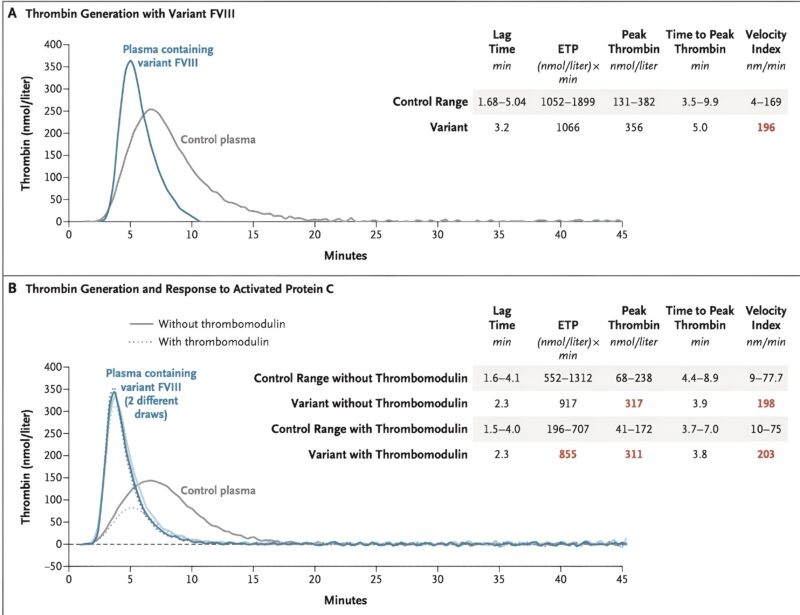
The authors reported a gain of function mutation in FVIII, called FVIII Aurora.
This can be thought of as analogous to FIX Padua which has transformed hemophilia B gene therapy.
Will FVIII Aurora transform hemophilia A gene therapy?
Having read the letter and the supplement, I have a number of questions/comments:
1. The thrombotic history is fairly extreme. No information about treatment with anticoagulants is given. Was this patient never treated for the multiple severe thrombotic episodes?
2. Only 2 FVIII levels are given in the supplement, and they were 370 and 615%. The patient’s clinical circumstances when these blood samples were drawn are not given. FVIII is an acute phase reactant, so knowing the status of the patient when they were drawn is critical.
3. In the letter it is stated the FVIII levels were between 300-900%. Whenever I see factor levels ending in such round numbers, I become suspicious. Did this patient really have a level that was precisely 900%? Why were the authors not asked to provide all the FVIII levels from this patient?
4. Although the patient and grandparents are deceased, we are not told if there are any other relatives with this mutation alive.
5. It is surprising that the NEJM has published this without the expression data from the recombinant variant.
Potentially this is very important, but until we see the recombinant protein expression data, we will not know how important.”
Read the full article in The New England Journal of Medicine.
Stay updated on all science in the field of bleeding disorders with Hemostasis Today.
-
Oct 9, 2026, 16:23David Boone: Distinguishing Stroke Prevention from Rhythm Control in Atrial Fibrillation
-
Oct 9, 2026, 15:27Mohamed Hegazi: Geostatistical Modelling Maps Global β-Thalassaemia Carrier Prevalence
-
Oct 9, 2026, 15:15Maha Othman: Uncovering the Consensus on TXA in TBI – Call for Collaboration on a Landmark Umbrella Review
-
Oct 9, 2026, 15:07Daniel D. Han: How Inhalation Product Exposure Impairs Cardiac and Platelet Recovery After MI
-
Oct 9, 2026, 14:58William Toole: How Ultrasound-Guided PRP Therapy Relieves Joint and Tendon Pain
-
Oct 9, 2026, 14:50Shayan Mohammadmoradi: In Corpus Christi for the 20th Midwest Platelet Conference
-
Oct 9, 2026, 14:37Tariq Tramboo: High Platelet Concentrate for Osteoarthritis Knee – Recent Meta-Analyses
-
Oct 9, 2026, 14:26Yousma Khan: Hematology Series – Beyond RBCs, WBCs and Platelets
-
Oct 9, 2026, 14:13Jesus Ardila Novoa: Why the WHO’s Historic Essential Medicines List Decision Is Just the Beginning