


Ney Carter Borges: Bempedoic Acid Shows a Promising VTE Signal in CLEAR Outcomes Analysis
Ney Carter Borges, Member Cardiologist of Global Physician Association at Cleveland Clinic Florida, shared a post on LinkedIn about a recent article by Bernardo F. Spiazzi et al, published in JAMA Cardiology, adding:
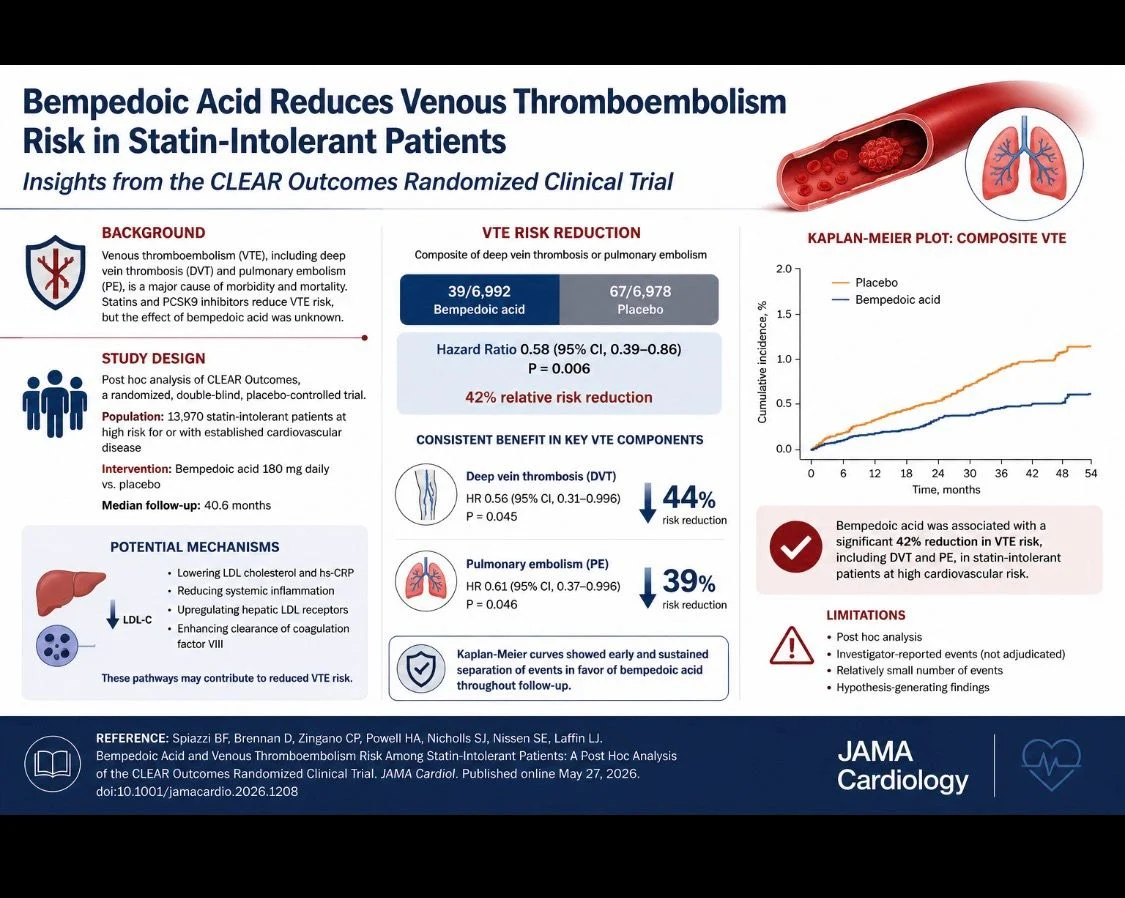
“Bempedoic Acid Reduces Venous Thromboembolism Risk in Statin-Intolerant Patients: Insig
hts from the CLEAR Outcomes Trial
Venous thromboembolism (VTE), encompassing deep vein thrombosis (DVT) and pulmonary embolism (PE), remains a major cause of cardiovascular morbidity and mortality.
While statins and PCSK9 inhibitors have previously demonstrated protective effects against VTE, whether bempedoic acid confers similar benefits has remained uncertain.
This post hoc analysis of the randomized CLEAR Outcomes trial provides the first robust evidence supporting a potential antithrombotic benefit of bempedoic acid in statin-intolerant patients.
The analysis included 13,970 statin-intolerant patients (mean age 65.5 years; 48.2 percent women) with established atherosclerotic cardiovascular disease or high cardiovascular risk, randomized to bempedoic acid 180 mg daily (n=6,992) or placebo (n=6,978).
Median follow-up was 40.6 months. During follow-up, 106 VTE events occurred: 39 in the bempedoic acid group versus 67 in the placebo group, corresponding to a 42 percent relative reduction in VTE risk (HR 0.58; 95 percent CI 0.39–0.86; P=0.006).
The benefit extended consistently to both major clinical components of VTE.
Deep vein thrombosis was reduced by 44 percent (HR 0.56; 95 percent CI 0.31–0.996; P=0.045), while pulmonary embolism declined by 39 percent (HR 0.61; 95 percent CI 0.37–0.996; P=0.046).
Kaplan-Meier curves demonstrated an early and progressive separation between treatment groups throughout follow-up, suggesting a sustained protective effect.
Potential mechanisms include reductions in systemic inflammation, LDL cholesterol lowering, and enhanced hepatic LDL receptor expression, which may accelerate clearance of coagulation factor VIII, thereby attenuating thrombotic risk.
These biological pathways parallel observations previously reported with statins and partially overlap with mechanisms proposed for PCSK9 inhibitors.
Importantly, the study has limitations.
VTE outcomes were investigator-reported rather than centrally adjudicated, event numbers were relatively small, and the analysis was post hoc.
Consequently, the findings should be considered hypothesis-generating rather than definitive evidence supporting bempedoic acid as an antithrombotic therapy.
Overall, these results expand the clinical profile of bempedoic acid beyond LDL-cholesterol reduction and major adverse cardiovascular event prevention, suggesting that the drug may also lower the incidence of venous thromboembolism in statin-intolerant individuals.
Dedicated prospective studies are warranted to confirm whether this promising signal should influence future strategies for VTE prevention.”
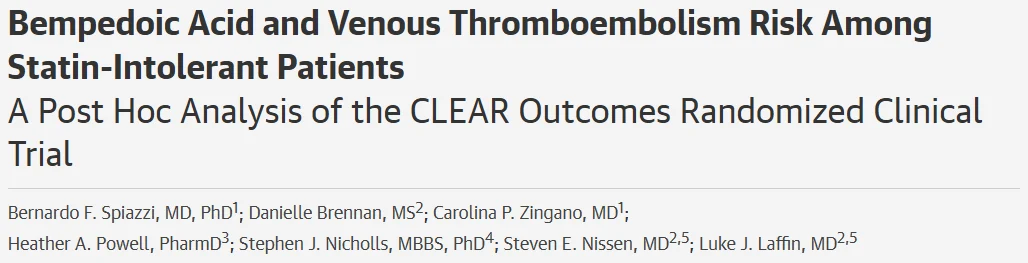
Title: Bempedoic Acid and Venous Thromboembolism Risk Among Statin-Intolerant Patients. A Post Hoc Analysis of the CLEAR Outcomes Randomized Clinical Trial
Authors: Bernardo F. Spiazzi, Danielle Brennan, Carolina P. Zingano, Heather A. Powell, Stephen J. Nicholls, Steven E. Nissen, Luke J. Laffin
Stay updated on all scientific advances with Hemostasis Today.
-
Oct 7, 2026, 16:44Amor Salah: 2026 NCS/SCCM Guidelines for Managing Antithrombotic-Associated ICH
-
Oct 7, 2026, 16:04NETs in Thrombosis: From Mechanism to Therapeutic Target
-
Oct 7, 2026, 15:28Amir Samimi: Prognostic Value of Platelet Count in Resected HNSCC
-
Oct 7, 2026, 15:21Eloïse Laouenan: Bridging Immunity and Thrombosis in MVTE
-
Oct 7, 2026, 15:10Uthra Sundaram: Honouring Donors During International Plasma Awareness Week
-
Oct 7, 2026, 15:04Daniel Victor Ortigoza: Should Frail Older Patients With AF Switch From VKA to DOACs?
-
Oct 7, 2026, 14:53Susan Noone: Donor Turned Recipient Shares Lifesaving Transfusion Story
-
Oct 7, 2026, 14:49Aimee Burtenshaw: The Impact of the Infected Blood Inquiry on Hospital Transfusion Laboratories
-
Oct 7, 2026, 14:41Vikash Jaiswal: Does Timing Matter for Calcium in Pre-Eclampsia Prevention?