

Daratumumab in Difficult-to-Treat iTTP: Updated Results from the International DarTTP Study
At the ISTH 2026 Congress in Paris, Juri Alessandro Giannotta, Hematologist at Fondazione IRCCS Ca’ Granda Ospedale Maggiore Policlinico, presented updated findings from the International DarTTP Study, the largest international cohort evaluating daratumumab in patients with difficult-to-treat immune-mediated thrombotic thrombocytopenic purpura (iTTP).
The study provides important real-world evidence on the efficacy and safety of anti-CD38 therapy in patients with relapsing and refractory disease.
Immune-mediated thrombotic thrombocytopenic purpura (iTTP) remains a major therapeutic challenge, particularly in patients who relapse or fail to respond despite multiple immunosuppressive therapies.
Although plasma exchange, corticosteroids, rituximab and other immune-directed treatments have improved outcomes, some patients remain refractory, while treatment-related toxicity may limit continued use of available therapies.
When CD20-targeting therapies fail, targeting long-lived plasma cells represents a biologically promising approach.
Daratumumab, an anti-CD38 monoclonal antibody, has emerged as a potential plasma cell–directed therapy in iTTP. However, previous evidence has been limited to isolated case reports and small national case series.
Building Evidence for Plasma Cell–Targeted Therapy in iTTP
To better define the role of daratumumab in clinical practice, investigators designed the International DarTTP Study, a retrospective, international, multicenter study including adult patients with iTTP treated with daratumumab during either the acute phase of disease or remission.
Patients were required to have at least six months of post-treatment follow-up.
The primary objective was to evaluate the efficacy and safety of daratumumab in patients with refractory disease or those requiring additional immunosuppressive therapy after previous treatments.
Data were collected using a dedicated REDCap electronic case report form, and the study was registered on ClinicalTrials.gov.
Beginning in January 2025, investigators contacted 45 centers across Europe, Australasia, and America.
By December 2025, 15 centers had enrolled patients, creating the largest international cohort of daratumumab-treated patients with difficult-to-treat iTTP.
Clinical Characteristics of the DarTTP Cohort
The study included 33 patients, who received a total of 45 daratumumab treatment courses, as several patients underwent repeated treatment cycles, mainly during remission.
All patients had previously received corticosteroids and rituximab. More than half had also received additional immunosuppressive therapies, including oral immunosuppressants and bortezomib, another plasma cell–directed therapy.
Treatment allocation reflected real-world clinical practice and was guided by physician choice, resulting in variation among participating centers.

Clinical Indications for Daratumumab Treatment
Among the enrolled patients:
- 20 patients received daratumumab for relapsing disease.
- 8 patients received treatment for truly refractory iTTP, including 5 patients who remained refractory despite additional immunosuppressive therapies.
- 5 patients received daratumumab because previous therapies could not be continued due to severe infusion reactions or cyclophosphamide-related organ toxicity.
Approximately one-third of patients also received concomitant immunosuppressive therapy.
Efficacy Outcomes of Daratumumab Therapy
Across the first three daratumumab treatment exposures, investigators observed an overall response rate of 70%.
Responses occurred rapidly, within approximately 21 days of treatment initiation.
Response rates varied according to treatment indication. Patients treated because of previous treatment toxicity all responded, while approximately 60–65% of patients with relapsing or refractory iTTP achieved a response.
The median duration of remission was approximately 10 months, although sustained remission occurred in only approximately 60–70% of initial responders.
Importantly, investigators found that concomitant immunosuppressive therapy did not influence treatment efficacy outcomes.

Durability of Response and Retreatment Outcomes
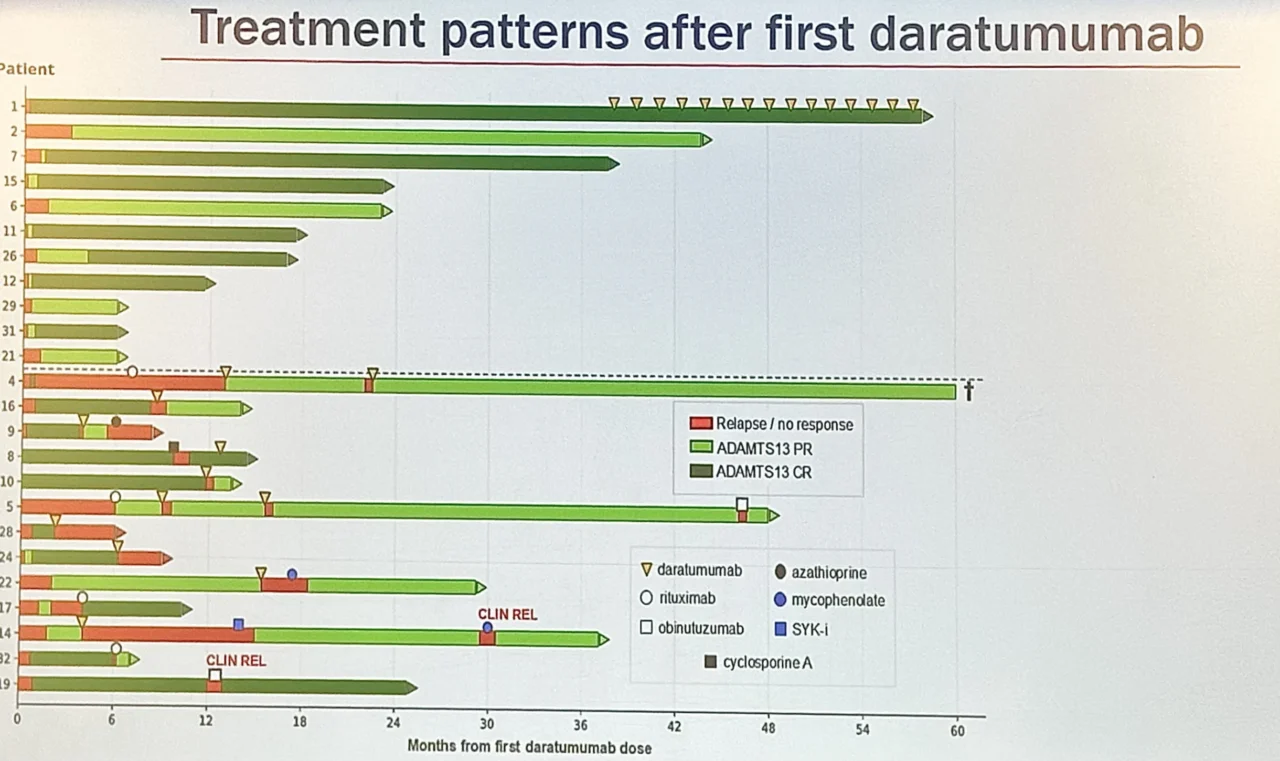
The investigators presented a swimmer plot summarizing the clinical course of responding patients.
Approximately half of responding patients remained in persistent remission at the last follow-up. Among patients who relapsed, most experienced biochemical relapse.
Daratumumab retreatment was performed in 10 patients, with 6 patients responding again, suggesting that repeated treatment cycles may remain effective for selected patients.
However, remission durability remained variable, highlighting the importance of individualized treatment decisions based on patient preferences and treatment goals.
Safety and Tolerability Profile
Daratumumab demonstrated a favorable safety profile throughout the study.
Nine patients experienced immediate infusion reactions, which were mostly mild, grade 1, and self-limiting. Infusion reactions were more common with the intravenous formulation compared with subcutaneous daratumumab, consistent with previous observations in multiple myeloma cohorts.
Only one grade 2 herpes zoster skin infection was reported, occurring in a patient who had not received antiviral prophylaxis.
Overall, the safety profile compared favorably with another plasma cell–directed therapy, bortezomib, although direct comparative data are not available.
Study Limitations and Future Directions
The investigators acknowledged several limitations.
Differences in monitoring schedules and adverse event assessment across participating centers may have influenced estimates of remission duration.
In addition, daratumumab allocation was based on physician choice rather than standardized criteria. Therefore, it remains uncertain whether all patients represented the same degree of treatment refractoriness, which remains an important unmet need within the iTTP community.
To address this challenge, investigators have initiated an international collaboration within the ASH community to develop a modified Delphi consensus focused on defining refractory iTTP and improving future treatment strategies.
Implications for Future iTTP Management
The International DarTTP Study represents the largest reported cohort of daratumumab-treated patients with difficult-to-treat iTTP.
In this heavily pretreated population, daratumumab achieved a 70% overall response rate, induced rapid responses within approximately three weeks, and demonstrated a favorable safety profile, particularly with the subcutaneous formulation.
Although long-term remission was not achieved in every patient, retreatment remained effective in many patients who experienced relapse.
These findings provide important real-world evidence supporting daratumumab as a potential therapeutic option for selected patients with relapsing or refractory immune-mediated thrombotic thrombocytopenic purpura and highlight the growing role of plasma cell–targeted strategies in the future management of iTTP.
Stay Updated with the Latest ISTH 2026 Updates on Hemostasis Today.
-
Oct 19, 2026, 19:44Where You Live Should not Determine Whether You Receive Care – World Federation of Hemophilia
-
Oct 19, 2026, 19:42Belen Bianco: Prevention, Early Suspicion and an Interdisciplinary Approach Save Lives
-
Oct 19, 2026, 19:40Christina Chrysohoou: Catheter-Based LAAC vs OAC for Stroke Prevention in Atrial Fibrillation
-
Oct 19, 2026, 19:38Matthew Flick: A Two-Day Research Meeting on Fibrinogen, Hemostasis and Thrombosis
-
Oct 19, 2026, 19:37Hayat Saeed: Excited to Share Our Publication on the FGL1–Hepcidin Axis in Iron Homeostasis and Disease
-
Oct 19, 2026, 19:08IPAW 2026 Comes to a Close, but the Work Continues – PPTA
-
Oct 19, 2026, 17:44Paul Riley: Moderating a Webinar on Anticoagulation Monitoring
-
Oct 19, 2026, 16:36Christopher Pittman: Blood Clot Prevention Cannot End at Hospital Discharge
-
Oct 19, 2026, 16:13Javier M. Floren: When Immune Cells Move With Their Environment