

Factor XIII and the Future of Anticoagulation in VTE
One of the most thought-provoking presentations at the ISTH 2026 Congress invited clinicians and researchers to rethink a fundamental question in thrombosis:
What if preventing venous thromboembolism (VTE) is not only about reducing coagulation, but also about controlling how a clot is built?
Rather than focusing solely on thrombin generation or upstream coagulation pathways, the lecture highlighted the importance of fibrin architecture, clot biomechanics, and Factor XIII (FXIII)-mediated fibrin cross-linking in determining thrombus size, composition, and stability.
The emerging concept is both simple and transformative – future therapies may not need to stop clot formation entirely but instead create smaller, less obstructive, and potentially safer clots.
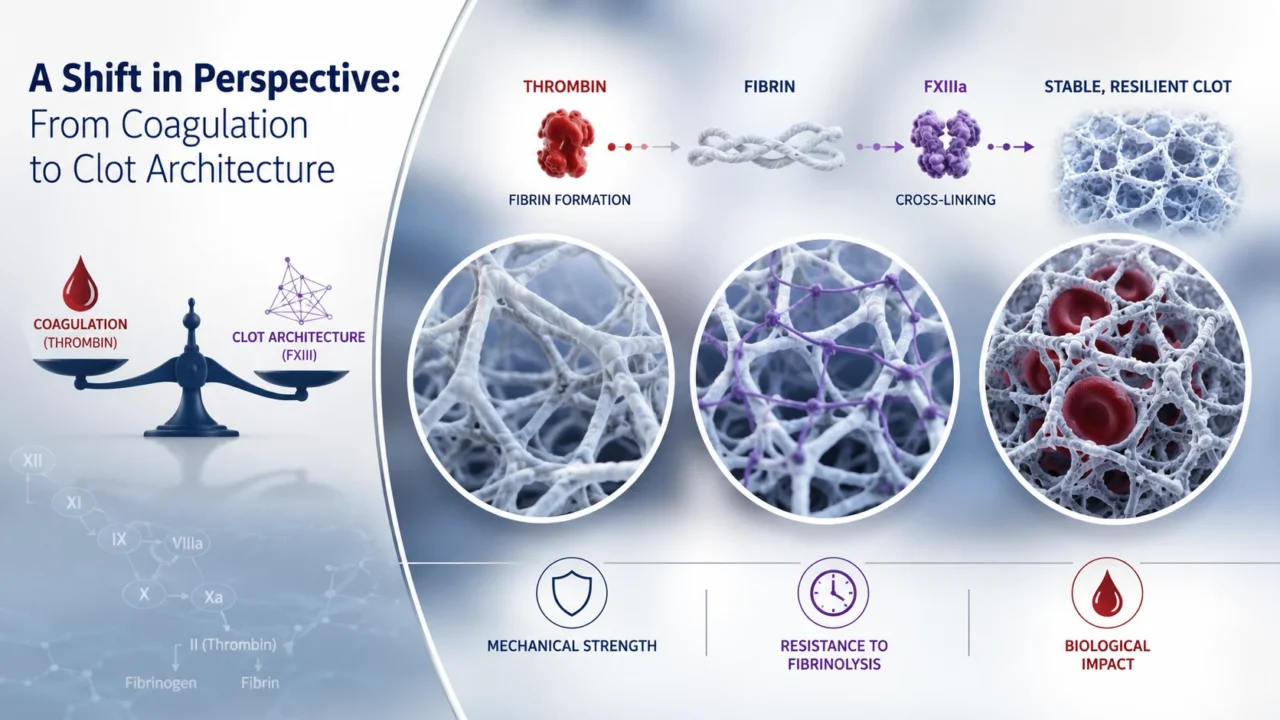
A Shift in Perspective: From Coagulation to Clot Architecture
For decades, anticoagulant therapy has targeted the coagulation cascade, with thrombin serving as the central therapeutic focus.
This presentation suggested that the physical properties of fibrin may be just as important as the amount of thrombin generated.
The speaker summarized the concept with a striking distinction:
- Thrombin creates fibrin. Factor XIII determines what kind of clot that fibrin becomes.
- After thrombin converts fibrinogen into fibrin, activated FXIII forms covalent cross-links between fibrin fibers, transforming an initially fragile scaffold into a dense, mechanically stable three-dimensional network that resists deformation and fibrinolysis.
This process not only strengthens the clot but also shapes its biological behavior.
Factor XIII Builds the Scaffold That Holds Red Blood Cells
One of the most fascinating aspects of the lecture addressed a long-standing question: Why are venous thrombi so rich in red blood cells?
Contrary to previous assumptions, FXIII does not directly bind or cross-link erythrocytes. Instead, it remodels the fibrin network itself.
By strengthening fibrin fibers and reducing pore deformability, FXIII creates a resilient meshwork capable of retaining red blood cells during platelet-driven clot contraction.
Without adequate fibrin cross-linking, erythrocytes are gradually squeezed out of the clot instead of remaining trapped within it.
Imaging studies presented during the session vividly demonstrated this process, showing active extrusion of red blood cells through fibrin pores when FXIII activation was absent or delayed.
The implication is profound: Factor XIII influences thrombus composition through biomechanics rather than direct cellular interactions.
Why Red Blood Cell Retention Matters
Experimental models further illustrated the importance of this mechanism.
In murine inferior vena cava ligation studies, FXIII-deficient mice consistently developed smaller venous thrombi containing far fewer red blood cells. Importantly, thrombus size closely correlated with erythrocyte content rather than with fibrin quantity alone.
These findings suggest that much of the bulk of a venous thrombus results from the ability of a cross-linked fibrin network to mechanically retain red blood cells.
This represents a subtle but important shift in our understanding of venous thrombosis: clot size depends not only on how much fibrin is produced, but also on how effectively that fibrin traps blood cells.
It’s Not More Fibrinogen – It’s Better Fibrin Polymerization
Another key message challenged a common assumption about fibrinogen.
Although elevated fibrinogen levels have long been associated with thrombosis, genetic models presented during the lecture showed that normal fibrinogen concentrations alone are insufficient to drive thrombus formation if fibrin polymerization is impaired.
Mice with defective fibrin polymerization—but normal circulating fibrinogen levels—developed significantly smaller thrombi with reduced propagation.
These findings indicate that fibrin polymerization itself, rather than fibrinogen concentration, is the critical biological process promoting venous thrombosis.
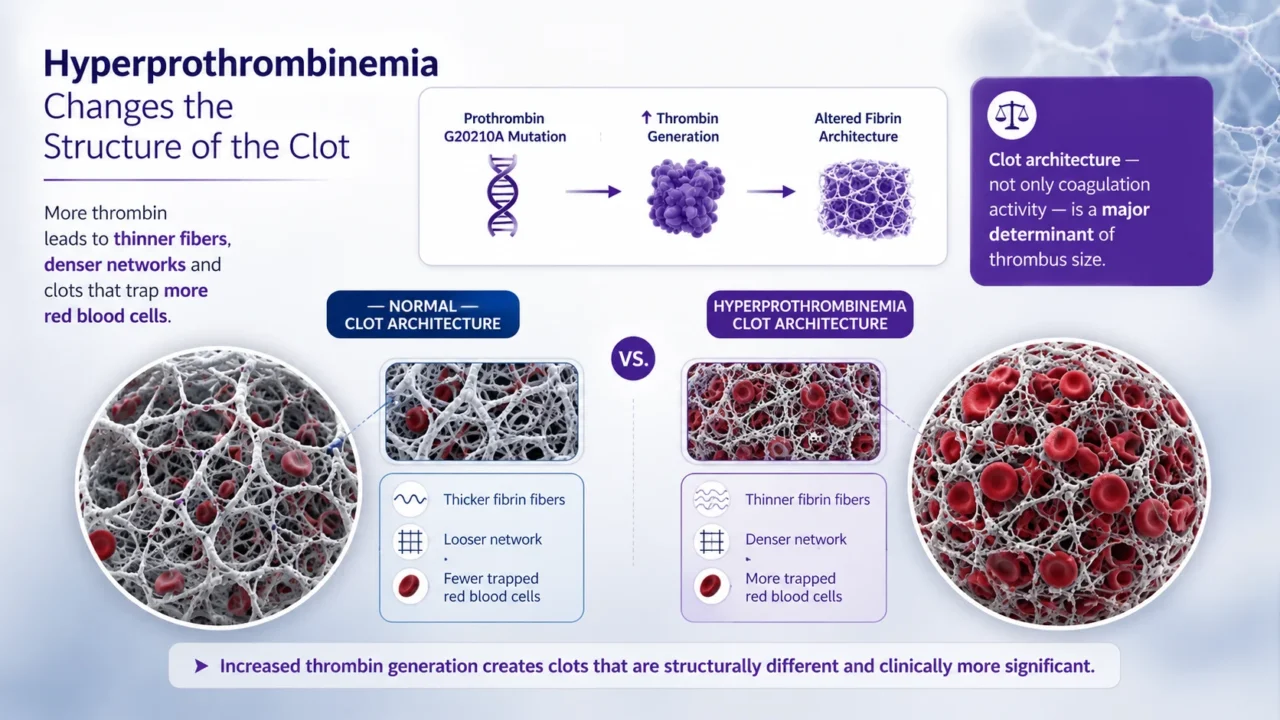
Hyperprothrombinemia Changes the Structure of the Clot
The lecture also revisited the prothrombin G20210A mutation, but from a structural rather than purely biochemical perspective.
Increased thrombin generation produces thinner fibrin fibers and denser fibrin networks, creating an architecture that retains substantially more red blood cells. This results in disproportionately larger venous thrombi that cannot be explained simply by increased fibrin deposition.
Once again, clot architecture – not only coagulation activity – emerged as a major determinant of thrombus size.
A Different Strategy: Delaying Factor XIII Activation
Perhaps the most exciting translational aspect of the session was the introduction of a completely new therapeutic concept.
Instead of inhibiting FXIII or reducing its circulating levels, investigators have developed antibodies that temporarily delay FXIII activation.
This distinction is important.
Unlike inhibitory antibodies seen in acquired FXIII deficiency, these agents allow coagulation to begin normally while postponing fibrin cross-linking during the earliest stages of clot formation.
Preclinical studies demonstrated that delayed FXIII activation led to:
- delayed fibrin stabilization,
- increased extrusion of red blood cells,
- smaller venous thrombi,
- reduced vessel occlusion.
By targeting clot maturation rather than clot initiation, this strategy may reduce thrombosis while preserving physiological hemostasis.
Moving Beyond Conventional Anticoagulation
Current anticoagulants—including heparins, direct thrombin inhibitors, direct oral anticoagulants (DOACs), and emerging Factor XI inhibitors—primarily interfere with thrombin generation or activity.
The approach presented at ISTH 2026 offers a fundamentally different philosophy.
Instead of preventing coagulation altogether, future therapies could modify the structure of the clot itself, allowing normal hemostatic responses while limiting the formation of large, obstructive thrombi.
If successful, this downstream strategy could achieve the long-sought balance between effective thrombosis prevention and reduced bleeding risk.
Looking Ahead
Although these discoveries remain largely preclinical, they highlight an exciting evolution in thrombosis research.
Rather than viewing venous thrombosis solely as a disorder of excessive coagulation, investigators are increasingly recognizing it as a disease influenced by fibrin architecture, clot mechanics, and cellular organization.
Selective modulation of fibrin polymerization and delayed FXIII activation may represent an entirely new class of antithrombotic therapies—one designed not to eliminate clotting, but to produce smaller, less occlusive, and biologically safer thrombi.
Key Takeaways
Among the many innovative sessions at ISTH 2026, this lecture stood out for redefining how we think about venous thrombosis.
It positioned Factor XIII as a key architect of thrombus structure, demonstrating that clot composition depends as much on fibrin mechanics as on coagulation itself.
As research continues to advance, the next generation of anticoagulants may move beyond simply asking
“How do we stop clotting?”
Instead, they may focus on a more sophisticated question:
“How can we engineer safer clots while preserving normal hemostasis?”
Written by Heghine Khachatryan, MD, PhD, Editor-in-Chief at Hemostasis Today.
Stay Updated with the Latest ISTH 2026 Updates on Hemostasis Today.
-
Oct 19, 2026, 19:44Where You Live Should not Determine Whether You Receive Care – World Federation of Hemophilia
-
Oct 19, 2026, 19:42Belen Bianco: Prevention, Early Suspicion and an Interdisciplinary Approach Save Lives
-
Oct 19, 2026, 19:40Christina Chrysohoou: Catheter-Based LAAC vs OAC for Stroke Prevention in Atrial Fibrillation
-
Oct 19, 2026, 19:38Matthew Flick: A Two-Day Research Meeting on Fibrinogen, Hemostasis and Thrombosis
-
Oct 19, 2026, 19:37Hayat Saeed: Excited to Share Our Publication on the FGL1–Hepcidin Axis in Iron Homeostasis and Disease
-
Oct 19, 2026, 19:08IPAW 2026 Comes to a Close, but the Work Continues – PPTA
-
Oct 19, 2026, 17:44Paul Riley: Moderating a Webinar on Anticoagulation Monitoring
-
Oct 19, 2026, 16:36Christopher Pittman: Blood Clot Prevention Cannot End at Hospital Discharge
-
Oct 19, 2026, 16:13Javier M. Floren: When Immune Cells Move With Their Environment