

Can Low-Dose Emicizumab Expand Hemophilia Care?
One of the most impactful presentations at the ISTH 2026 Congress challenged the traditional approach to hemophilia A prophylaxis by asking an important global health question: can advanced therapies be delivered in a way that is both clinically effective and economically sustainable?
Researchers from Thailand presented real-world evidence demonstrating that a low-dose monthly emicizumab regimen can substantially reduce bleeding, improve quality of life, and lower treatment costs.
Their experience highlights how innovative dosing strategies may help expand access to prophylaxis in low- and middle-income countries, where the high cost of treatment remains a major barrier.
Building a National Hemophilia Program
Thailand’s progress reflects years of coordinated efforts involving clinicians, patient advocacy groups, and government health authorities.
Historically, many patients relied on episodic clotting factor replacement, with prophylaxis available only to a limited number of individuals. Following sustained advocacy, dedicated government funding enabled the country to gradually transition toward routine prophylactic treatment.
This national investment created an opportunity to evaluate whether emicizumab could be used in a more affordable manner without compromising clinical efficacy.
Evaluating a Low-Dose Emicizumab Strategy
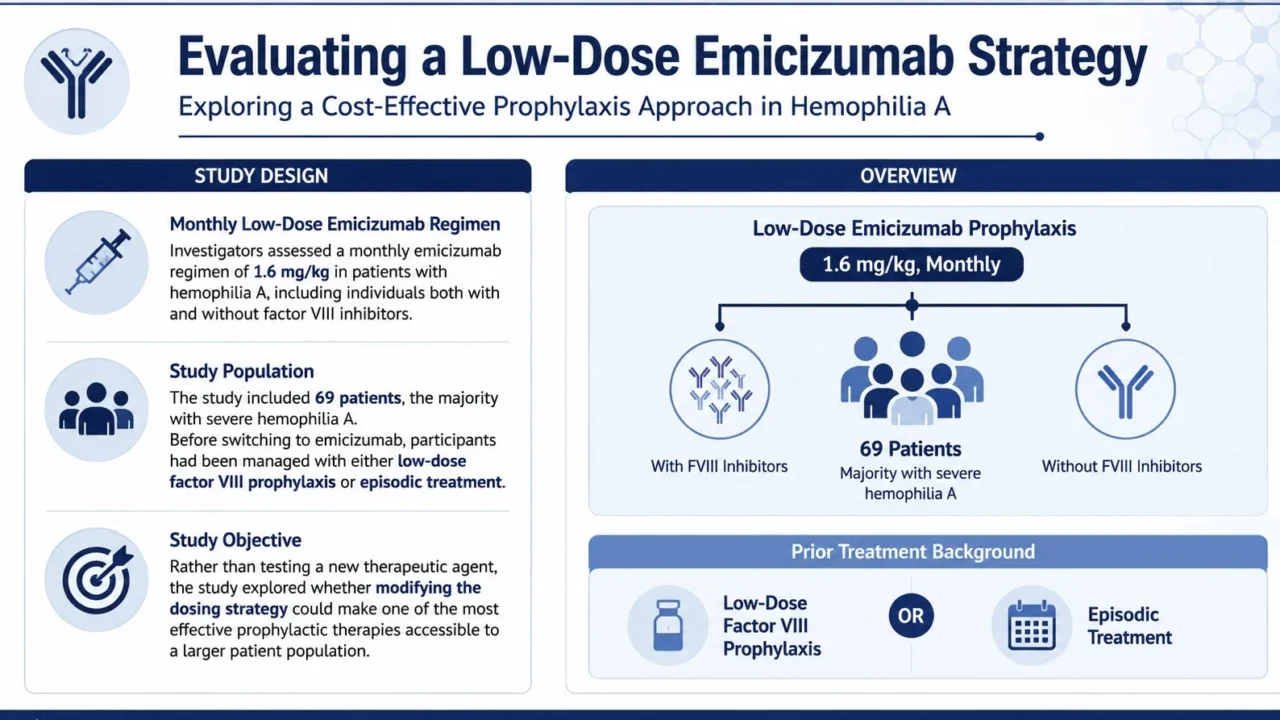
Investigators assessed a monthly emicizumab regimen of 1.6 mg/kg in patients with hemophilia A, including individuals both with and without factor VIII inhibitors.
The study included 69 patients, the majority with severe hemophilia A. Before switching to emicizumab, participants had been managed with either low-dose factor VIII prophylaxis or episodic treatment.
Rather than testing a new therapeutic agent, the study explored whether modifying the dosing strategy could make one of the most effective prophylactic therapies accessible to a larger patient population.
Significant Reductions in Bleeding
Clinical outcomes demonstrated substantial improvements after patients initiated low-dose emicizumab prophylaxis.
Total bleeding episodes declined dramatically, decreasing from 443 events before treatment to 83 events during prophylaxis.
Among the initial study cohort, the median annualized bleeding rate (ABR) fell from 27 to 4.
Patients who had already been receiving low-dose factor VIII prophylaxis also experienced further benefit, with median ABR decreasing from 3 to 1.
Perhaps most notably, the proportion of patients experiencing no bleeding episodes increased from 11.9% before treatment to 48.8% after starting emicizumab.
Investigators also observed that most remaining bleeding episodes were related to trauma rather than spontaneous hemorrhage, suggesting that baseline hemostatic protection improved considerably with prophylaxis.
Benefits Beyond Bleeding Control
The study emphasized that successful hemophilia management extends beyond reducing bleeding frequency.
Parents and patients consistently reported greater confidence in daily activities, less anxiety about unexpected bleeding and improved overall functioning after transitioning to emicizumab.
Researchers also incorporated longitudinal assessments of musculoskeletal health and quality of life, recognizing that preserving joint function and maintaining long-term physical wellbeing are central goals of modern hemophilia care.
These findings reinforce the importance of evaluating outcomes that matter directly to patients, alongside traditional clinical measures such as annualized bleeding rates.
Improving Access Through Cost-Effective Care
One of the most important findings presented at ISTH 2026 was the economic impact of the low-dose strategy.
Compared with previous low-dose factor VIII prophylaxis, monthly low-dose emicizumab reduced overall treatment costs by approximately 50%, while simultaneously improving bleeding outcomes and patient satisfaction.
For healthcare systems with limited resources, this represents a potentially transformative approach. Lower treatment costs could enable national programs to offer prophylaxis to a larger proportion of patients without requiring proportional increases in healthcare expenditure.
The Thai experience illustrates that optimizing treatment strategies can be just as important as developing new therapies when striving to improve global access to care.
Future Directions
Investigators suggested that future protocols may incorporate loading-dose regimens to achieve therapeutic emicizumab concentrations more rapidly and reduce breakthrough bleeding during the early weeks of treatment.
Longer follow-up and larger studies will be important to confirm the durability of these findings and determine how widely this approach can be implemented across different healthcare settings.
Nevertheless, the study provides compelling evidence that innovation in hemophilia care extends beyond pharmaceutical development. Careful optimization of existing therapies has the potential to improve outcomes while making advanced prophylaxis accessible to many more patients worldwide.
Key Takeaways
The presentation from Thailand reflected one of the broader themes emerging throughout the ISTH 2026 Congress: advancing hemophilia care is no longer solely about introducing new molecules but also about delivering existing therapies more efficiently, equitably and sustainably.
By combining strong clinical outcomes with meaningful cost reductions, low-dose emicizumab offers a promising model for countries seeking to expand access to prophylaxis despite financial constraints.
As additional real-world evidence becomes available, this strategy may help reshape national treatment policies and narrow global disparities in hemophilia care.
Written by Heghine Khachatryan, MD, PhD, Editor-in-Chief at Hemostasis Today.
-
Oct 20, 2026, 06:45Grant Garcia: Why Does a Blood Clot Diagnosis Immediately End an Athlete’s Season?
-
Oct 20, 2026, 06:35Parag Tamhankar: Landmark Study Reveals Genetic Spectrum and Targeted Therapies for ALPS in the Indian Population
-
Oct 20, 2026, 06:26Nina Houben: Neonatal Blood Transfusion Symposium and PhD Defense
-
Oct 20, 2026, 05:46Jan T. Kielstein: DNP Poisoning and Hemoadsorption The Limits of Rescue Therapy
-
Oct 20, 2026, 05:33Giulia Di Paolo: Connecting Plasma Donation to the Patients Who Depend on It
-
Oct 20, 2026, 05:20James Knowles: Exploring Plasma Manufacturing and Strengthening Industry Collaboration
-
Oct 20, 2026, 05:11Giuseppe Lippi։ Understanding Liver Test Abnormalities After AAV Gene Therapy
-
Oct 20, 2026, 05:02Sanam Loghavi: Test Your Hematology Knowledge at ASH 2026!
-
Oct 20, 2026, 04:13Ifeanyichukwu Ifechidere: DOACs Are Not the Answer to Every Anticoagulation Question