


Platelet-Derived Extracellular Vesicles for Hemostasis and Bleeding Reduction in TBI – Every Labs
Every Labs shared a post on LinkedIn about a recent article by Alpa Trivedi et al., pubished in Journal of Translational Medicine, adding:
“Freeze-dried platelet vesicles cut bleeding in the injured brain, no cold chain needed.
New in the Journal of Translational Medicine (July 20, 2026), a UCSF-led team tested freeze-dried platelet-derived extracellular vesicles (LPEVs) in traumatic brain injury. Mice received one dose 40 minutes after controlled cortical impact.
Why this matters
- Hemorrhage is the leading cause of preventable death worldwide; intracranial bleeding drives early deaths after TBI.
- TBI is the top cause of death and disability in people aged 1 to 44 globally.
- Freeze-dried vesicles need no cold chain, so they could ride in an ambulance or field kit.
Key takeaways
- One LPEV dose 40 minutes post-injury significantly reduced intracranial hemorrhage in a mouse cortical impact model.
- LPEVs generated thrombin and sped clot formation in blood from healthy donors, trauma patients, and dysfunctional platelets.
- Effects ran through GPIIb/IIIa-dependent platelet aggregation; blood-brain barrier permeability and neuroinflammation were unchanged.
Reality check
The authors note LPEVs kept platelets’ hemostatic cargo but lost vasculoprotective factors, decoupling bleeding control from barrier protection. Human trials and dosing studies come next.
Bottom line
A shelf-stable vesicle product may stop brain bleeding early after trauma, though barrier repair will need something more.
Institutions
- University of California, San Francisco
- Cellphire Therapeutics, Inc.
- Vitalant Research Institute
- Uniformed Services University
Citation
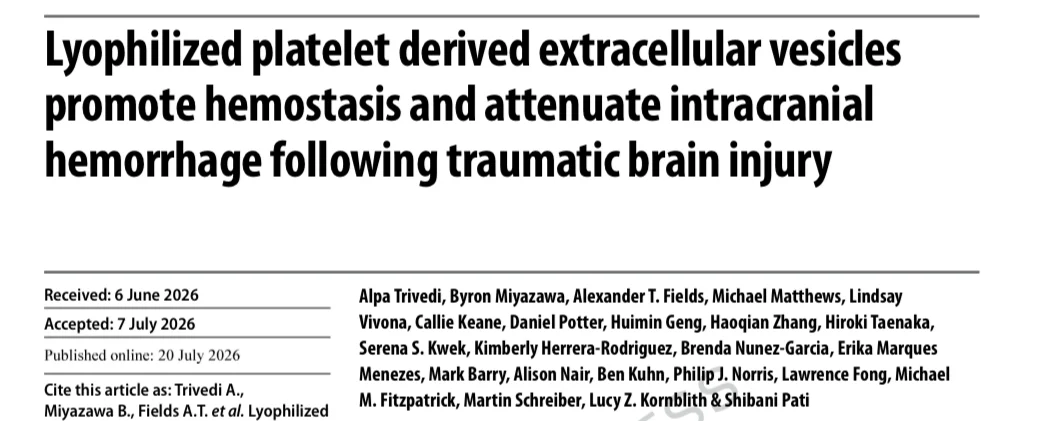
Lyophilized platelet derived extracellular vesicles promote hemostasis and attenuate intracranial hemorrhage following traumatic brain injury Trivedi et al., Journal of Translational Medicine (2026). Volume and article number not yet indexed at time of writing.”
Title: Lyophilized platelet derived extracellular vesicles promote hemostasis and attenuate intracranial hemorrhage following traumatic brain injury
Authors: Alpa Trivedi, Byron Miyazawa, Alexander T. Fields, Michael Matthews, Lindsay Vivona, Callie Keane, Daniel Potter, Huimin Geng, Haoqian Zhang, Hiroki Taenaka, Serena S. Kwek, Kimberly Herrera-Rodriguez, Brenda Nunez-Garcia, Erika Marques de Menezes, Mark Barry, Alison Nair, Ben Kuhn, Philip J. Norris, Lawrence Fong, Michael M. Fitzpatrick, Martin Schreiber, Lucy Z. Kornblith and Shibani Pati
Stay updated on all scientific advances with Hemostasis Today.

-
Sep 20, 2026, 09:51Ceasovschih Alexandr: A Closer Look at Lipid Disorders in CKM Syndrome
-
Sep 20, 2026, 09:05World Stroke Academy: Can Adjunct IAT Improve Tissue Reperfusion?
-
Sep 20, 2026, 06:46Neeraj Songara: From Donated Blood to Engineered Therapeutics
-
Sep 20, 2026, 06:24Louise St. Germain Bannon: Improving Awareness and Care for Women Across the Lifespan
-
Sep 20, 2026, 05:17Maxime Dely: When ABO Compatibility Isn’t Enough for Safe Transfusion
-
Sep 20, 2026, 04:54William Aird: What Does a Complete History and Physical Really Mean?
-
Sep 20, 2026, 04:34Hons Saurabh Kaushik: Why Uncontrolled LDL Can Be Harmful
-
Sep 20, 2026, 03:58Salih Ehsan: The Complexities of HbF and HbA2
-
Sep 20, 2026, 03:22The Voices of People Living With Bleeding Disorders – EHC