

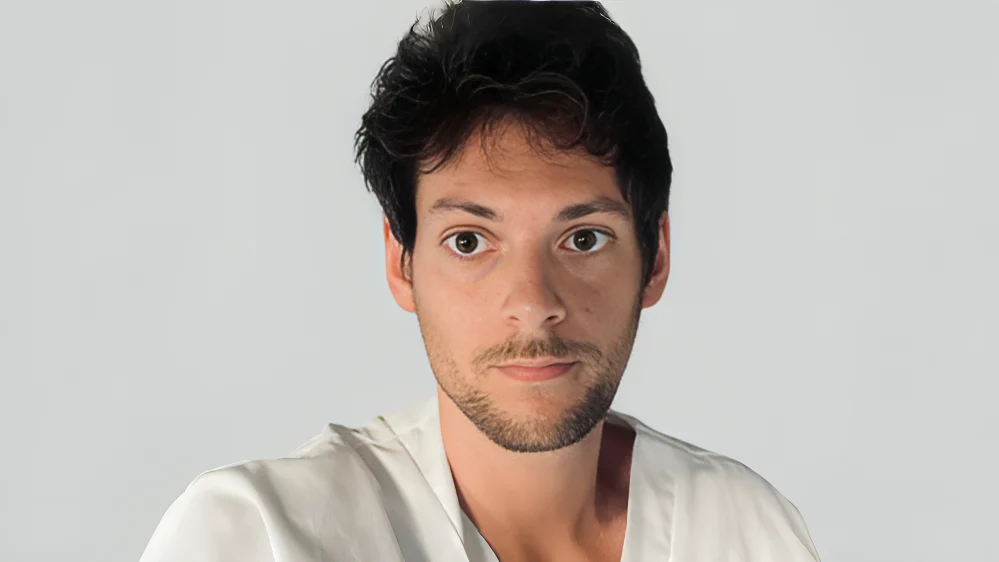
Matteo Foschi: New Insights Into Breakthrough Ischemic Stroke
Matteo Foschi, Neurologist at Azienda USL della Romagna, Affiliated Researcher at the Cochrane MS and Rare Diseases of the CNS Review Group, shared a post on LinkedIn, about a recent article he and his colleagues co-authored, published in Journal of Neurology, adding:
”Great to see this new ASPERA-R analysis published in the Journal of Neurology!
Among 1,649 patients with breakthrough ischemic stroke despite ongoing oral anticoagulation, 43.9% had at least one identifiable potential cause, most commonly drug–drug interactions (28.4percent), competing stroke etiologies (24.3percent), and active cancer (4.4percent). Importantly, the presence of greater than or equal to 1 potential cause was associated with a twofold higher risk of recurrent ischemic stroke at 90 days (HR 2.04, 95percent CI 1.18–3.53).
These findings reinforce the idea that breakthrough stroke is a heterogeneous and often multifactorial condition, calling for a careful diagnostic work-up and mechanism-driven secondary prevention.
Congratulations to Federico De Santis and Raffaele Ornello for leading this analysis… and to the entire ASPERA collaboration!”
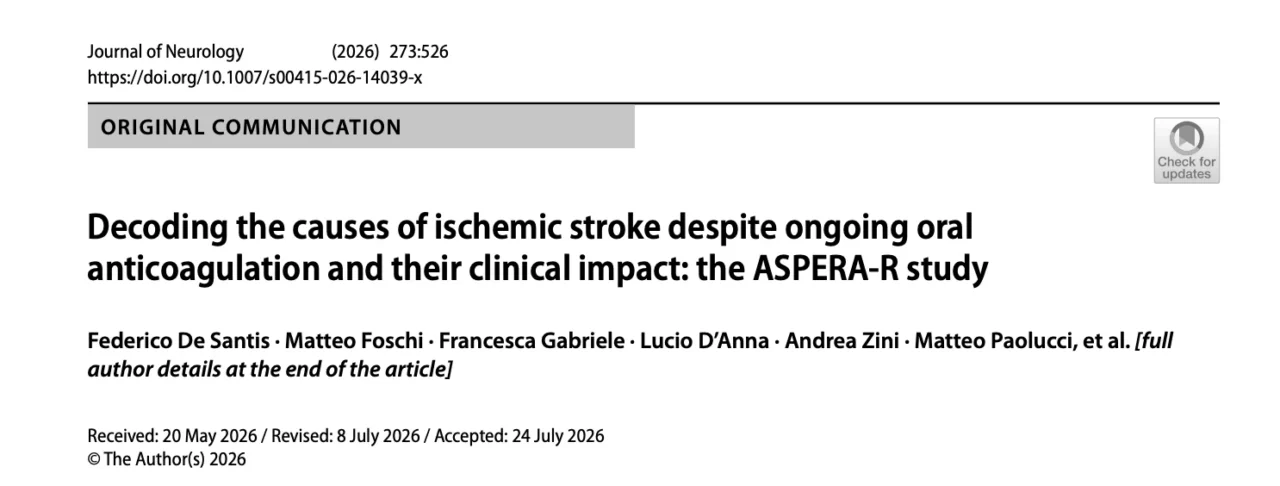
Title: Decoding the causes of ischemic stroke despite ongoing oral anticoagulation and their clinical impact: the ASPERA-R study
Authors: Federico De Santis, Matteo Foschi, Francesca Gabriele, Lucio D’Anna, Andrea Zini, Matteo Paolucci, Stefano Forlivesi, Ludovica Migliaccio, Maria Maddalena Viola, Angelo Cascio Rizzo, Maria Sessa, Ghil Schwarz, Rachele Tortorella, Soma Banerjee, Gaurav Desai, Kazi Farhad Ahmed, Gabriele Prandin, Leonardo Pantoni, Francesco Mele, Giuseppe Scopelliti, Ilaria Cova, Mariarosaria Valente, Domenico Maisano, Luca Antonelli, Maria Rosaria Bagnato, Giovanni Di Mauro, Francesca Bernocchi, Martina Gaia Di Donna, Barbara Casolla, Souleymane-M.-Bara Diallo, Baptiste Alvarez, Julie Contenti, Laura González-Martìn, Ricardo Rigual, Blanca Fuentes, Carlos Hervás-Testal, Paolo Candelaresi, Vincenzo Andreone, Antonio De Mase, Emanuele Spina,Diana Aguiar de Sousa, Mariana Almudi Souza, Alberto Fior, Miguel Serôdio, Pietro Caliandro, Aurelia Zauli, Giuseppe Reale, Ahmed Abdelalim, Sandra Ahmed, Samah Ali Ismail, Liqun Zhang, Tara Latimer, Muhammad Elboghdady, Ahmed Elbassiouny, Tamer Roushdy, Hossam Shokri, Federica Ferrari, Nicola Davide Loizzo, Federico Mazzacane, Maria Guarino, Valentina Barone, Paola Forti, Giuseppe Rinaldi, Marco Vito Rossi, Vincenzo Laterza, Giovanni Frisullo, Pier Andrea Rizzo, Aldobrando Broccolini, Marina Mannino, Valeria Terruso, Marcella Caggiula, Annalisa Rizzo, Ana Catarina Fonseca, Bernardo Antunes, Ana M. Barbosa, Hrvoje Budincevic, Petra Crnac, Giovanna Viticchi, Mauro Silvestrini, Lorenzo Barba, Viktoria Musienko, Markus Otto, Piergiorgio Lochner, Benjamin Landau, Sandeep Buddha, Roumeisa Khalil, Maria Grazia Piscaglia, Elena Minguzzi, Marialuisa Zedde, Ahmed Nasreldein, Luisa Vinciguerra, Luis Rufo Costa, Ahmed Elsaid Elsayed, Mona AlBanna, Laura Tudisco, Maria Giulia Mosconi, Alexandros A. Polymeris, Giovanni Merlino, Simona Sacco,Raffaele Ornello
Other posts featuring Matteo Foschi on Hemostasis Today.
-
Oct 5, 2026, 22:55Steve Humphreys: A Big Thank You to BSHT for Providing Me With a Recent Skills Exchange Award
-
Oct 5, 2026, 22:52William McKeown: Great to Be in Istanbul for the Opening of the EHC 2026
-
Oct 5, 2026, 22:48Laura Quintas Lorenzo: A New Approach to Healthcare for von Willebrand Disease at EHC 2026
-
Oct 5, 2026, 22:46Anas Zayad: Pleased to Share Our New Review on Thrombosis in SCD and Beta Thalassemia
-
Oct 5, 2026, 22:44Cihan Ay: Honouring Eric Kandel and Eugene Braunwald at the Medical University of Vienna
-
Oct 5, 2026, 22:42Heather L. Gornik: Testing for Aortic and Arterial Thrombosis at VSS 2026
-
Oct 5, 2026, 22:34Hasan Abbas Zaheer: Honoured to Have Co-Authored One of the Four Reviews in The Lancet Thalassemia Series
-
Oct 5, 2026, 22:34Kamyar Shameli: Understanding the Coagulation Cascade – How Anticoagulants Prevent Blood Clots
-
Oct 5, 2026, 22:31Risika Samanta: Pediatric ITP in a 12-year-old – An Atypical Presentation without a Viral Prodrome