


Ney Carter Borges: Anticoagulation Versus Antiplatelet Therapy After TAVI ESC 26
Ney Carter Borges, Member Cardiologist of Global Physician Association at Cleveland Clinic Florida, shared a post on LinkedIn:
”ACASA-TAVI: Anticoagulation Versus Antiplatelet Therapy After TAVI ESC 26
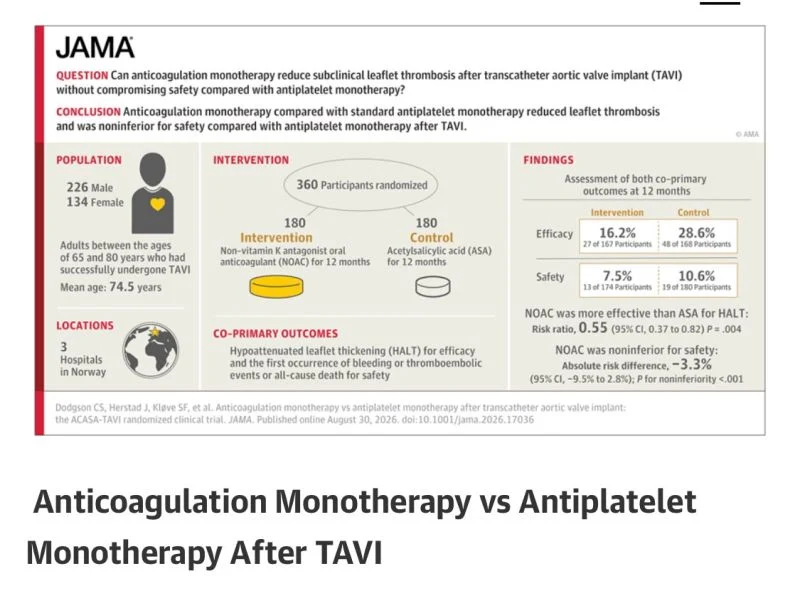
ACASA-TAVI was a multicenter, randomized, open-label trial with blinded endpoint assessment comparing direct oral anticoagulant monotherapy with aspirin after transcatheter aortic valve implantation (TAVI). Between 2021 and 2025, 360 Norwegian patients aged 65–80 years without an independent indication for anticoagulation or antiplatelet therapy were randomized to 12 months of a factor Xa inhibitor—apixaban, edoxaban, or rivaroxaban—or aspirin. Mean age was 74.5 years, and 37 percent were women.
The primary efficacy endpoint was subclinical leaflet thrombosis, defined as hypoattenuated leaflet thickening (HALT) on cardiac computed tomography at 12 months. HALT occurred in 16.2 percent of patients assigned to anticoagulation and 28.6 percent assigned to aspirin, corresponding to a risk ratio of 0.55 (95 percent confidence interval, 0.37 to 0.82; P equals .004), a 45 percent relative reduction and 12.4-percentage-point absolute reduction.
The primary safety composite of VARC-3 bleeding, thromboembolic events, and all-cause death occurred in 7.5 percent versus 10.6 percent, respectively (risk difference, −3.3percent; 95 percent CI, −9.5 percent to 2.8 percent; P for noninferiority less than 001). VARC-3 bleeding occurred in 2.3 percent versus 4.0 percent, while thromboembolic events occurred in 4.0 percent versus 2.9 percent. Mortality was lower with anticoagulation (1.1 percent vs 5.6 percent), although this secondary finding should be considered exploratory.
Anticoagulant monotherapy therefore reduced HALT without compromising overall safety. However, the trial was open-label, included relatively younger TAVI recipients, and recorded few clinical events. Consequently, it does not establish a definitive net clinical benefit or support routine anticoagulation after TAVI, but provides a strong rationale for further investigation and carefully selected use.”
Find more posts featuring Ney Carter Borges on Hemostasis Today.
-
Oct 20, 2026, 06:45Grant Garcia: Why Does a Blood Clot Diagnosis Immediately End an Athlete’s Season?
-
Oct 20, 2026, 06:35Parag Tamhankar: Landmark Study Reveals Genetic Spectrum and Targeted Therapies for ALPS in the Indian Population
-
Oct 20, 2026, 06:26Nina Houben: Neonatal Blood Transfusion Symposium and PhD Defense
-
Oct 20, 2026, 05:46Jan T. Kielstein: DNP Poisoning and Hemoadsorption The Limits of Rescue Therapy
-
Oct 20, 2026, 05:33Giulia Di Paolo: Connecting Plasma Donation to the Patients Who Depend on It
-
Oct 20, 2026, 05:20James Knowles: Exploring Plasma Manufacturing and Strengthening Industry Collaboration
-
Oct 20, 2026, 05:11Giuseppe Lippi։ Understanding Liver Test Abnormalities After AAV Gene Therapy
-
Oct 20, 2026, 05:02Sanam Loghavi: Test Your Hematology Knowledge at ASH 2026!
-
Oct 20, 2026, 04:13Ifeanyichukwu Ifechidere: DOACs Are Not the Answer to Every Anticoagulation Question