


Danny Hsu: Paradigm Shift in PE Management? – Unpacking the PRAGUE-26 Trial
Danny Hsu, President of THANZ, Director of Therapeutic Apheresis, Immune and Obstetric Haematology at South Western Sydney Local Health District, shared Australian Institute of Medical and Clinical Scientists’s post on LinkedIn about a recent article by Josef Kroupa, published in NEJM, adding:
“Paradigm Shift in PE Management? Unpacking the PRAGUE-26 Trial
Congratulations Josef Kroupa, Viktor Kočka and co-authors!
The recently published PRAGUE-26 trial in the New England Journal of Medicine provides incredibly compelling data on the use of catheter-directed thrombolysis (CDT) that could significantly shape our Pulmonary Embolism Response Team (PERT) protocols.
This multicenter, randomized trial evaluated 558 patients with intermediate-high-risk acute pulmonary embolism.
For context, this patient cohort-defined by hemodynamic stability, a simplified Pulmonary Embolism Severity Index (PESI) score of more than 1, and right ventricular dysfunction combined with elevated cardiac troponin or natriuretic peptides-correlates directly with the C3 category in the new AHA guidelines.
The trial compared CDT with alteplase plus anticoagulation versus standard anticoagulation therapy alone, and the 7-day outcomes are striking:
- The primary composite outcome (death from any cause, recurrent pulmonary embolism, or cardiorespiratory decompensation/collapse) occurred in only 0.7% of the CDT group, compared to a concerning 6.8% in the standard-care group.
- This highly significant reduction was driven primarily by a lower incidence of cardiorespiratory decompensation or collapse in the patients receiving catheter-directed thrombolysis.
- Perhaps most importantly for our clinical decision-making, this efficacy did not come at the cost of safety; by day 7, there was no significant difference between the groups regarding clinically relevant bleeding or major bleeding.
The Takeaway for Australia and New Zealand:
For our C3/intermediate-high-risk PE patients, our traditional approach has often been to rely on anticoagulation and reserve reperfusion as a ‘rescue’ therapy only if the patient clinically deteriorates.
However, PRAGUE-26 strongly supports the concept that earlier, catheter – based reperfusion can successfully prevent that deterioration before overt hemodynamic collapse occurs.
As we look to update our local guidelines and pathways, this trial provides provocative evidence that conventional CDT (even without ultrasound facilitation) is a highly effective, safe strategy to stabilize our high-risk patients.
I would love to hear from all our colleagues – how is your local PERT currently managing this C3 cohort, and will this data shift your threshold for early interventional referral?”
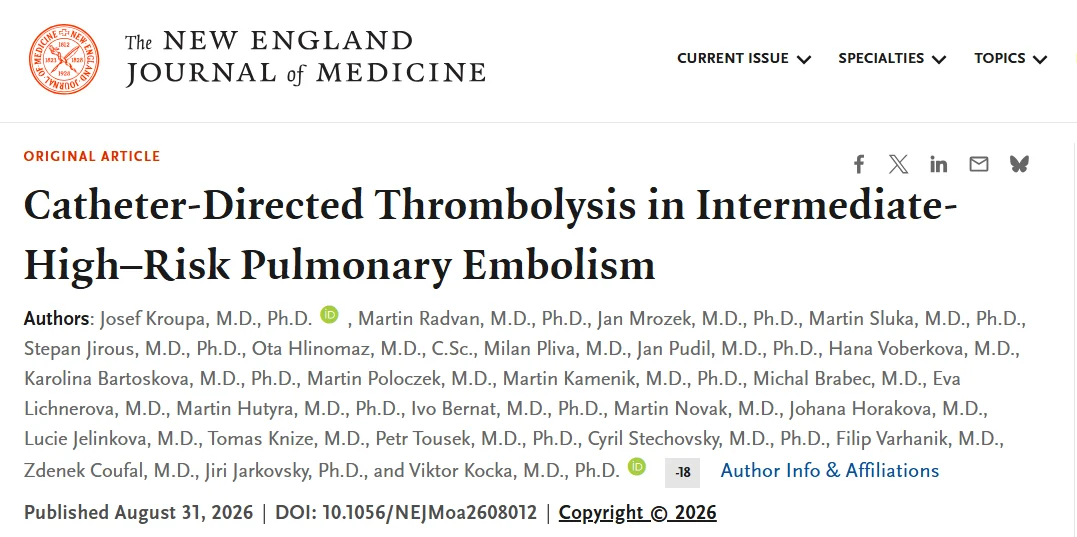
Title: Catheter-Directed Thrombolysis in Intermediate-High–Risk Pulmonary Embolism
Authors: Josef Kroupa, Martin Radvan, Jan Mrozek, Martin Sluka, Stepan Jirous, Ota Hlinomaz, Milan Pliva, Jan Pudil, Hana Voberkova, Karolina Bartoskova, Martin Poloczek, Martin Kamenik, Michal Brabec, Eva Lichnerova, Martin Hutyra, Ivo Bernat, Martin Novak, Johana Horakova, Lucie Jelinkova, Tomas Knize, Petr Tousek, Cyril Stechovsky, Filip Varhanik, Zdenek Coufal, Jiri Jarkovsky, Viktor Kocka
Other posts featuring Danny Hsu on Hemostasis Today.
-
Oct 18, 2026, 08:02Neda Ashayeri: Global Perspectives on Hemophilia and Rare Bleeding Disorders in Abu Dhabi
-
Oct 18, 2026, 07:55Anu Thomas: A Stepwise Laboratory Approach to Positive IAT and Pretransfusion Compatibility
-
Oct 18, 2026, 07:49Matthew Hazell: Molecular Matching and the Future of Transfusion Practice
-
Oct 18, 2026, 07:05Behnood Bikdeli: Vasculearn Network Highlights Expert Perspectives on PE Risk Stratification and Advanced Therapies
-
Oct 18, 2026, 06:27Gregory Makris: NEJM Study Supports Earlier Catheter-Directed Intervention in Intermediate-High–Risk PE
-
Oct 18, 2026, 06:26Danny Hsu: BLOOD 2026 Return to Aotearoa
-
Oct 18, 2026, 02:43Priya Sriskandarajah: Diagnosis and Management of PV and JAK2-Unmutated Erythrocytosis
-
Oct 18, 2026, 02:41C. Michael Gibson: A Meta-Analysis of DOACs and DAPT After Left Atrial Appendage Closure
-
Oct 18, 2026, 02:27What Hematologists Should Remember About the Person Behind the Platelet Count – ASH