

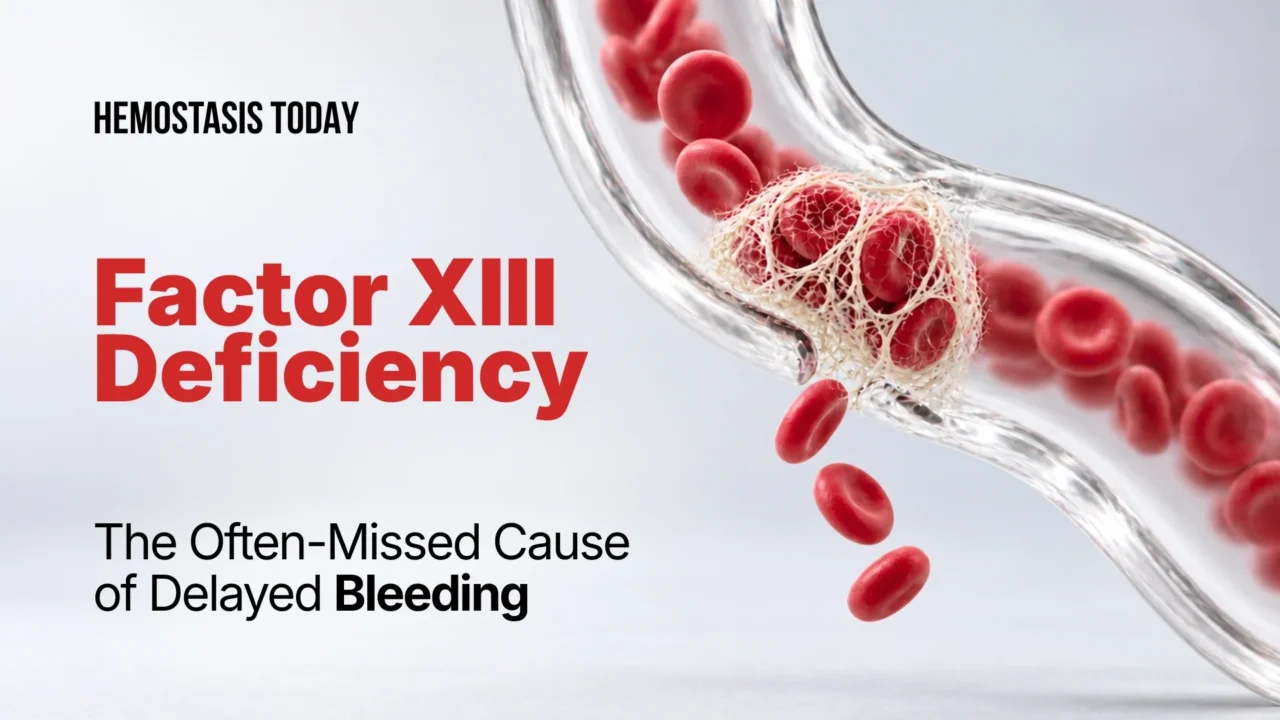
Factor XIII Deficiency An Often-Missed Bleeding Disorder
When persistent bleeding does not match the routine coagulation profile, the diagnosis may lie beyond standard coagulation tests.
A 23-year-old man presented to the Emergency Room with persistent bleeding from a traumatic ulcer on his left leg that had continued for one week despite debridement and initial treatment at an outside facility.
Over the following week, the wound evolved into an ulcer, and the patient developed a high-grade fever, prompting his presentation to the Emergency Room.
On examination, the patient was hemodynamically stable.
Local findings around the ulcer included ongoing bleeding, clot formation, warmth, tenderness, and surrounding edema. No pedal edema or generalized lymphadenopathy was observed.
Initial laboratory investigations, including routine coagulation studies, did not provide an obvious explanation for the persistent bleeding. The patient’s laboratory findings are presented below.
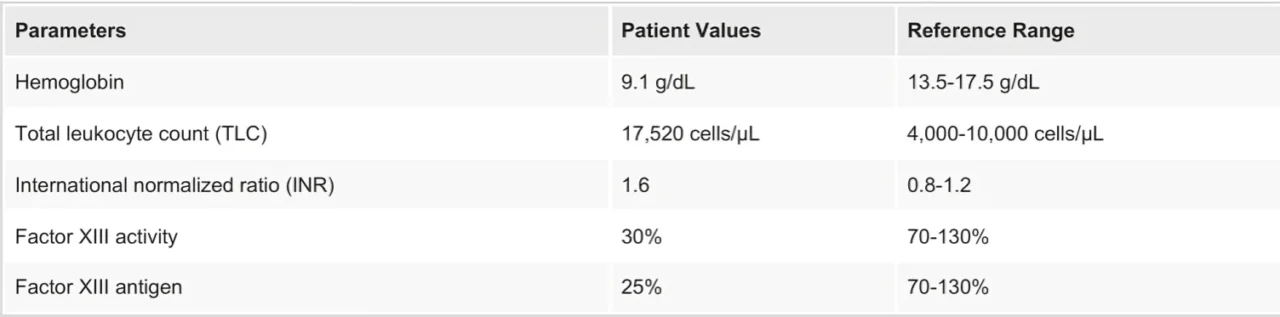
Further evaluation showed reduced Factor XIII activity (30%) and antigen levels (25%). Genetic testing subsequently identified a mutation in the F13A1 gene, confirming Factor XIII deficiency.
Factor XIII deficiency presents a particular diagnostic challenge because patients can have normal prothrombin time (PT), activated partial thromboplastin time (aPTT), and platelet counts.
Unlike coagulation factors assessed by routine PT and aPTT, Factor XIII acts after fibrin formation to stabilize the developing clot.
Consequently, significant bleeding can occur despite an apparently normal coagulation profile.
Factor XIII deficiency is an extremely rare inherited bleeding disorder, with an estimated prevalence of approximately 1 in 1,000,000 to 3,000,000 individuals worldwide.
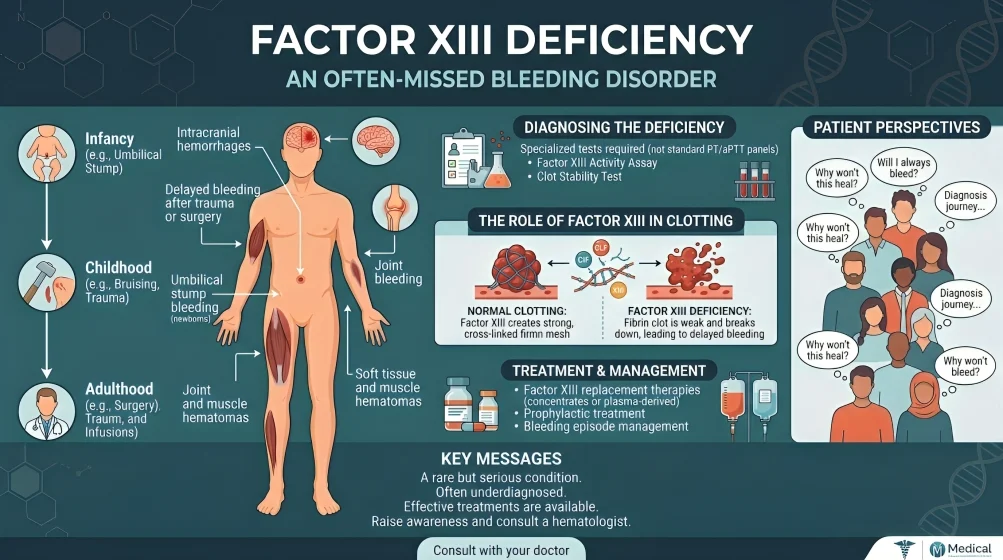
The disorder results from impaired fibrin stabilization and is characteristically associated with delayed bleeding, particularly after trauma or surgery.
Bleeding manifestations may begin during the neonatal period or early childhood, although milder cases can present later in life.
Clinical features include delayed bleeding after trauma or surgery, spontaneous intracranial hemorrhage, soft-tissue or muscle bleeding, impaired wound healing, and recurrent pregnancy loss in affected women.
Neonates may present with bleeding from the umbilical stump or delayed separation of the umbilical cord.
Beyond its role in fibrin stabilization, Factor XIII contributes to wound healing, tissue repair, macrophage function, and host defense.
Its deficiency may therefore produce clinical manifestations that extend beyond bleeding alone.
Persistent or delayed bleeding despite normal PT and aPTT should prompt consideration of Factor XIII deficiency and other bleeding disorders that are not detected by routine coagulation testing.
Congenital and Acquired Factor XIII Deficiency
Factor XIII deficiency can manifest in congenital and acquired forms, leading to reduced clot stability and abnormal bleeding tendencies.
Congenital FXIII Deficiency
Congenital FXIII deficiency comprises A (FXIII-A) and B (FXIII-B) subunits. FXIII-A is primarily produced in hematopoietic cells, whereas FXIII-B production occurs in hepatocytes.
FXIII consists of a dimer of catalytic A subunits (FXIII-A2) and a dimer of carrier or inhibitory B subunits (FXIII-B2), forming a heterotetrameric complex, FXIII-A2B2. Both subunits are required for normal FXIII activity; deficiency of either results in impaired clot stability.
A deficiency or defect in subunit B destabilizes the FXIII-A2B2 complex, leading to a relative deficiency of subunit A. Patients with a B subunit deficiency have a less severe bleeding phenotype.
Acquired FXIII Deficiency
Acquired FXIII deficiency can arise secondary to autoimmune conditions such as systemic lupus erythematosus, rheumatoid arthritis, and idiopathic retroperitoneal fibrosis.
Immunoglobulin G1 and G4 autoantibodies were believed to inhibit FXIII.
Diagnosing Factor XIII Deficiency
Routine coagulation tests, including prothrombin time (PT), activated partial thromboplastin time (aPTT), and international normalized ratio (INR), are typically normal in FXIII deficiency.
This is because FXIII acts after fibrin formation, stabilizing the fibrin clot rather than participating in the coagulation reactions measured by PT and aPTT.
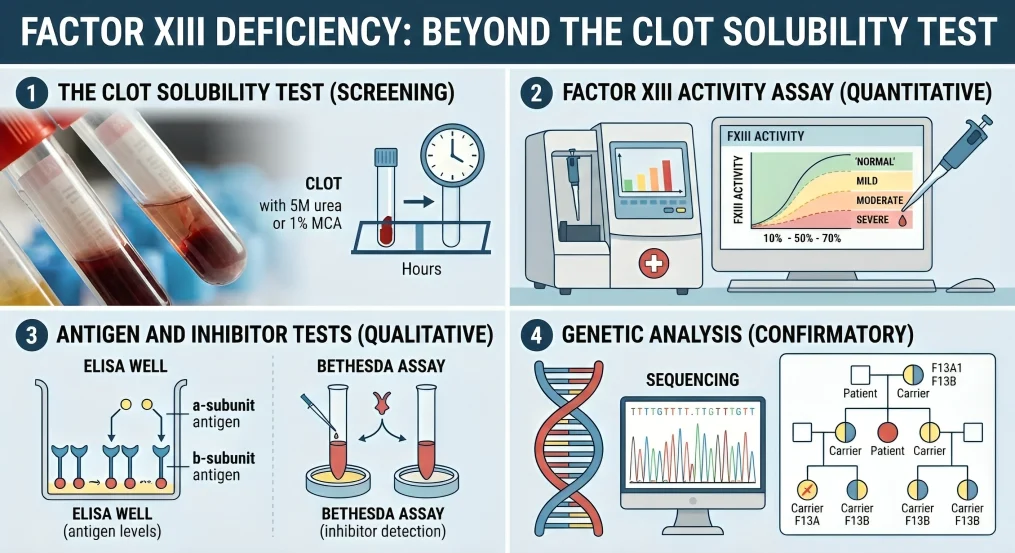
As a result, diagnosis requires specific laboratory testing, which may include:
- The clot solubility test evaluates clot solubility in either 5 mol/L urea or 1 percent monochloroacetic acid. If clot lysis occurs within a few hours, severe FXIII deficiency is likely, provided that fibrinogen levels are qualitatively and quantitatively within the reference range. But clot solubility test’s clinical reliability is limited by its false-positive rate. Furthermore, the test cannot reliably identify patients with mild or moderate FXIII deficiency, and heterozygous carriers may go undetected.
- Ammonia release assay. FXIII activity leads to the release of ammonia, which in turn converts nicotinamide adenine dinucleotide phosphate hydrogen (NADPH) or nicotinamide adenine dinucleotide hydrogen (NADH) to nicotinamide adenine dinucleotide (NAD+) or nicotinamide adenine dinucleotide phosphate (NADP+). The assay determines FXIII activity by measuring NADPH consumption.
- Amine incorporation assay: These tests use fluorescent, radiolabeled, or biotinylated amines covalently bound to a glutamine residue of the substrate, and the amount of unbound amines is measured after the protein fraction is released.
- Immunological Assays: FXIII antigen assays to distinguish Type A from Type B deficiency. An example of a widely used immunoassay is the enzyme-linked immunosorbent assay (ELISA). Electroimmunoassays and radioimmunoassays, although available, are less commonly used due to their lack of standardization and cumbersome procedures.
- FXIII Inhibitor Assays are necessary for patients suspected of developing anti-FXIII antibodies. These assays are conducted only in select countries and institutions where the necessary tests are available. With more than 1000 polymorphisms present in both FXIII subunits, mapping the entire gene in all patients is impractical. Evidence suggests that these polymorphisms vary based on ethnicity.
Molecular genetic testing can confirm the diagnosis, identify the subtype and support family studies.
Differential Diagnosis
When a patient presents with unexplained or persistent bleeding, particularly with an abnormal bleeding history, the differential diagnosis includes:
- Hemophilia A and B
- von Willebrand disease
- Other rare coagulation factor deficiencies
- Platelet disorders
- Acquired coagulation factor inhibitors
In patients with normal PT and aPTT, however, FXIII deficiency should remain an important consideration, particularly when bleeding is delayed or persistent after trauma or surgery.
How Is Factor XIII Deficiency Treated?
Management of Factor XIII deficiency focuses on replacing FXIII, controlling active bleeding, and preventing recurrent bleeding.
FXIII replacement therapy is the mainstay of treatment. Plasma-derived FXIII concentrates, which contain both FXIII-A and FXIII-B, can be used across FXIII deficiency subtypes.
Recombinant FXIII-A is also available and is primarily used in patients with congenital FXIII-A deficiency. Because FXIII has a long half-life, replacement can provide sustained protection against bleeding.
Prophylaxis is recommended for patients with severe congenital FXIII deficiency, particularly those with a history of significant or recurrent bleeding.
Treatment is generally given at regular intervals, often every 4–6 weeks, with the regimen individualized according to the patient’s bleeding phenotype and FXIII levels. Lifelong prophylaxis is particularly important in severe deficiency because of the risk of serious bleeding, including intracranial hemorrhage.
When specific FXIII concentrates are unavailable, cryoprecipitate or fresh frozen plasma (FFP) may be used as alternative sources of FXIII.
Cryoprecipitate contains a higher concentration of FXIII than FFP.
Antifibrinolytic agents such as tranexamic acid may be useful as adjunctive therapy, particularly for mucosal bleeding.
In acquired FXIII deficiency, treatment should also address the underlying cause. Patients with autoimmune-mediated deficiency may require immunosuppressive therapy, while treatment of an associated malignancy or other underlying disorder may help correct the acquired deficiency.
Factor XIII deficiency illustrates an important principle in hemostasis: a normal coagulation screen does not necessarily mean normal hemostasis.
When unexplained or delayed bleeding occurs despite normal PT and aPTT, FXIII deficiency should remain in the differential diagnosis.
How Long Does FXIII Replacement Last?
A 12-week pharmacokinetic and safety study evaluated plasma-derived FXIII concentrate at 40 IU/kg every 28 days in 14 patients with congenital FXIII deficiency.
Once-monthly prophylaxis produced rapid correction of FXIII activity without excessive elevation, reaching a mean peak activity of 87.7% at 1.72 hours after infusion and maintaining a mean trough level of 5.0% at day 28. The reported elimination half-life was 6.6 days.
The regimen was well tolerated, with no thromboembolic events, viral transmission, treatment-requiring bleeding, or treatment-related hypersensitivity reactions reported.
Only two potentially treatment-related laboratory adverse events were observed, without clinical consequences.
Longer-term prophylaxis data further showed that ≥97% of patients maintained trough FXIII activity levels of at least 5%, with few dose adjustments and an annualized spontaneous bleeding rate of 0.000 episodes per patient-year requiring FXIII treatment.
Together, these findings support 40 IU/kg every 28 days as an effective and well-tolerated prophylactic regimen for children and adults with congenital FXIII deficiency.
FDA approved Corifact for Routine Prophylaxis in Congenital Factor XIII Deficiency
Corifact (Factor XIII Concentrate, Human) is FDA-approved for routine prophylaxis and perioperative management of surgical bleeding in adults and children with congenital FXIII deficiency.
The product is supplied as a lyophilized powder in single-use vials containing 1,000–1,600 IU of FXIII. It is reconstituted with 20 mL of Sterile Water for Injection and administered intravenously.
For routine prophylaxis, the labeled dose is 40 IU/kg every 28 days. Dosing may be individualized according to FXIII activity levels, clinical response, and the timing of surgery. Around surgical procedures, additional management may be required based on the patient’s most recent dose and FXIII activity.
Corifact received its initial U.S. approval in 2011, with the perioperative indication added in 2014.
Recombinant FXIII for Long-Term Prophylaxis
In a multinational, open-label phase 3 trial (NCT00713648), monthly prophylaxis with recombinant FXIII-A₂ (rFXIII) was evaluated in 41 patients aged ≥6 years with congenital FXIII-A deficiency.
Only five bleeding episodes occurred during prophylaxis, all following trauma. Four patients required treatment with FXIII-containing products, and no spontaneous bleeding episodes were reported.
The treatment was also well tolerated. Four patients developed low-titer, non-neutralizing anti-rFXIII antibodies, which were transient and declined below detectable levels despite continued treatment. None experienced allergic reactions, treatment-requiring bleeding, or clinically relevant changes in FXIII pharmacokinetics.
Across the rFXIII clinical development program, no neutralizing inhibitors, anaphylaxis, or treatment-related thromboembolic events were reported, supporting rFXIII as an effective and well-tolerated option for long-term prophylaxis in patients with congenital FXIII-A deficiency.
Recombinant FXIII-A2 prophylaxis prevents bleeding and supports long-term treatment
A clinical trial evaluated the safety and efficacy of monthly recombinant FXIII-A₂ (rFXIII-A₂) prophylaxis in patients with congenital FXIII-A deficiency. Patients received 35 IU/kg every 28 ± 2 days for at least 52 weeks. A total of 60 patients were treated, with a median age of 26 years.
The regimen was well tolerated, with no clinically significant safety concerns and no detectable neutralizing or non-neutralizing antibodies against FXIII.
Importantly, rFXIII-A₂ provided adequate hemostatic coverage during 12 minor surgical procedures without additional FXIII replacement. Eight procedures were performed within 7 days of the scheduled dose, while four occurred 10–21 days after the last dose.
These findings support monthly rFXIII-A₂ prophylaxis as a practical long-term treatment option for patients with congenital FXIII-A deficiency.
Key Clinical Takeaways:
- Normal PT and aPTT do not exclude a bleeding disorder. Persistent or delayed bleeding should raise suspicion for Factor XIII deficiency.
- Factor XIII deficiency requires specialized testing. FXIII activity, antigen testing, and genetic studies can help confirm the diagnosis.
- Replacement therapy is the cornerstone of management. Regular prophylaxis can provide long-term protection against serious bleeding.
- Clinical suspicion remains essential. Delayed bleeding after trauma or surgery and impaired wound healing are important clues.
FAQ
1. Why do standard coagulation tests such as PT and aPTT fail to detect Factor XIII deficiency?
Because PT and aPTT assess coagulation up to fibrin formation, whereas FXIII acts afterward to cross-link and stabilize the fibrin clot.
2. What is the characteristic bleeding pattern in FXIII deficiency?
Delayed bleeding, often occurring hours to days after trauma, injury or surgery.
3. What are the early clinical manifestations of FXIII deficiency in newborns?
Umbilical stump bleeding and delayed separation of the umbilical cord are classic early manifestations.
4. What is a major limitation of the clot solubility test?
It has limited sensitivity and may miss mild or moderate FXIII deficiency and heterozygous carriers. False-positive results can also occur.
5. How does the ammonia release assay measure FXIII activity?
It measures ammonia released during the FXIII reaction through changes in NADPH or NADH consumption.
6. Why is recombinant FXIII-A not suitable for FXIII-B deficiency?
Recombinant FXIII-A provides only the A subunit, whereas plasma-derived concentrates contain both A and B subunits.
7. What non-hemostatic processes involve FXIII?
FXIII contributes to wound healing, tissue repair, macrophage function, and host defense.
8. What reproductive complications can occur in women with inherited FXIII deficiency?
Heavy menstrual bleeding and recurrent pregnancy loss are important clinical manifestations.
9. Which life-threatening hemorrhage is strongly associated with FXIII deficiency?
Intracranial hemorrhage, which may occur spontaneously or after relatively minor trauma.
10. How do FXIII-A and FXIII-B deficiencies differ clinically?
FXIII-A deficiency generally causes a more severe bleeding phenotype, whereas FXIII-B deficiency is typically milder.
Written by Sona Gevorgyan
Stay updated with Hemostasis Today.
-
Sep 14, 2026, 15:36Lesley Van Wyk: Hemolytic Anemia Quick Revision – Tips and Tricks
-
Sep 14, 2026, 15:35Maha Othman: ISTH-BAT Reference Ranges Validated Across Five Continents in Children
-
Sep 14, 2026, 15:30Umberto Pensato։ Left Ventricular Dysfunction and DOAC Benefit in ESUS
-
Sep 14, 2026, 15:22Meral Kayikcioglu: Why Do Women and Men Differ in LDL-C Management?
-
Sep 14, 2026, 15:22James Crowley: The Complex Role of CRP in Cardiovascular Risk and Atherosclerosis
-
Sep 14, 2026, 15:07Raffaele Piccolo: Heparin Against Jellyfish Venom?
-
Sep 14, 2026, 15:06Contemporary Research in Thrombosis and Hemostasis – Seminars in Thrombosis and Hemostasis
-
Sep 14, 2026, 15:00Obi Light Ogbonnia: Improving Outcomes for People Living with Sickle Cell Disease in Nigeria
-
Sep 14, 2026, 14:57Closing the Global Gap in NCD Prevention and Care – ISTH