


Leo Nicolai։ The Spleen Emerges as a Key Regulator of Thromboinflammation
Leo Nicolai, Physician at LMU University Hospital in Munich, shared a post on LinkedIn about a recent article he and his colleagues co-authored, published in Science, adding:
”I’m beyond excited to share our publication just published in Science Magazine.
Here, we show that the spleen is a central regulator of thrombo-inflammatory risk.
The spleen specifically retains activated platelets across thrombosis and inflammatory diseases, which is central to limit hyperinflammation and propagation of thrombosis.
Mechanistically, platelets encounter extracellular matrix in the splenic red pulp, leading to low-grade platelet activation via the GPVI receptor; this is counterbalanced by inhibitory signalling through G6b-Shp1/2, engaging perlecan also exposed in the spleen.
In case of pre-activated platelets, this inhibitory signalling is overridden and platelets are retained through beta1 integrin dependent inside-out signalling.
We think that these findings provide important insights into systemic regulatory mechanisms of thrombo-inflammation, might offer novel therapeutic options, and also partly explain known complications of splenectomy: increased thrombosis risk and mortality due to inflammatory disease/sepsis.
First and foremost I want to thank stellar MD students Lisa Laun, Alexander Leunig and Felix Zhang, who spearheaded this project, established crucial methodology and invested countless hours in the lab.
Also, this was a team effort – thanks to Sezer Akgöl, Afra Anjum, Lennart Kreutz, Maité Mulkers Jean Solarz, Dr. med. Raphael Escaig Robin Dewender Konstantin Stark Florian Gaertner Rainer Kaiser, Prof. Dr. med. Steffen Massberg and many more!
This study was only possible through collaborations with great scientists, in particular Yotis Senis and Alexandra Mazharian who critically advanced the field with regards to G6B biology and phosphatase signaling, David Newby and Craig Balmforth providing compelling translational evidence from patients using a novel platelet-specific PET-Tracer, Matthias Philipp Fabritius (LMU Radiology), Klauschen Frederick (LMU pathology), colleagues from Würzburg Bernhard Nieswandt, Zoltan Nagy.”
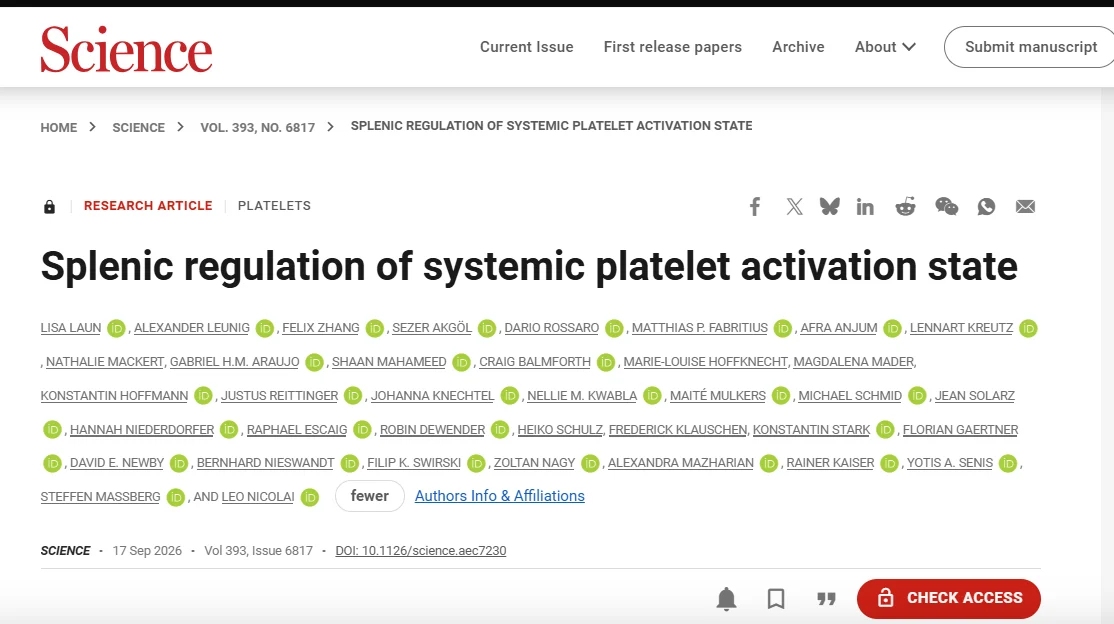
Title: Splenic regulation of systemic platelet activation state
Authors: Lisa Laun, Alexander Leunig, Felix Zhang, Sezer Akgöl, Dario Rossaro, Matthias P. Fabritius, Afra Anjum, Lennart Kreutz, Nathalie Mackert, Gabriel H.M. Araujo, Shaan Mahameed, Craig Balmforth, Marie-Louise Hoffknecht, Magdalena Mader, Konstantin Hoffmann, Justus Reittinger, Johanna Knechtel, Nellie M. Kwabla, Maité Mulkers, Michael Schmid, Jean Solarz, Hannah Niederdorfer, Raphael Escaig, Robin Dewender, Heiko Schulz, Frederick Klauschen, Konstantin Stark, Florian Gaertner, David E. Newby, Bernhard Nieswandt, Filip K. Swirski, Zoltan Nagy, Alexandra Mazharian, Rainer Kaiser, Yotis A. Senis, Steffen Massberg, Leo Nicolai
Stay updated on all scientific advances with Hemostasis Today.
-
Nov 2, 2026, 18:08Jonathan Penm: Antithrombotic Stewardship Optimizes VTE Prophylaxis in ICU Patients
-
Nov 2, 2026, 14:48Heghine Khachatryan: Vitamin B12 Replacement Choosing the Right Route for Each Patient
-
Nov 2, 2026, 14:28Anastasia Conti: ASH Global Research Award Backs New Directions in AML Research
-
Nov 2, 2026, 14:22Sara Zalghout: Linking Bacterial Virulence to NETosis and Thromboinflammation
-
Nov 2, 2026, 13:58Functional Iron Deficiency: From Iron Sequestration to Therapeutic Targeting
-
Nov 2, 2026, 13:56Jan Terje Andersen: Albumin Engineering Opens New Routes for Erythropoietin Delivery
-
Nov 2, 2026, 13:44Rishiraj Sinha: Strengthening ISBT–AABB Collaboration in Transfusion Medicine
-
Nov 2, 2026, 13:28Jeremiah Morris: Why Blood Detection Reagents Work Better on Dry Bloodstains
-
Nov 2, 2026, 12:38Maria Τektonidou: Machine Learning – A New Approach to CVD Risk in SLE