


Pedro Perez: “Provoked” VTE May Not Always Mean the Risk Disappears When the Provoking Event Does
Pedro Perez, Southeast Vascular Sales Manager at Argon Medical Devices, Inc., shared a post on LinkedIn about a recent article Andrew Peseski et al., published in Blood Advances, adding:
“‘Provoked’ VTE may not always mean the risk disappears when the provoking event does.
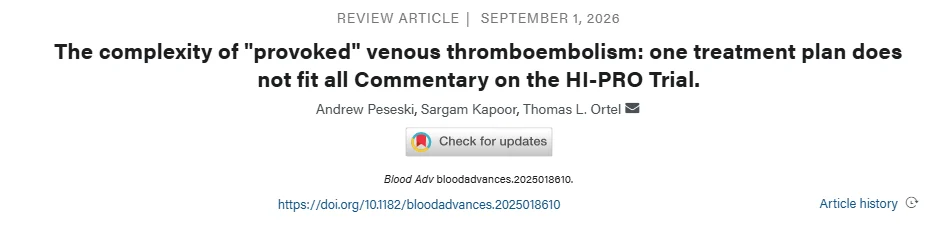
A timely September 2026 commentary in Blood Advances highlights results from the HI-PRO trial, which examined patients with a provoked VTE who also had persistent risk factors.
Extended thromboprophylaxis was associated with lower recurrent VTE, challenging the traditional assumption that every provoked DVT or PE should automatically follow the same time-limited anticoagulation strategy.
This aligns with a broader shift in VTE care: treatment duration is becoming increasingly individualized around recurrence risk versus bleeding risk, rather than simply labeling an event ‘provoked’ or ‘unprovoked.’
The 2026 American College of Cardiology scientific statement on DOACs similarly emphasizes contemporary evidence for individualized thromboembolic management.
The question may no longer be just ‘What caused the clot?’ but also ‘What risk remains after the initial cause is gone?’
Could better identification of persistent risk factors change how we define—and treat—provoked VTE?”
Title: The complexity of “provoked” venous thromboembolism: one treatment plan does not fit all Commentary on the HI-PRO Trial.
Authors: Andrew Peseski, Sargam Kapoor, Thomas L. Ortel
Other posts featuring Pedro Perez on Hemostasis Today.
-
Sep 25, 2026, 20:01Anand Gupta: Timing of DOAC Initiation in Newly Diagnosed Atrial Fibrillation
-
Sep 25, 2026, 19:56Steven Fein: A History of Blood Clots Doesn’t Mean a Healthy Pregnancy Is Out of Reach
-
Sep 25, 2026, 19:53Kemal Karaagac: Calcitriol May Reduce Thrombotic Risk in MASLD
-
Sep 25, 2026, 19:52The SINGLE-AF Trial Anticoagulation for Intermediate Stroke Risk – NEJM
-
Sep 25, 2026, 19:49Shinya Goto: DOAC vs Placebo in Intermediate Stroke Risk of AF in Single Country?
-
Sep 25, 2026, 19:47Bryan Cotton: DOACs Versus Nothing When Stroke Risk Is Not Zero
-
Sep 25, 2026, 19:45Selin Yaman Seval: ITP Is More Than a Low Platelet Count
-
Sep 25, 2026, 19:44Cy R. Wilkins: Treating Chemotherapy-Induced Thrombocytopenia Beyond the Platelet Count
-
Sep 25, 2026, 19:42Mahitap Hossam: What the Platelet Count Cannot Show in ITP