

Huda Salah Eldin: The Challenge of Balancing Antithrombotic Therapy After PCI
Huda Salah Eldin, Certified traineer in clinical pharmacy and critical care at Egyption health council at Egyption Health Council, shared a post on LinkedIn:
“One of the most challenging situations we faced in the CCU: balancing antiplatelet therapy and anticoagulation after PCI.
A patient with a recent myocardial infarction (MI) undergoes PCI with stent placement and requires dual antiplatelet therapy (DAPT).
But what if the patient also has an indication for long-term oral anticoagulation, such as atrial fibrillation (AF) or venous thromboembolism requiring extended treatment?
Combining these medications increases bleeding risk-making the choice and duration of therapy crucial.
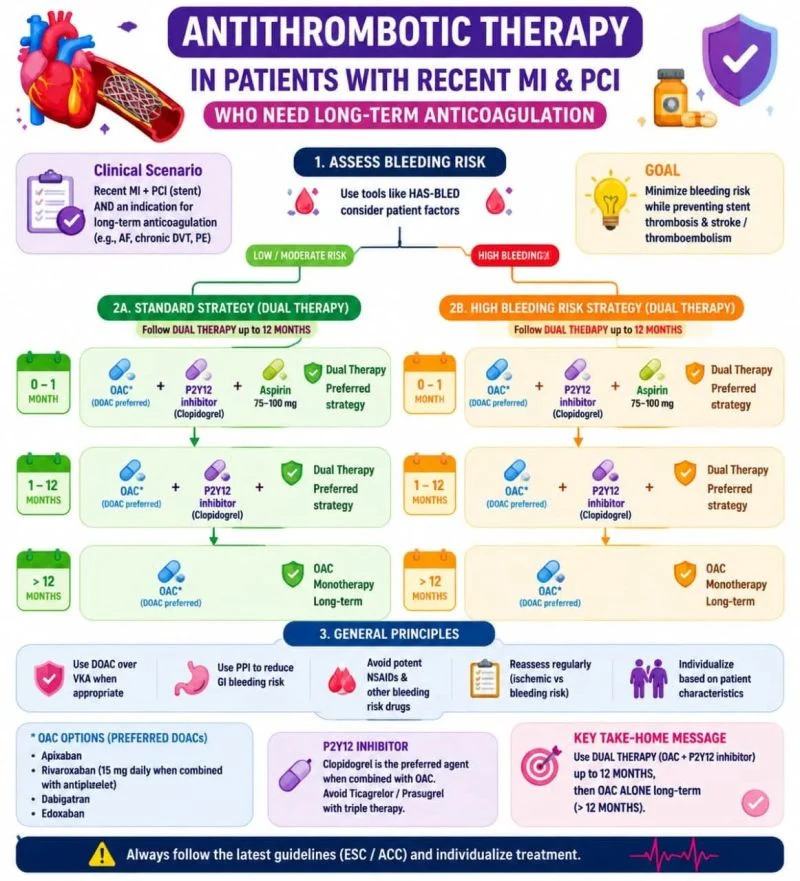
The 2023 ESC guidelines for acute coronary syndromes outline an approach tailored to each patient’s ischaemic and bleeding risks:
1.Initial phase: Triple therapy
- Oral anticoagulant plus Clopidogrel plus Aspirin
The default duration is up to 1 week. This may be extended to 1 month when the risk of stent thrombosis outweighs the bleeding risk.
2.Next phase: Dual antithrombotic therapy
- Stop Aspirin and continue Oral anticoagulant plus Clopidogrel.
Continue for up to 12 months after the acute event. A shorter duration may be considered in selected patients at high bleeding risk.
3.Beyond 12 months: Anticoagulation alone
- Discontinue Clopidogrel and continue the oral anticoagulant alone in most patients with an ongoing indication.
The goal is always to balance protection against stent thrombosis and thromboembolic events with the risk of bleeding.
An individualised treatment plan – and regular reassessment – makes all the difference.
Which factors most influence your decision about the duration of triple therapy in clinical practice?”
Stay updated with Hemostasis Today.
-
Sep 30, 2026, 14:41Bruna Gigante: Balancing Thrombosis and Bleeding in Cardiovascular Care
-
Sep 30, 2026, 14:13Ashok Choudhury: Portal Vein Thrombosis and Outcomes in Cirrhosis
-
Sep 30, 2026, 13:57Leslye Conde Bazán: When Conventional Imaging Is Not Enough – The Role of IVUS
-
Sep 30, 2026, 13:29Abdus Salam: What Can CT Venography Reveal About the Veins?
-
Sep 30, 2026, 13:03Amira Mohy: Diagnostic Flow Cytometry Panels for Hematological Malignancies
-
Sep 30, 2026, 12:52Paul Watton: Could Repetitive Head Impacts Leave a Molecular Memory?
-
Sep 30, 2026, 12:41The Journey to ISTH 2027 Starts in Vancouver
-
Sep 30, 2026, 11:36Basit Ali: A Closer Look at CT Venography
-
Sep 30, 2026, 11:16Christina Pohlman: Could aPL Levels Help Predict Stroke Recurrence?