


Reza Shojaei: The Invisible Crisis, Part 1- Donor Deferral in Whole Blood
Reza Shojaei, Chief Operating Officer at Canadian Plasma Resources, shared a post on LinkedIn:
”How much potential supply disappears between recruitment, appointment, screening, and collection, and why most blood systems cannot tell you.
Note: This is Part 1 of a two-part series on donor deferral, and it covers blood (whole-blood) donors.
Part 2 will cover plasma donors, where visit frequency, screening reasons and the evidence base differ enough to need their own analysis.
On 22 July 2026, Canadian Blood Services reported that the national blood supply had fallen by nearly 20 percent since 1 June, with weekly bookings running 1,500 to 2,500 short of the roughly 18,000 the system needs (Canadian Blood Services, 2026). The call to action was to book an appointment. The executive question is what happens after the booking. In one American Red Cross analysis of 47.8 million donor presentations, 12.8% ended in deferral (Zou et al., 2008). Booking gaps make the news. The leakage between a booked appointment and a collected unit is rarely reported in a form that lets one system be compared with another.
Executive summary
Deferral is the most visible loss in the collection funnel, but not the only one. Supply also leaks between recruitment and booking, booking and attendance, and collection and the next visit. Each loss is small enough to be accepted as normal. Together they are of the same order as the shortfalls that trigger national appeals.
The evidence is consistent. Whole-blood deferral runs at roughly 10% to 16% of presentations (see Figure 2). The damage continues after the visit: in an Australian cohort, 20.9 percent of first-time donors deferred for low haemoglobin returned, against 69.9 percent of non-deferred first-timers (Hillgrove et al., 2011).
The harder finding is about measurement. Deferral rates move with instruments, interviewers, intervals and definitions. At one large U.S. centre, female low-haemoglobin deferrals fell from 12.2 percent in 2016 to 7.7 percent in 2023, then returned to 12.2 percent in 2024 after a new calibrator was introduced (Goel et al., 2026), and a seven-country modelling study estimated that using each repeat donor’s historical mean haemoglobin could cut low-haemoglobin deferrals by 30 percent to 70 percent (Meulenbeld et al., 2026). None of this argues for weaker safeguards. It argues for counting the leak, separating necessary from avoidable deferral, and pairing any target with safety counter-metrics.
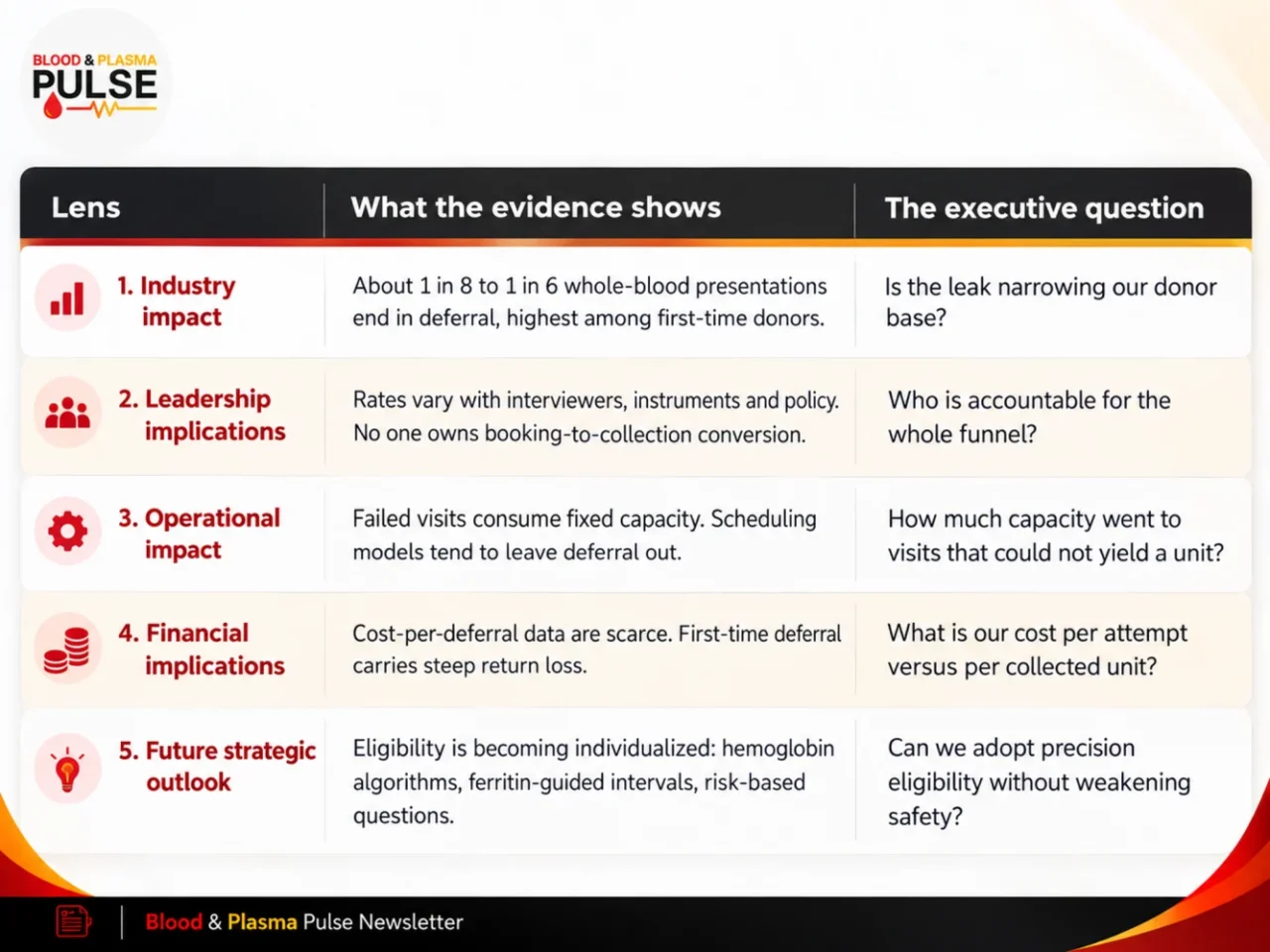
Table 1. The five lenses at a glance
Why this matters now
Recruitment is harder while demand grows. Canadian Blood Services reports that only 2 percent of eligible Canadians donate (Canadian Blood Services, 2025). In the United States, successful first-time donors fell 22.3% between 2019 and 2021 (America’s Blood Centers, 2023). Analysis. When new donors are scarce, the donors most exposed to deferral, first-timers, are the ones a system can least afford to lose.
Eligibility rules are being rewritten. The FDA replaced time-based deferral with individual risk-based questions in 2023 (U.S. Food and Drug Administration, 2023) and, in 2024, issued a compliance policy on donor blood pressure and pulse limits (U.S. Food and Drug Administration, 2024). Each change is a natural experiment that few systems evaluate in funnel terms.
The trade-offs are now measurable. Canadian Blood Services lengthened the female donation interval from 56 to 84 days in 2015 and raised the male minimum hemoglobin in 2017 (Canadian Blood Services, n.d.-b), then began ferritin testing of female donors in 2023. Two years on, 77.5 percent of low-ferritin donors had returned, against 88.5 percent of normal- or high-ferritin donors (Goldman et al., 2026). Protecting donors has a supply price, and it can now be seen.
The issue explained
Deferral is one of four leak points in a conversion funnel.
Recruitment to booking. Recruits who never book. No published cross-system figure found on this point.
Booking to attendance. In an Australian study, 85.07 percent of first-time donors who did not cancel in advance attended their first appointment (Masser et al., 2016).
Attendance to collection. Across 5.6 million presentations at six U.S. centres, 81.2 percent were successful, 5.4 percent unsuccessful, and 13.4 percent ended in deferral, 95.6 percent of them temporary (Custer et al., 2012).
Collection to next visit. Donors lost after a deferral or an unsuccessful visit. The return evidence below shows how large that loss can be.
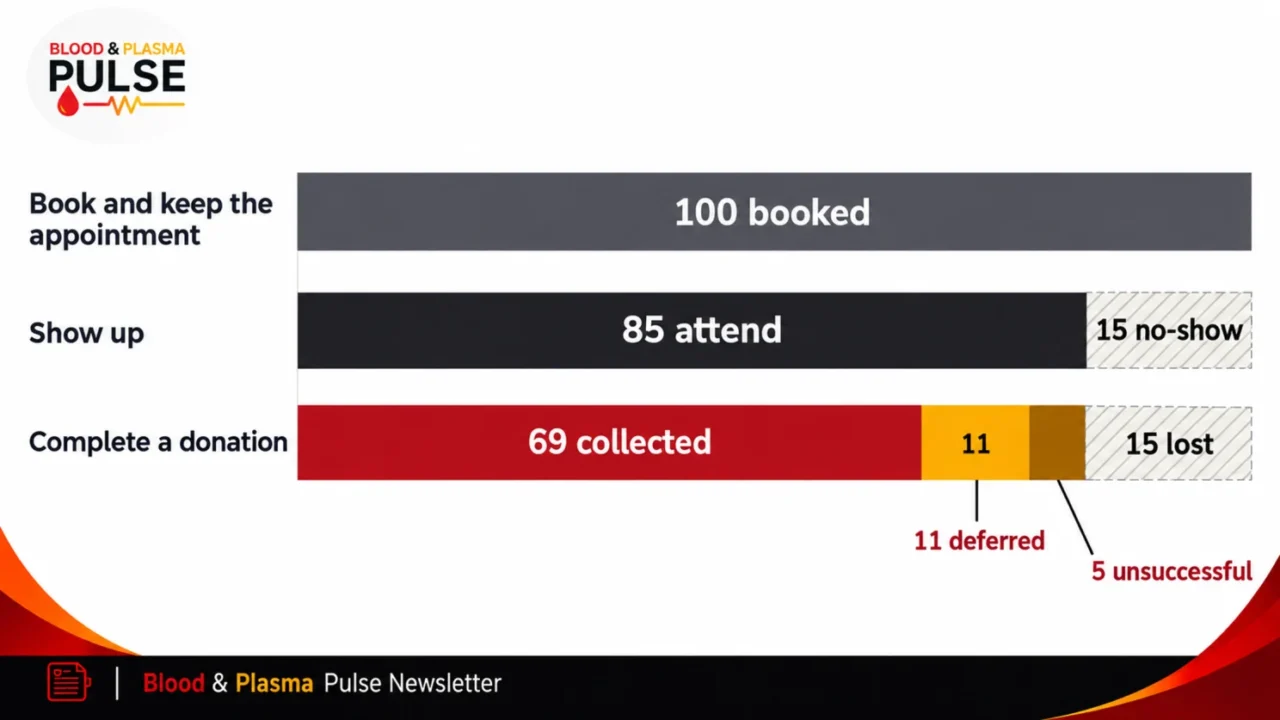
Figure 1. What could happen to 100 booked first-time appointments (illustrative). Assumes 85.07 percent attend (Masser et al., 2016) and, of attendees, 81.2 percent donate, 5.4 percent have an unsuccessful visit and 13.4 percent are deferred (Custer et al., 2012).
Deferral is also not one thing. For a leader, the useful distinction is managerial:
Non-modifiable: Permanent and recipient-safety deferrals. Keep the safeguard; make sure the donor understands and is thanked.
Modifiable by the donor: Iron status, blood pressure, pulse, timing. Prevention and follow-up can recover some of these donors.
Modifiable by the system: Measurement variability, interval policy, interviewer practice, scheduling and information. Operators have the most direct control here.
The evidence
How large is the leak?
Published whole-blood deferral rates cluster around 10 percent to 16 percent of presentations: 10.35 percent of Dutch donor visits (de Kort et al., 2019), 12.8 percent at the American Red Cross (Zou et al., 2008) and 13.4 percent at six U.S. centres (Custer et al., 2012). A ratio that was derived from U.S. national estimates, 2,010,000 deferrals against 12,302,000 presenting donors in 2021, is 16.3 percent (America’s Blood Centers, 2023; Kracalik et al., 2023). The World Health Organization reports a median national deferral rate of 13 percent, with country values from 1 percent to 67 percent (World Health Organization, 2022).
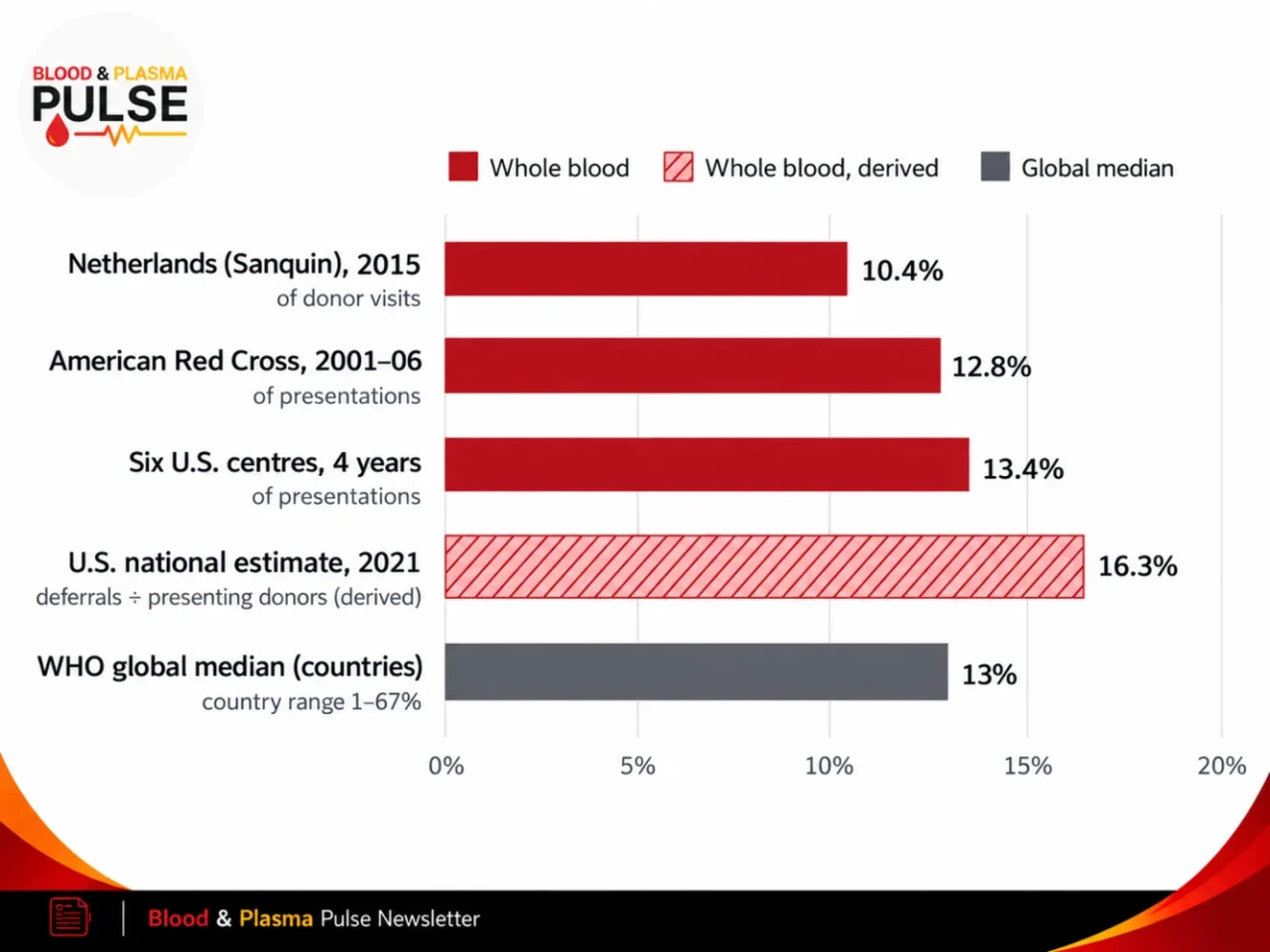
Figure 2. Reported deferral rates differ in period, unit and definition. Sources: de Kort et al. (2019); Zou et al. (2008); Custer et al. (2012); America’s Blood Centers (2023) and Kracalik et al. (2023), derived; World Health Organization (2022).
The reason mix determines the lever.
In the U.S. in 2021, 51.1 percent of deferrals for whole blood were for low hemoglobin or hematocrit, followed by other non-medical reasons (24.6 percent), pulse (6.9 percent), and blood pressure (6.4 percent) (America’s Blood Centers, 2023; Kracalik et al., 2023). Rates also hide who is deferred: from 5.6 percent among repeat male White donors to nearly 40 percent among first-time female Asian donors (Custer et al., 2012).
The loss continues after the visit
In the Netherlands, experienced donors returned at 92 percent after a deferral versus 96 percent when not deferred, but first-time donors returned at 69 percent versus 82 percent (Spekman et al., 2019). In Australia, 20.9 percent of first-time donors deferred for low hemoglobin returned during follow-up versus 69.9 percent of non-deferred first-timers; among repeat donors the figures were 64.0 percent and 91.0% (Hillgrove et al., 2011).
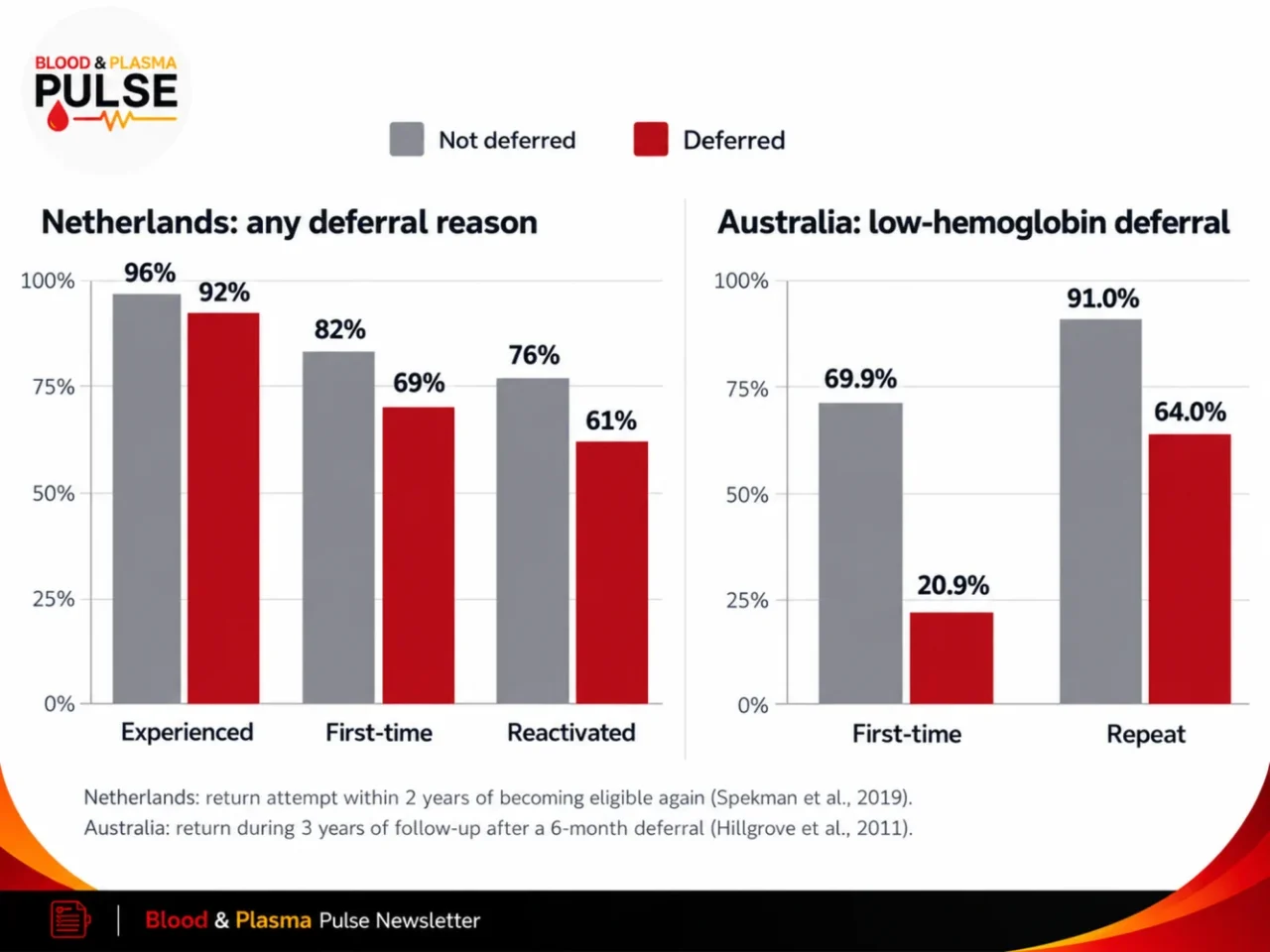
Figure 3. First-time donors bear the return penalty. The two studies use different definitions of return and follow-up, so compare patterns within each panel, not across them.
Variability that is not biology
Some variation is biological. A striking share is operational. In a Dutch study, deferral rates varied substantially among interviewers even after adjustment (de Kort et al., 2019). Longer minimum donation intervals were associated with lower low-hemoglobin deferral rates in women and men (rate ratio 0.53), and iron supplementation in women with a rate ratio of 0.47 (Zalpuri et al., 2020). Janssen (2022) argues that hemoglobin measurement variability drives many unnecessary on-site deferrals, and some donations below the legal minimum. Instruments matter too: after a new calibrator was introduced for some fingerstick haemoglobinometers in 2024, U.S. centres saw a sharp rise in low-haemoglobin deferrals, and the authors recommend treating mean donor hemoglobin as a sentinel metric (Goel et al., 2026).
What has been shown to recover supply
Prepare first-timers. A call-centre contact plus a brochure raised first-appointment attendance by 8.36% at a 2% relative increase in recruitment cost (Masser et al., 2016).
Talk to the deferred donor. In a 30-centre cluster randomised trial, a brochure, guided conversation and email raised the odds of returning within three months of deferral ending; email alone did not (Gemelli et al., 2022).
Stop treating one reading as truth. Modelling estimated 30 percent to 70 percent fewer low-hemoglobin deferrals, and 0.7 percent to 3.3 percent more net donations, from historical-mean hemoglobin, but flagged about 1 percent of current donors with consistently low values. It is retrospective (Meulenbeld et al., 2026).
Tune intervals and iron, and price the trade. In England, a shorter minimum interval had the lowest cost per additional unit (about £10, against an estimated £30 current collection cost) but raised low-hemoglobin deferrals (Willis et al., 2019). In Canada, low-ferritin donors who returned within six months had a 16% hemoglobin deferral rate, against 4.4 percent and 5.2 percent in comparison groups (Goldman et al., 2026).
Evidence limits. Most of this evidence is observational; cross-country comparisons are confounded, and the algorithm evidence is modelling, not trials.
Stakeholder perspectives
Donors. A deferral can read as rejection. Canadian Blood Services tells donors deferred for low hemoglobin that most can improve their iron level and donate successfully (Canadian Blood Services, n.d.-a).
Patients and operators. Patients experience inventory, not funnels: Canadian Blood Services said hospitals were still receiving the blood they needed, but the supply level was not sustainable if the trend continued (Canadian Blood Services, 2026). Operators manage capacity and safety at once, with limited ability to see which deferrals were necessary.
Regulators, funders and advocates. Regulators must hold safety and availability together. Provincial and territorial health ministries primarily fund Canadian Blood Services (Canadian Blood Services, 2026), so funders have a stake in conversion as well as inventory. Advocates want a donor base that reflects patients, which the demographic spread of deferral makes harder (Custer et al., 2012).
Leadership lens
Lens 1: Industry impact
Analysis. Deferral is an industry-wide cost that has been treated as weather. It taxes the scarcest donors, first-timers, most heavily. It narrows the base because the groups with the highest deferral rates are often the ones systems are trying to recruit, and it leans supply on the donors least likely to be deferred (Custer et al., 2012).
Lens 2: Leadership implications
Opinion. Ownership is fragmented. Recruitment owns bookings, scheduling owns capacity, the medical function owns eligibility, and donor care owns retention. Conversion from booking to collection, and from deferral back to donation, is nobody’s number.
Analysis. Treat deferral as a process, not a verdict. Interviewer variance and instrument drift are classic signals of weak process control (de Kort et al., 2019; Goel et al., 2026). Track deferral and mean hemoglobin by site, interviewer, instrument and season, investigate unexpected movement in either direction, and pair every target with counter-metrics such as post-donation hemoglobin and ferritin, adverse events and compliance with legal minimums (Janssen, 2022; Goldman et al., 2026).
Lens 3: Operational impact
Failed visits consume fixed capacity. Illustration. If all 18,000 weekly appointments Canadian Blood Services said it needs were attended and deferral matched the 12.8 percent to 13.4 percent seen in U.S. data, about 2,300 to 2,400 would end in deferral each week, the same order as the booking shortfall of 1,500 to 2,500. I found no published Canadian conversion rate, so this is an assumption to test.
Scheduling models tend to leave deferral out. A study of Canadian Blood Services clinic data built an overbooking model that explicitly excluded expected deferrals (Pond and Turner, 2020). A plan that ignores deferral will overstate realised yield.
Lens 4: Financial implications
The missing number. The only unit-cost anchor that was verified is an England estimate of about £30 to collect a unit of whole blood (Willis et al., 2019). It is not portable, and no comparable published cost per deferral was found. Analysis. That gap is itself a finding: without it, leaders cannot price the trade-offs their eligibility rules create.
Three cost layers. Direct cost is the staff time and consumables of an attempt that yields no unit. Indirect cost is future supply lost from donors who do not return: American Red Cross deferrals were estimated to cost about 1.69 million donors over six years (Zou et al., 2008). Opportunity cost is the collection the chair could have delivered.
Prevention can be cheap. The Australian preparation study raised attendance by 8.36 percent for a 2 percent relative rise in recruitment cost (Masser et al., 2016). Derived. On those numbers, cost per attending first-time donor falls by about 6 percent.
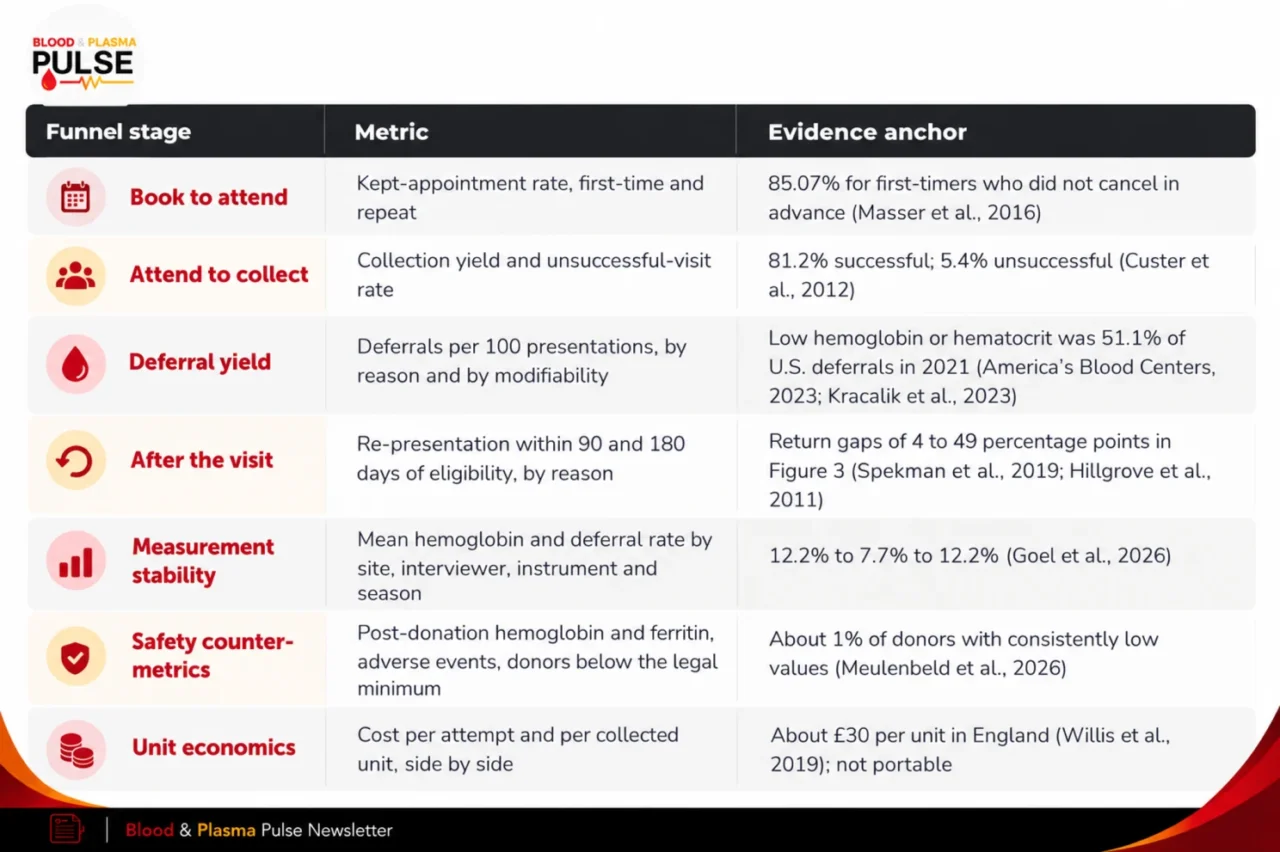
Metric definitions are our recommendations, not published standards. Return gaps are simple differences between the bars in Figure 3.
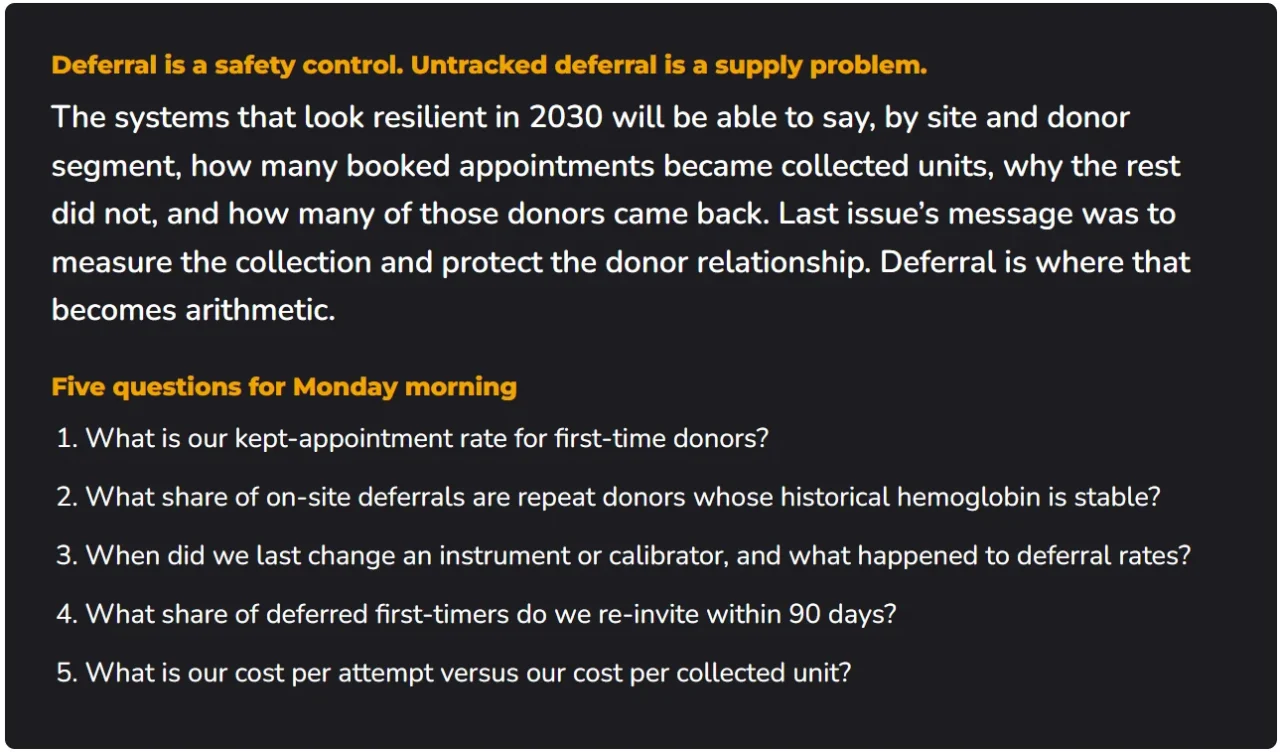
Leadership takeaway
Next week, Part 2: plasma donors. Plasma donors visit far more often, typically lose supply to a different mix of screening reasons, and have a thinner evidence base. Part 2 will apply the same five lenses and the donor conversion ledger to plasma collection.
References
- America’s Blood Centers. (2023, September 18). 2021 NBCUS supplemental data published.
- Canadian Blood Services. (n.d.-a). Low hemoglobin. Retrieved September 20, 2026.
- Canadian Blood Services. (n.d.-b). Donor wellness and iron ferritin testing. Retrieved September 20, 2026.
- Canadian Blood Services. (2025). Spring 2025 [Blood Notes newsletter].
- Canadian Blood Services. (2026, July 22). Blood supply drops 20 percent; donors needed now to replenish lifesaving essentials [News release].
- Custer, B., Schlumpf, K., Simon, T. L., Spencer, B. R., Wright, D. J., and Wilkinson, S. L. (2012). Demographics of successful, unsuccessful and deferral visits at six blood centers over a 4-year period. Transfusion, 52(4), 712–721.
- de Kort, W., Prinsze, F., Nuboer, G., Twisk, J., and Merz, E.-M. (2019). Deferral rate variability in blood donor eligibility assessment. Transfusion, 59(1), 242–249.
- Gemelli, C. N., Kruse, S. P., Thijsen, A., Van Dyke, N., Karki, S., and Davison, T. E. (2022). Improving donor retention following a temporary deferral: A cluster randomized controlled trial of deferral educational materials. Transfusion, 62(6), 1230–1239.
- Goel, R., Bravo, M., Hopkins, C., and Vassallo, R. (2026). Sentinel trends in donor hemoglobin values and low-hemoglobin deferrals in a large US blood center. Transfusion, 66(4), 720–727.
- Goldman, M., Wang, C., Khandelwal, A., and O’Brien, S. F. (2026). Assessment of implementation of ferritin testing on donor return. Transfusion, 66(7), 1358–1365.
- Hillgrove, T., Moore, V., Doherty, K., and Ryan, P. (2011). The impact of temporary deferral due to low hemoglobin: Future return, time to return, and frequency of subsequent donation. Transfusion, 51(3), 539–547.
- Janssen, M. P. (2022). Why the majority of on-site repeat donor deferrals are completely unwarranted… Transfusion, 62(10), 2068–2075.
- Kracalik, I., Sapiano, M. R. P., Wild, R. C., Chavez Ortiz, J., Stewart, P., Berger, J. J., Basavaraju, S. V., and Free, R. J. (2023). Supplemental findings of the 2021 National Blood Collection and Utilization Survey. Transfusion, 63(S4), S19–S42.
- Masser, B., France, C. R., Foot, J., Rozsa, A., Hayman, J., Waller, D., & Hunder, E. (2016). Improving first-time donor attendance rates through the use of enhanced donor preparation materials. Transfusion, 56(6pt2), 1628–1635.
- Meulenbeld, A., Styles, C., Shuttleworth, G., Manathunga, S., van Remoortel, H., Malard, L., Brits, T., Swanevelder, R., García-Erce, J. A., Garcia-Martínez, I., Karki, S., Welvaert, M., Russell, W. A., Arvas, M., van den Hurk, K., Pothast, M., & Janssen, M. (2026). Potential benefits of an alternative haemoglobin deferral strategy evaluated in seven countries. Vox Sanguinis, 121(1), 26–34.
- Pond, G., & Turner, I. (2020). Regression analysis of historical blood donors to improve clinic scheduling. In Proceedings of the 9th International Conference on Operations Research and Enterprise Systems (ICORES 2020) (pp. 344–349). SCITEPRESS.
- Spekman, M. L. C., van Tilburg, T. G., and Merz, E.-M. (2019). Do deferred donors continue their donations? A large-scale register study on whole blood donor return in the Netherlands. Transfusion, 59(12), 3657–3665.
- U.S. Food and Drug Administration. (2023). Recommendations for evaluating donor eligibility using individual risk-based questions to reduce the risk of human immunodeficiency virus transmission by blood and blood products: Guidance for industry.
- U.S. Food and Drug Administration. (2024). Blood pressure and pulse donor eligibility requirements—Compliance policy: Guidance for industry.
- Willis, S., De Corte, K., Cairns, J. A., Zia Sadique, M., Hawkins, N., Pennington, M., Cho, G., Roberts, D. J., Miflin, G., and Grieve, R. (2019). Cost-effectiveness of alternative changes to a national blood collection service. Transfusion Medicine, 29(Suppl. 1), 42–51.
- World Health Organization. (2022). Global status report on blood safety and availability 2021.
- Zalpuri, S., Romeijn, B., Allara, E., Goldman, M., Kamel, H., Gorlin, J., Vassallo, R., Grégoire, Y., Goto, N., Flanagan, P., Speedy, J., Buser, A., Kutner, J. M., Magnussen, K., Castrén, J., Culler, L., Sussmann, H., Prinsze, F. J., Belanger, K., … BEST Collaborative Study Group. (2020). Variations in hemoglobin measurement and eligibility criteria across blood donation services are associated with differing low-hemoglobin deferral rates: A BEST Collaborative study. Transfusion, 60(3), 544–552.
- Zou, S., Musavi, F., Notari, E. P., Rios, J. A., Trouern-Trend, J., and Fang, C. T. (2008). Donor deferral and resulting donor loss at the American Red Cross Blood Services, 2001 through 2006. Transfusion, 48(12), 2531–2539.”
Other posts featuring Reza Shojaei on Hemostasis Today.
-
Oct 2, 2026, 18:34Kamini Khillan: Massive Transfusion Protocol for PPH Management
-
Oct 2, 2026, 18:24Garima Sharma։ GLP-1 Receptor Agonists Across the Reproductive Life Course
-
Oct 2, 2026, 18:13Priya Sriskandarajah: Roginolisib Plus JAK Inhibitors in Myelofibrosis
-
Oct 2, 2026, 17:40Chokri Ben Lamine: A Two-Day Journey Through Modern Hematology at KFSHRC
-
Oct 2, 2026, 16:02Advancing Antithrombotic Stewardship to Optimise Care – American Heart Association
-
Oct 2, 2026, 15:37Pall T. Onundarson: Monitoring Warfarin Beyond Factor VII
-
Oct 2, 2026, 15:26Nicola Carter: World Thrombosis Day Highlights Gender Specific Risks and Prevention
-
Oct 2, 2026, 14:56Wolfgang Miesbach: Direct Comparison Reveals Distinct Mechanisms Among FVIIIa Mimetics
-
Oct 2, 2026, 14:47Strengthening Hemophilia Care Through Advocacy and Partnership – World Federation of Hemophilia