

PAI-1 Inhibition as a New Strategy for Enhancing Fibrinolysis and Clot Resolution
Thrombosis reflects an imbalance between clot formation and clot removal.
While anticoagulants primarily limit thrombin generation and thrombus propagation, fibrinolysis is responsible for degrading fibrin within an established clot.
This has created interest in therapeutic strategies that could actively enhance endogenous clot resolution rather than only prevent further thrombus growth. One emerging approach is inhibition of plasminogen activator inhibitor-1 (PAI-1), an important endogenous regulator of fibrinolysis.
The Fibrinolytic System and the Role of PAI-1
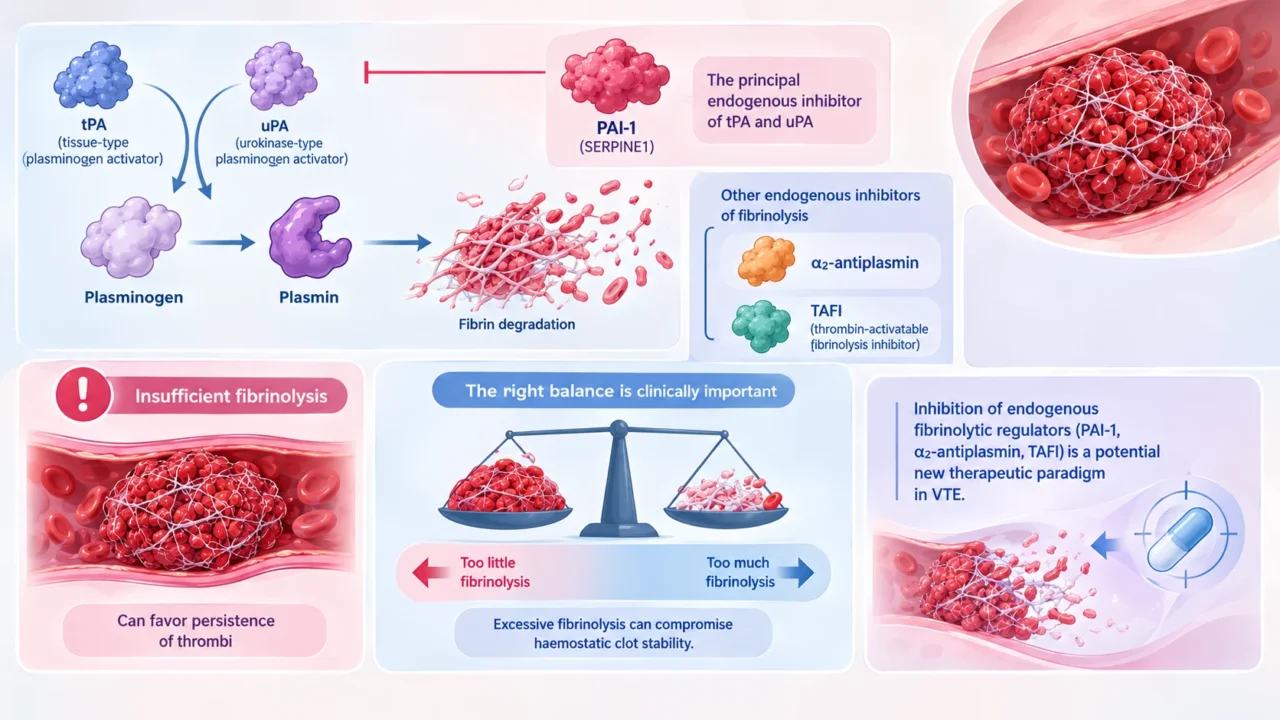
Physiological fibrinolysis depends mainly on tissue-type plasminogen activator (tPA) and urokinase-type plasminogen activator (uPA), which convert plasminogen into plasmin. Plasmin then cleaves fibrin within the thrombus.
PAI-1, encoded by SERPINE1, is the principal endogenous inhibitor of tPA and uPA and therefore acts as an important brake on the initiation of fibrinolysis.
The balance is clinically important: insufficient fibrinolysis can favor persistence of thrombi, whereas excessive fibrinolysis can compromise haemostatic clot stability. PAI-1 is one component of a broader inhibitory network that also includes α2-antiplasmin and thrombin-activatable fibrinolysis inhibitor (TAFI). Recent reviews of VTE therefore describe inhibition of endogenous fibrinolytic regulators as a potential new therapeutic paradigm.
PAI-1, Vitronectin and the Fibrin Surface
PAI-1 does more than circulate freely in plasma. It can bind vitronectin, which stabilizes the active conformation of PAI-1 and can help localize PAI-1 to fibrin-containing environments. This interaction is relevant because active PAI-1 positioned near a fibrin clot can inhibit tPA-mediated fibrinolysis more effectively.
PAI-1 therefore functions as a molecular brake at the first major step of fibrinolysis: plasminogen activation. When PAI-1 activity is increased, less active tPA and uPA are available, reducing plasmin generation and potentially creating a hypofibrinolytic environment.
Elevated PAI-1 has been associated with thrombotic disease, although PAI-1 is also involved in vascular remodeling, inflammation, extracellular-matrix biology and other processes.
Why Target PAI-1?
The therapeutic concept is different from conventional anticoagulation. Rather than primarily reducing thrombin generation, PAI-1 inhibition attempts to enhance the body’s endogenous fibrinolytic capacity. The proposed sequence is PAI-1 inhibition → greater tPA/uPA activity → increased plasmin generation → enhanced fibrin degradation → potentially faster thrombus resolution.
Importantly, a PAI-1 inhibitor does not directly convert plasminogen into plasmin. Instead, it reduces inhibition of endogenous plasminogen activators. This distinguishes the approach mechanistically from pharmacological thrombolysis with exogenous plasminogen activators such as recombinant tPA.
Tiplaxtinin: Experimental Proof of Concept
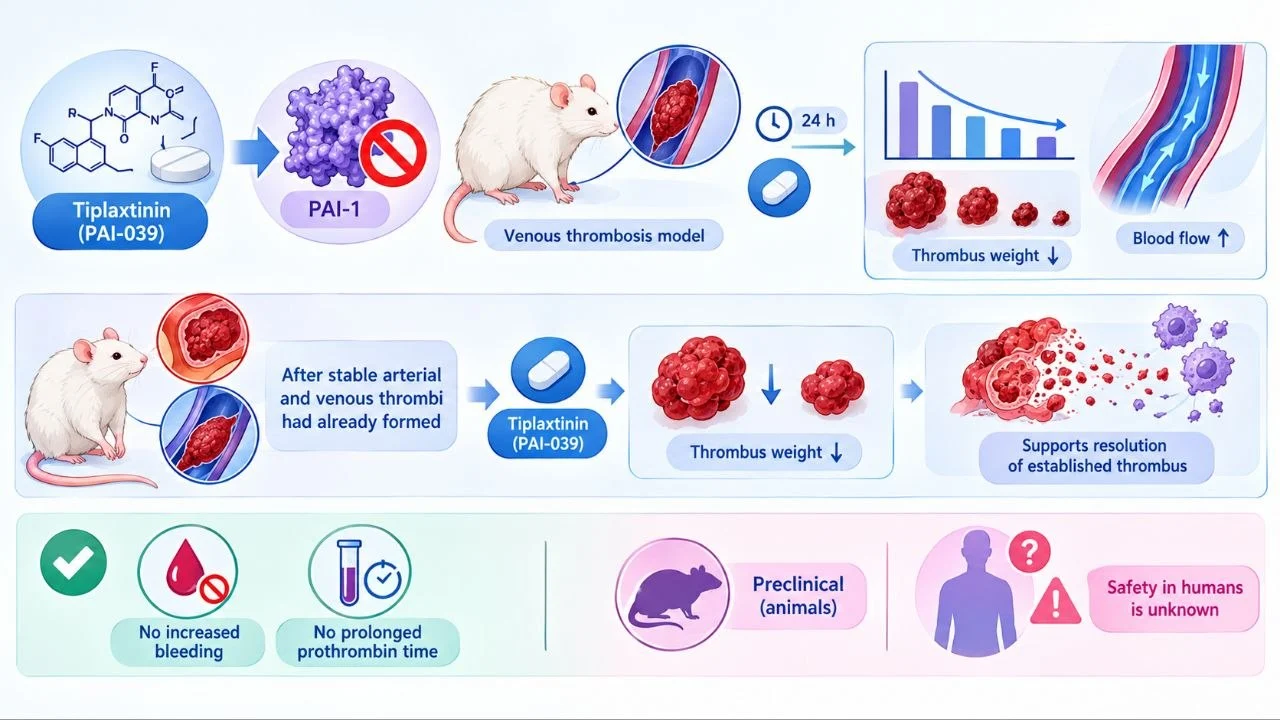
One of the best-studied experimental PAI-1 inhibitors is tiplaxtinin (PAI-039), an orally bioavailable small-molecule PAI-1 antagonist. In a rat model of venous thrombosis, treatment started 24 hours after thrombosis and produced dose-dependent reductions in thrombus weight; treatment was also associated with increased recovery of inferior vena cava blood flow.
Another rat study examined tiplaxtinin after stable arterial and venous thrombi had already formed. Administration after thrombus formation reduced thrombus weight, supporting the concept that PAI-1 inhibition can influence resolution of an established thrombus, rather than acting solely as a thrombosis-prevention strategy.
These findings are mechanistically important but remain preclinical. The reported absence of increased bleeding or prolonged prothrombin time in these animal experiments cannot establish the safety profile of PAI-1 inhibition in humans.
Could PAI-1 Inhibition Offer an Alternative to Conventional Thrombolysis?
Conventional thrombolysis introduces a pharmacological source of plasminogen activation and can produce relatively rapid fibrinolysis, but bleeding is an important limitation. PAI-1 inhibition takes a different approach by attempting to release inhibition of the patient’s own endogenous fibrinolytic system.
The theoretical attraction is therefore not simply “more fibrinolysis,” but more efficient endogenous fibrinolysis without directly administering a large dose of exogenous plasminogen activator. Whether this can provide a clinically meaningful safety advantage over existing thrombolytic or catheter-based approaches remains an open translational question.
The Bleeding Question and the Therapeutic Window
Because PAI-1 physiologically limits fibrinolysis, excessive inhibition could theoretically shift the haemostatic balance toward hyperfibrinolysis and bleeding. Human genetic observations also show that severe PAI-1 deficiency can cause a bleeding phenotype, emphasizing that PAI-1 is not simply a pathological protein that can be eliminated without consequence.
The therapeutic challenge is therefore to achieve sufficient inhibition to improve fibrin clearance while preserving physiological haemostasis. This may depend on the magnitude, duration and tissue distribution of PAI-1 inhibition, issues that remain important obstacles in the development of PAI-1-directed therapies.
From Tiplaxtinin to Human Clinical Research
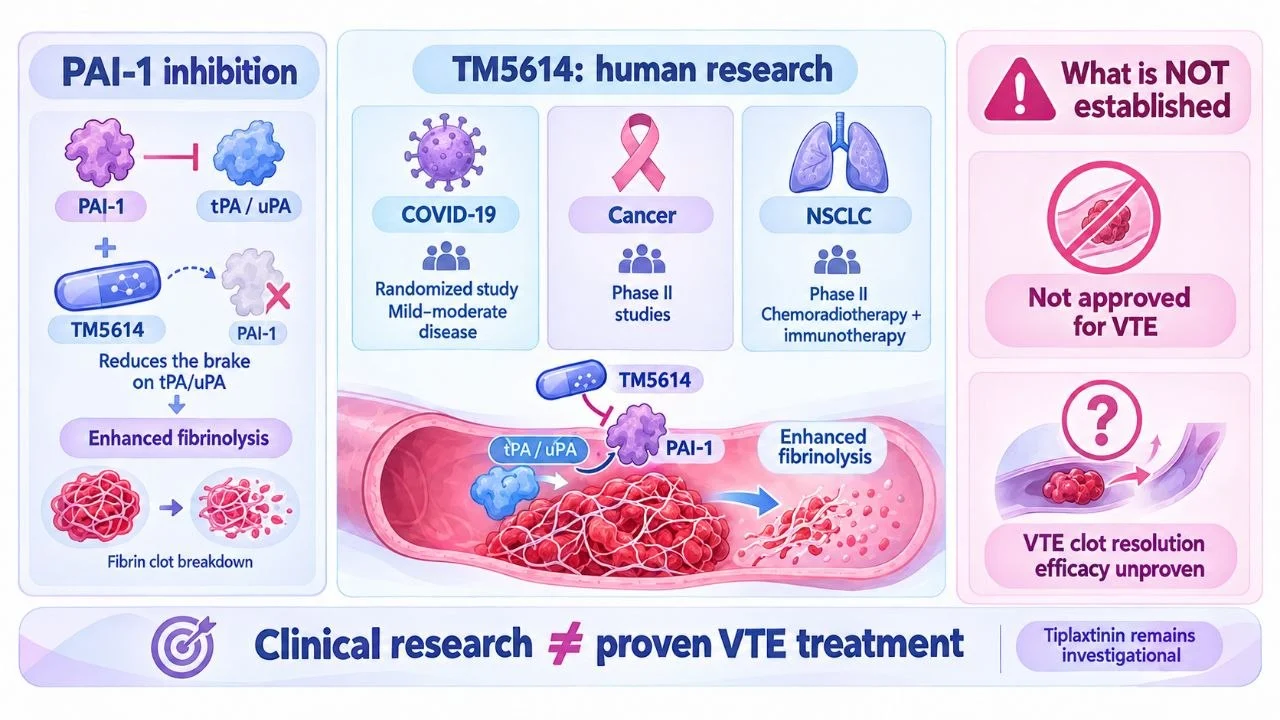
Tiplaxtinin remains an investigational compound and has not become an approved treatment for VTE or thrombus resolution. More recently, another PAI-1 inhibitor, TM5614, has entered human clinical research in several disease settings, providing some clinical experience with pharmacological PAI-1 inhibition.
A randomized clinical study of TM5614 in Japanese patients with mild-to-moderate COVID-19 evaluated safety and clinical outcomes, while other phase II studies have investigated TM5614 in cancer and other conditions. These studies demonstrate that PAI-1 inhibition has progressed into human research, but they do not establish TM5614 as an effective treatment for acute VTE.
As of 2026, a Phase II investigator-initiated study is also evaluating TM5614 in combination with chemoradiotherapy and immune-checkpoint inhibitor consolidation in locally advanced non-small-cell lung cancer. This is a cancer study, not a VTE-treatment trial, and its results cannot be used to claim efficacy for thrombus resolution.
The Current Clinical Gap
Despite a strong biological rationale and encouraging experimental findings, PAI-1 inhibition has not yet become an established treatment for acute VTE or established thrombus resolution. A 2026 state-of-the-art review notes that there are currently no FDA- or EMA-approved therapies specifically targeting PAI-1.
The major unanswered questions are whether PAI-1 inhibition can produce sufficient fibrinolytic enhancement in humans, whether established thrombi can be meaningfully reduced, and whether this can be achieved without clinically important bleeding. These questions require appropriately designed clinical trials rather than extrapolation from animal models.
From Preventing Thrombosis to Promoting Thrombus Resolution
Most established antithrombotic therapies primarily prevent thrombus extension, recurrence or embolization.
PAI-1 inhibition represents a different therapeutic concept: actively enhancing endogenous fibrinolysis to facilitate removal of fibrin from an established thrombus.If this strategy can be successfully translated into clinical practice, PAI-1 inhibition could potentially complement existing antithrombotic approaches.
For now, however, it should be regarded as an emerging research strategy rather than an established therapeutic option for patients with VTE.
The Future of PAI-1 Targeting
PAI-1 sits at the intersection of fibrinolysis, vascular biology, extracellular-matrix remodeling, inflammation, cancer biology and cellular senescence. This biological complexity creates opportunities for therapeutic development but also means that systemic PAI-1 inhibition may have effects extending beyond fibrin degradation.
For thrombosis, the central hypothesis remains straightforward: reducing excessive PAI-1 activity may preserve endogenous tPA and uPA activity, increase plasmin generation and facilitate fibrin clearance. The next step is determining whether this mechanism can be converted into a safe, selective and clinically meaningful treatment strategy.
FAQ
1. What does PAI-1 do?
PAI-1 is an important physiological inhibitor of tPA and uPA. By limiting plasminogen activation, it regulates the rate of plasmin generation and therefore fibrin degradation.
2. Why could PAI-1 inhibition help dissolve thrombi?
Inhibiting PAI-1 may preserve endogenous tPA and uPA activity, allowing greater plasmin generation and potentially accelerating degradation of fibrin within an established thrombus.
3. Is PAI-1 an anticoagulant target?
No. PAI-1 is primarily a regulator of fibrinolysis. Its inhibition is intended to enhance fibrin breakdown rather than directly suppress thrombin generation.
4. What is tiplaxtinin?
Tiplaxtinin, also known as PAI-039, is an orally bioavailable small-molecule PAI-1 antagonist that has demonstrated antithrombotic and profibrinolytic effects in experimental models.
5. Does PAI-1 inhibition directly activate plasminogen?
No. PAI-1 inhibitors act indirectly. They reduce inhibition of endogenous plasminogen activators, allowing tPA and uPA to activate plasminogen more effectively.
6. Can PAI-1 inhibition dissolve an established thrombus?
Preclinical studies suggest that it can promote resolution of established thrombi. However, this evidence comes primarily from experimental animal models and has not yet established clinical efficacy in humans.
7. Could PAI-1 inhibition cause bleeding?
Potentially. Because PAI-1 normally restrains fibrinolysis, excessive inhibition could theoretically promote hyperfibrinolysis. Determining the therapeutic window is therefore an important part of clinical development.
8. Is tiplaxtinin approved for VTE treatment?
No. Tiplaxtinin remains an investigational compound and has not been established as an approved treatment for VTE or thrombus resolution.
9. Is TM5614 being studied in humans?
Yes. TM5614 has entered human clinical research, including a 2026 Phase II study in locally advanced non-small-cell lung cancer. These studies do not establish its efficacy for treating thrombosis.
10. What is the main therapeutic concept behind PAI-1 inhibition?
The goal is to remove an endogenous brake on fibrinolysis. By reducing PAI-1 activity, endogenous tPA and uPA may remain more active, increasing plasmin generation and potentially accelerating physiological clot resolution.
Written by Hermine Sayiyan, MD
Stay updated with Hemostasis Today.
-
Oct 12, 2026, 12:12Jean-Jacques Kiladjian: Improving Treatment Strategies with JAK Inhibitors in Myelofibrosis
-
Oct 12, 2026, 12:04Chloe Homich: AABB Annual Meetings – Building Connections and Advancing Transfusion Medicine
-
Oct 12, 2026, 11:51Daniel Sop: Sickle Cell Research Takes Center Stage at ASCAT 2026
-
Oct 12, 2026, 07:39Emmanuel J Favaloro: 100 Years of von Willebrand Disease and the Importance of Local Diagnosis and Management
-
Oct 12, 2026, 07:39Post-Stroke Fatigue Trajectories – 38% Recovered at 12 Months, While 16% Developed New Fatigue – International Journal of Stroke
-
Oct 12, 2026, 07:28Beth Sara: IBMS Specialist Portfolio Achievement and a New Role in Transfusion Practice
-
Oct 12, 2026, 07:28Abdul Mannan: PCC vs. aPCC – The Small ‘a’ That Changes Emergency Management
-
Oct 12, 2026, 07:20Mokhtar Tazik: Improving Access to Plasma Derived Medicines Through Awareness, Interest and Accessibility
-
Oct 12, 2026, 07:08Larissa Chastain: Partnering to Transform Anticoagulation Management Through INR Self-Testing