


Abdul Mannan: PCC vs. aPCC – The Small ‘a’ That Changes Emergency Management
Abdul Mannan, Consultant Haematologist, Director Haemophilia Centre, Haematology Lab Lead at Betsi Cadwaladr University Health Board, shared a post LinkedIn:
“That small ‘a’ changes the bleeding treatment you choose.
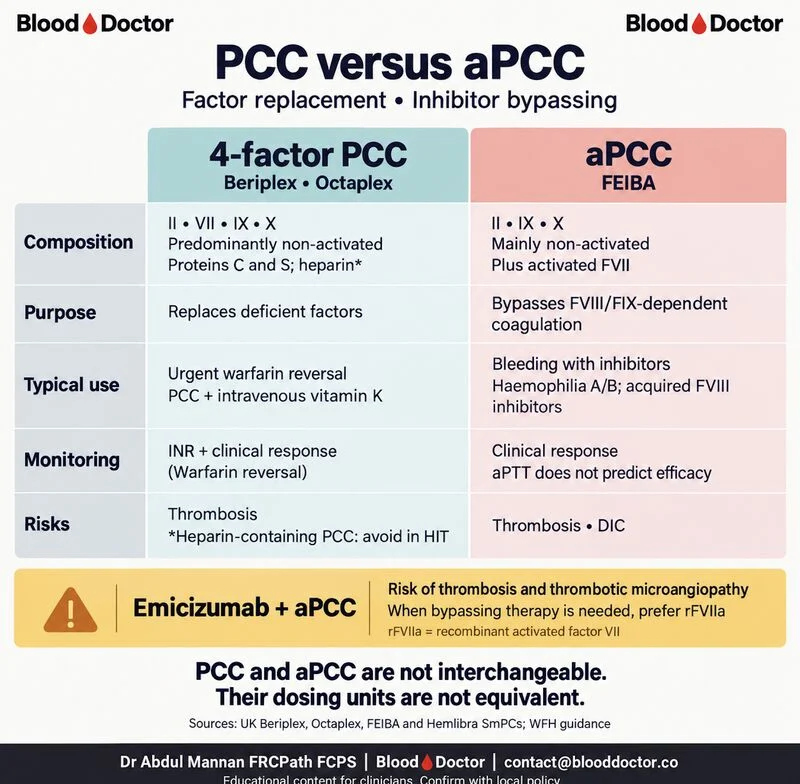
PCC and aPCC have similar names, but different jobs.
Their dosing units are not equivalent.
For trainees, start with the mechanism:
- 4-factor PCC replaces factors II, VII, IX and X, predominantly in their non-activated forms.
Think urgent warfarin reversal, with intravenous vitamin K. Beriplex and Octaplex also contain proteins C and S, plus heparin.
- Activated PCC (aPCC), such as FEIBA, contains mainly non-activated factors II, IX and X, plus activated FVII.
It supports thrombin generation despite FVIII or FIX inhibitors.
- Monitoring differs. Follow INR and clinical response after PCC for warfarin reversal. With FEIBA, assess bleeding clinically: aPTT correction does not reliably predict haemostatic efficacy.
Before choosing a bypassing agent, check whether the patient receives emicizumab.
Combining emicizumab with aPCC can cause thrombosis and thrombotic microangiopathy. For haemophilia A with inhibitors on emicizumab, WFH guidance prefers recombinant activated factor VII (rFVIIa) when bypassing treatment is needed.
PCC and aPCC are not interchangeable.
Check the product, indication and haemophilia centre plan before treatment.
Which part of this distinction causes the most confusion on call?”
More posts featuring Abdul Mannan on Hemostasis Today.
-
Oct 12, 2026, 07:28Beth Sara: IBMS Specialist Portfolio Achievement and a New Role in Transfusion Practice
-
Oct 12, 2026, 07:20Mokhtar Tazik: Improving Access to Plasma Derived Medicines Through Awareness, Interest and Accessibility
-
Oct 12, 2026, 07:08Larissa Chastain: Partnering to Transform Anticoagulation Management Through INR Self-Testing
-
Oct 12, 2026, 06:57Saiful Islam: Laboratory Spot Check – Microcytic Anemias and The Thalassemia Spectrum
-
Oct 12, 2026, 06:45Nick Lenamon: Stroke Awareness at Any Age Recognizing the Signs and Acting FAST
-
Oct 12, 2026, 04:45Aparna Korisetty: Upper GI Bleeding and Severe Anemia Secondary to Duodenal NET
-
Oct 12, 2026, 04:38Aya AlFakih: Why HbA1c Can Be High even When this Morning’s Glucose Looks Normal?
-
Oct 11, 2026, 22:40Bahram Alamdary Badlou: Platelets as First Responders in Hemostasis, Immunity, and Inflammation
-
Oct 11, 2026, 22:22Vipin Singh: New Publication on Hippo-YAP Signaling and Platelet Activation