


Ifeanyichukwu Ifechidere: Cancer, Clotting and Bleeding – The Critical Role of Haemostasis in Oncology
Ifeanyichukwu Ifechidere, Specialist Biomedical Scientist at Sheffield Teaching Hospitals, shared a post on LinkedIn:
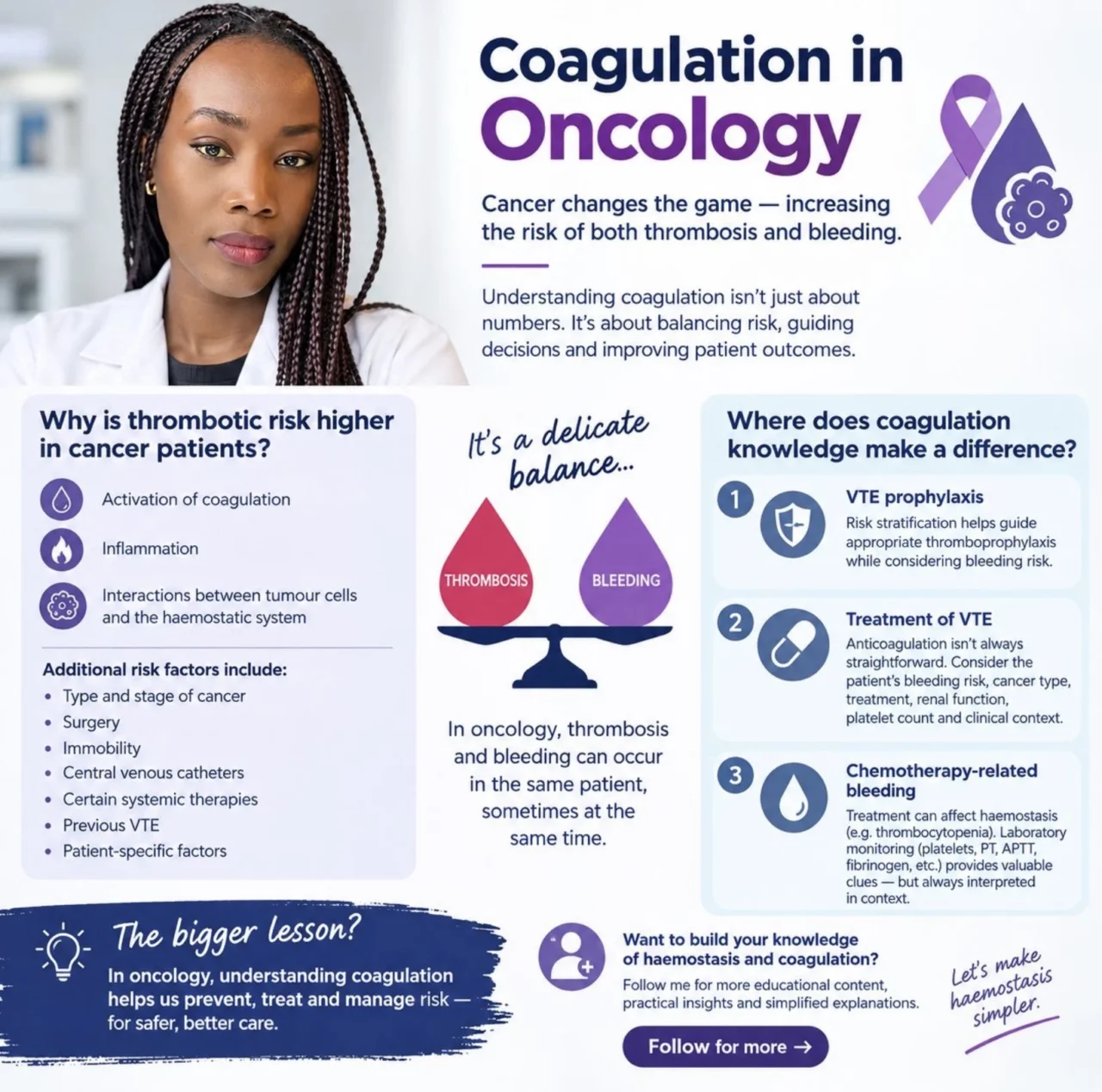
“Cancer, clotting and bleeding: why does coagulation matter so much in oncology?
When we think about cancer, we often think about tumour biology, chemotherapy, radiotherapy and treatment response.
But there is another important piece of the puzzle that can be easy to overlook:
Haemostasis.
Cancer can significantly increase a patient’s risk of venous thromboembolism (VTE), while at the same time, the disease and its treatment can increase the risk of bleeding.
So in oncology, understanding coagulation isn’t just about interpreting a PT or APTT.
It’s about understanding the delicate balance between:
- Thrombosis and
- Bleeding
- Why are cancer patients at increased risk of thrombosis?
Malignancy can promote a prothrombotic state through multiple mechanisms, including activation of coagulation, inflammation and interactions between tumour cells and the haemostatic system.
The risk can be further influenced by:
- Type and stage of cancer
- Surgery
- Immobility
- Central venous catheters
- Certain systemic anticancer therapies
- Previous VTE
- Patient-specific risk factors
This is why VTE risk assessment is an important part of oncology care.
Where does coagulation knowledge become clinically useful?
1) VTE prophylaxis
Not every patient with cancer has the same thrombotic risk or requires the same approach.
Understanding risk helps clinicians make appropriate decisions about thromboprophylaxis while considering bleeding risk.
2) Treatment of VTE
When a patient with cancer develops DVT or pulmonary embolism, anticoagulation may be required.
But the decision isn’t simply:
‘Clot equals giving an anticoagulant.’
The patient’s bleeding risk, cancer type, treatment, renal function, platelet count and clinical circumstances all matter.
3) Chemotherapy-related bleeding
Cancer treatment can affect haemostasis in different ways.
For example, treatment-associated thrombocytopenia can significantly increase bleeding risk.
This is where laboratory monitoring becomes particularly valuable.
A platelet count, PT, APTT, fibrinogen and other haemostatic investigations can provide important pieces of the clinical picture-but they must always be interpreted in context.
The bigger lesson?
In oncology, thrombosis and bleeding are not separate problems.
They can exist in the same patient, sometimes at the same time.
That makes haemostasis a fascinating—and incredibly important-part of cancer care.
For biomedical scientists, laboratory professionals and clinicians, understanding the principles of coagulation helps us appreciate why the results matter, what questions they can answer, and when further investigation may be needed.
And behind every coagulation result is a patient whose treatment may depend on getting that balance right.
Want to build your knowledge of haemostasis, coagulation and practical laboratory medicine?
Follow me for more educational content breaking down coagulation concepts and making haemostasis easier to understand—one topic at a time.”
Stay updated with Hemostasis Today.
-
Oct 7, 2026, 09:20Maurizio Bertaina: Optimizing Anticoagulation in Temporary Mechanical Circulatory Support
-
Oct 7, 2026, 08:39Pediatric Hematology – Careers in Thrombosis and Blood Disorders – ASH Education
-
Oct 7, 2026, 07:57Edward Lee Carter: When Should Apixaban Become the Default for Acute VTE?
-
Oct 7, 2026, 07:40Annette Bowyer: Exploring New Developments in Thrombin Generation
-
Oct 7, 2026, 07:06Omid Seidizadeh: When Acquired von Willebrand Syndrome Takes Different Paths
-
Oct 7, 2026, 06:49Neeraj Songara: Can a Negative Antibody Screen Be Misleading?
-
Oct 7, 2026, 04:09James P. Crowley: Could the Microbiome Protect Us From Severe EBV Infection?
-
Oct 7, 2026, 03:58Sohanur Rohanman Sohan: Explainable AI for Anemia Prediction Using Machine Learning
-
Oct 7, 2026, 03:00Sandeep Kumar: A Second Chance for a Child with Fanconi Anemia