


Natalie Arnold։ Uncovering Hidden Cardiovascular Risk in Apparently Low-Risk Individuals
Natalie Arnold, Preventive Cardiologist at University Heart and Vascular Center Hamburg, shared a post on LinkedIn about recent articles she and her colleagues co-authored, adding:
”Further evidence that conventionally defined low cardiovascular risk is not negligible.
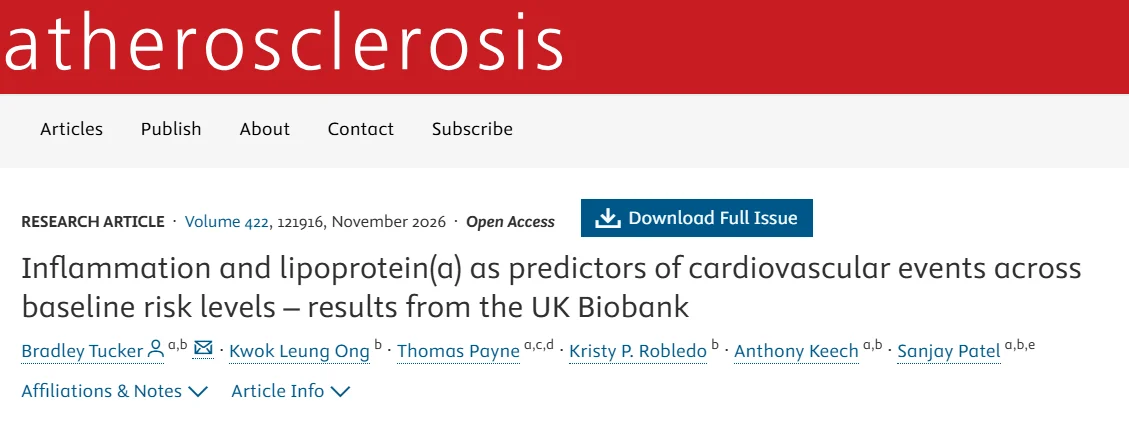
A new UK Biobank analysis published in Atherosclerosis studied more than 240,000 individuals classified as low risk, with a median estimated 10-year cardiovascular risk of only 1.8 percent.
Even in this population, elevated hsCRP and Lp(a) provided important prognostic information beyond conventional risk assessment.
Personally, I am very pleased to see growing research attention being paid to this large population – a group that is still too often assumed to be adequately protected.
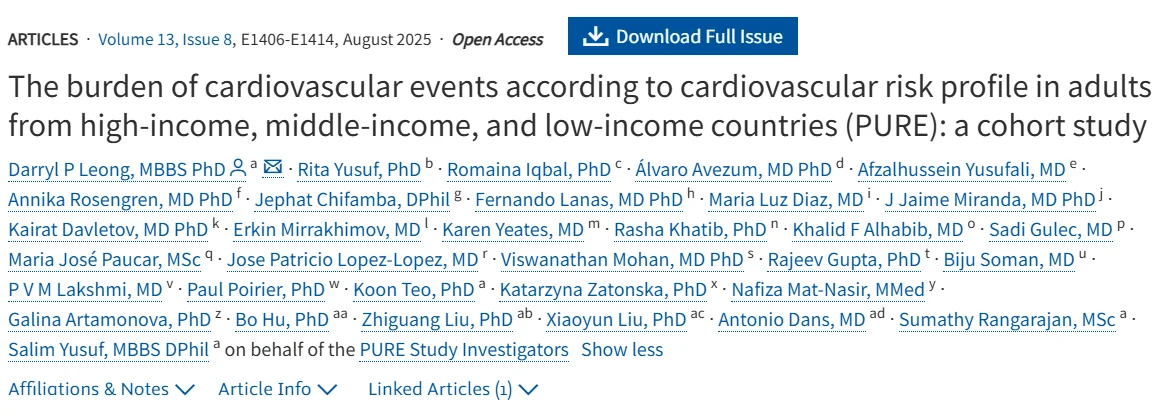
This is highly relevant at the population level: the PURE study showed that 41 percent of cardiovascular events occurred among people without previous cardiovascular disease who had been classified as low risk.
Over the past two years, three investigations from our BiomarCaRE Consortium have consistently pointed to the same conclusion: the apparent low-risk category is biologically heterogeneous, and Lp(a), hsCRP, and triglycerides can reveal part of the cardiovascular risk that conventional assessment leaves hidden.
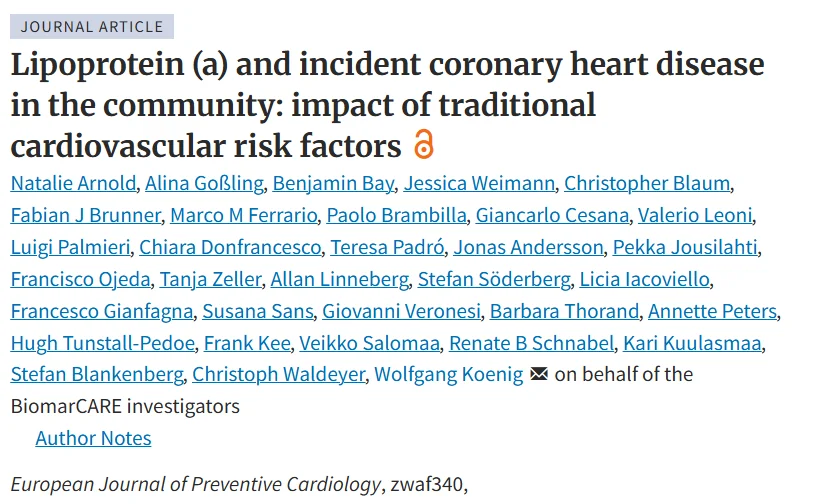
- Lp(a) remained predictive of incident coronary heart disease among individuals with no or only one traditional cardiovascular risk factor
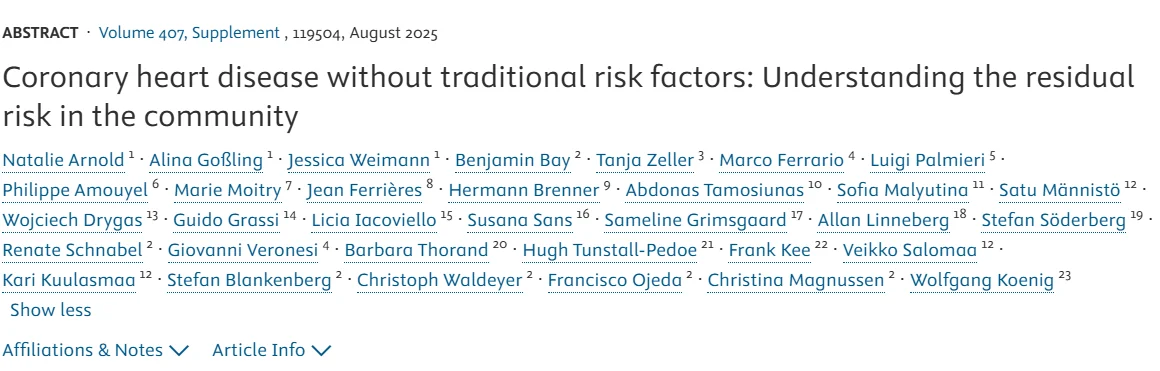
- hsCRP and triglycerides identified residual coronary risk among people with few or no traditional cardiovascular risk factors, including individuals commonly described as SMuRFless
- The combined burden of elevated hsCRP, Lp(a), and triglycerides substantially changed the absolute-risk picture
In other words, these biomarkers may help us identify individuals whose cardiovascular risk is substantially underestimated by traditional risk-factor assessment alone.
Against this background, the topline results from ZEUS and Lp(a)HORIZON should not be misinterpreted as invalidating hsCRP or Lp(a) as risk markers.
These trials examined whether specific interventions could reduce events in selected patient populations – not whether the biomarkers identify cardiovascular risk.
We should wait for the complete results before drawing broader conclusions.
Low conventional risk should not mean low attention.
We need to identify hidden risk earlier and act before the first cardiovascular event occurs.”
Title 1: Inflammation and lipoprotein(a) as predictors of cardiovascular events across baseline risk levels – results from the UK Biobank
Authors: Bradley Tucker, Kwok Leung Ong, Thomas Payne, Kristy P. Robledo, Anthony Keech, Sanjay Patel
Read the Full Article on Atherosclerosis
Title 2: The burden of cardiovascular events according to cardiovascular risk profile in adults from high-income, middle-income, and low-income countries (PURE): a cohort study
Authors: Darryl P Leong, Rita Yusuf, Romaina Iqbal, Álvaro Avezum, Afzalhussein Yusufali, Annika Rosengren, Jephat Chifamba, Fernando Lanas, Maria Luz Diaz, J Jaime Miranda, Kairat Davletov, Erkin Mirrakhimov, Karen Yeates, Rasha Khatib, Khalid F Alhabib, Sadi Gulec, Maria José Paucar, Jose Patricio Lopez-Lopez, Viswanathan Mohan, Rajeev Gupta, Biju Soman, P V M Lakshmi, Paul Poirier, Koon Teo, Katarzyna Zatonska, Nafiza Mat-Nasir, Galina Artamonova, Bo Hu, Zhiguang Liu, Xiaoyun Liu, Antonio Dans, Sumathy Rangarajan, Salim Yusuf
Read the Full Article on The Lancet Global Health
Title 3: Lipoprotein (a) and incident coronary heart disease in the community: impact of traditional cardiovascular risk factors
Authors: Natalie Arnold, Alina Goßling, Benjamin Bay, Jessica Weimann, Christopher Blaum, Fabian J Brunner, Marco M Ferrario, Paolo Brambilla, Giancarlo Cesana, Valerio Leoni, Luigi Palmieri, Chiara Donfrancesco, Teresa Padró, Jonas Andersson, Pekka Jousilahti, Francisco Ojeda, Tanja Zeller, Allan Linneberg, Stefan Söderberg, Licia Iacoviello, Francesco Gianfagna, Susana Sans, Giovanni Veronesi, Barbara Thorand, Annette Peters, Hugh Tunstall-Pedoe, Frank Kee, Veikko Salomaa, Renate B Schnabel, Kari Kuulasmaa, Stefan Blankenberg, Christoph Waldeyer, Wolfgang Koenig
Read the Full Article on European Journal of Preventive Cardiology
Title 4: Coronary heart disease without traditional risk factors: Understanding the residual risk in the community
Authors: Natalie Arnold, Alina Goßling, Jessica Weimann, Benjamin Bay, Tanja Zeller, Marco Ferrario, Luigi Palmieri, Philippe Amouyel, Marie Moitry, Jean Ferrières, Hermann Brenner, Abdonas Tamosiunas, Sofia Malyutina, Satu Männistö, Wojciech Drygas, Guido Grassi, Licia Iacoviello, Susana Sans, Sameline Grimsgaard, Allan Linneberg, Stefan Söderberg, Renate Schnabel, Giovanni Veronesi, Barbara Thorand, Hugh Tunstall-Pedoe, Frank Kee, Veikko Salomaa, Kari Kuulasmaa, Stefan Blankenberg, Christoph Waldeyer, Francisco Ojeda, Christina Magnussen, Wolfgang Koenig
Read the Full Article on Atherosclerosis
Title 5: Incident coronary heart disease, residual risk and traditional cardiovascular risk factors in the community: The role of the lipid-inflammatory axis
Authors: Natalie Arnold, Christina Magnussen, Jessica Weimann, Alina Goßling, Fabian J. Brunner, Marco M. Ferrario, Paolo Brambilla, Giancarlo Cesana, Valerio Leoni, Luigi Palmieri, Chiara Donfrancesco, Teresa Padró, Jonas Andersson, Pekka Jousilahti, Francisco Ojeda, Tanja Zeller, Allan Linneberg, Stefan Söderberg, Licia Iacoviello, Francesco Gianfagna, Susana Sans, Giovanni Veronesi, Barbara Thorand, Annette Peters, Hugh Tunstall-Pedoe, Frank Kee, Veikko Salomaa, Renate B. Schnabel, Kari Kuulasmaa, Stefan Blankenberg, Raphael Twerenbold, Wolfgang Koenig
Read the Full Article on American Journal of Preventive Cardiology
Stay updated on all scientific advances with Hemostasis Today.
-
Oct 11, 2026, 15:31Muhammad Alvi: CASPR Study Explores Treatment Response Across ESUS Phenotypes
-
Oct 11, 2026, 15:15Thalassaemia International Federation Joins ASCAT 2026 to Advance Sickle Cell and Thalassaemia Care
-
Oct 11, 2026, 15:14Challenges and Perspectives on Gene Therapy in Hemophilia A – Seminars in Thrombosis and Hemostasis
-
Oct 11, 2026, 15:07Neysa Rahardjo: Platelet Estimation Pitfalls and Discrepancy Resolution
-
Oct 11, 2026, 15:05Lance Trewhella: Reflections from the ASCLS Region V Fall Symposium
-
Oct 11, 2026, 15:04The Anti-Inflammatory Rationale for GLP-1 Agonists in Hemophilia – CRH French Reference Center for Hemophilia Lyon
-
Oct 11, 2026, 15:00Donja W.: Blood Shortages Aren’t Just Statistics
-
Oct 11, 2026, 14:54Archil Jaliashvili: NHSBT Highlights Persistent Gaps in Matched Blood for Sickle Cell Patients
-
Oct 11, 2026, 14:46Sebastien Lobet: Physiotherapy and Joint Health Across the Spectrum of Bleeding Disorders