


Sanja Seratlic: How Cow Feeding Systems Influence the Anti-Platelet Properties of Cheddar Cheese
Sanja Seratlic, Founder and Director of Plantinnova Ltd., shared a post on LinkedIn about a recent article she and her colleagues co-authored, published in Food Research International: Translational Research, adding:
“Hot off the press!
There’s so much more to cheese than its flavour and texture!
I’m really pleased to see some research I was involved in a while ago now published and available to read.
One of the things I’ve always enjoyed about dairy science is discovering how much is happening beneath the surface of a seemingly familiar food.
In this study, we explored how pasture-based and indoor feeding systems influence the polar lipid composition of Cheddar cheese, and how these differences relate to its anti-platelet properties.
Platelets play an essential role in blood clotting, but excessive platelet activation can contribute to unwanted clot formation and cardiovascular disease.
Interestingly, certain polar lipids found in cheese can inhibit platelet aggregation induced by platelet-activating factor (PAF) in laboratory assays, making their composition and biological activity particularly interesting to investigate.
What makes this even more intriguing is that the cows’ diet matters too — in our study, Cheddar cheese produced from milk of cows grazing white-clover pasture showed significantly greater inhibitory potency against PAF-induced platelet aggregation than cheese from grass-only or indoor feeding systems.
It’s a fascinating reminder that what dairy cows eat can influence not only milk composition, but also the bioactive components of the cheese we eat.
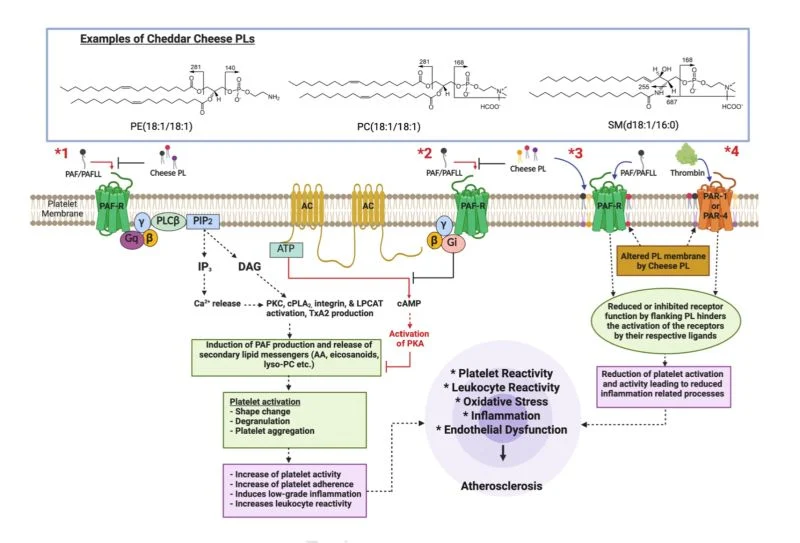
The figure below illustrates some of the proposed mechanisms through which cheese polar lipids may influence platelet activation.
It was a pleasure being part of this research and collaborating with Ronan Lordan, Ioannis Zabetakis, Tom Beresford and the rest of the team. Lovely to see our work published!”
Title: Pasture versus indoor feeding systems differentially affect the composition of polar lipids of Cheddar cheeses and their antiplatelet properties against platelet-activating factor
Authors: Ronan Lordan, Natalia P. Vidal, Thu Huong Pham, Sanja Seratlic, Alexandros Tsoupras, Raymond H. Thomas, Tom F. O’Callaghan, Tom Beresford, Ioannis Zabetakis

Stay updated on all scientific advances with Hemostasis Today.
-
Oct 13, 2026, 21:05Francisco Chacón-Lozsán: Heparin-Induced Thrombocytopenia – When an Anticoagulant Triggers Thrombosis
-
Oct 13, 2026, 21:04Aref Zribi: Isolated Tumor Thrombus and the Role of Prophylactic Anticoagulation
-
Oct 13, 2026, 21:01Alex Larson: Why Normal Bloodwork Does Not Always Tell the Whole Story
-
Oct 13, 2026, 20:58Juan Jauregui-Lozano: How Replication Stress Impairs Red Blood Cell Maturation
-
Oct 13, 2026, 20:55Caitlin Raymond: Understanding Platelet Refractoriness Before Ordering More Platelets
-
Oct 13, 2026, 20:50Ruchika Goel: Cord Blood Red Blood Cells as a Physiologically Aligned Transfusion Strategy
-
Oct 13, 2026, 20:47Sophia Delicou: Strengthening Transfusion Safety Through Advanced Screening and Haemovigilance
-
Oct 13, 2026, 20:45Lydia Pecker: Alloimmunization and Transfusion Indications in Sickle Cell Disease Pregnancy
-
Oct 13, 2026, 15:51Merel Timmer: Hemophilia Twinning Partnership Strengthens Care and Quality of Life in Indonesia