


Thirunavukkarasu Angappan: FVIII vs. FIX Expressive Durability – Key Lessons from GENEr8-1 and HOPE-B Long-Term Data
Thirunavukkarasu Angappan, Vice President – Operations and Manufacturing at PopVax, shared a post on LinkedIn:
“Two Hemophilia Gene Therapies Have Left the Market.
The Data Say Why Durability Is Still Debated.
Two hemophilia gene therapies left the market within 12 months.
Neither exit was about a clinical failure.
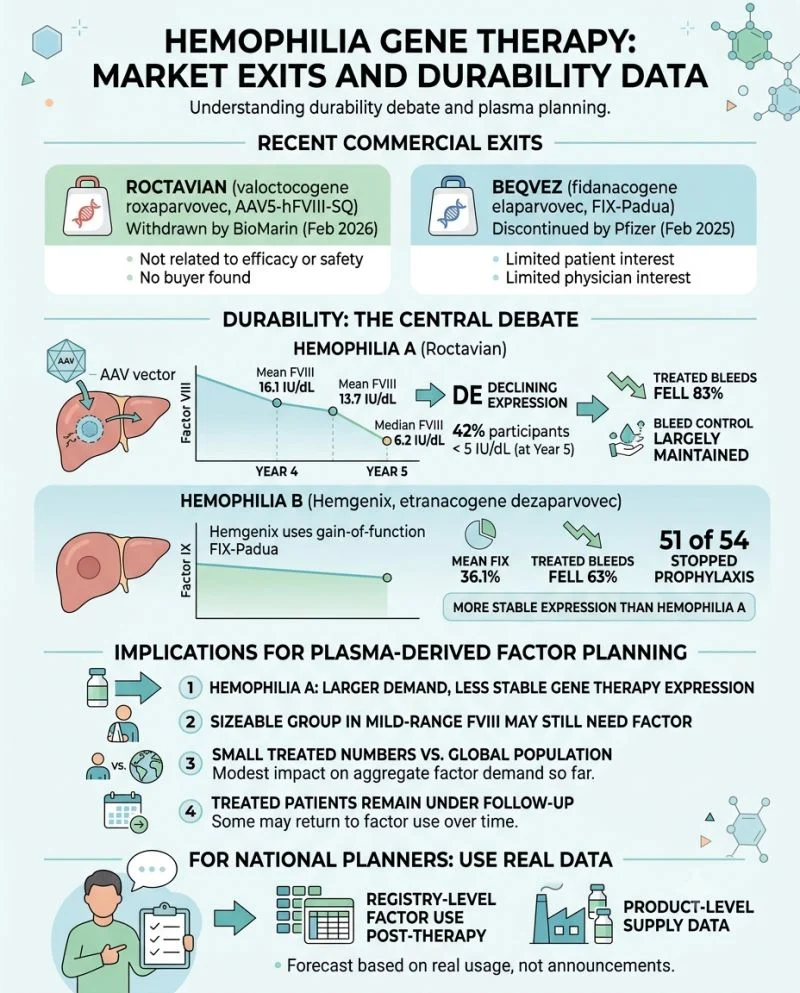
As per BioMarin (Feb 2026), Roctavian (valoctocogene roxaparvovec, an adeno-associated virus [AAV] vector delivering factor VIII [FVIII]) was withdrawn after the company found no buyer. It stated the decision was ‘not related to efficacy or safety.’
As per Pfizer (Feb 2025), Beqvez (fidanacogene elaparvovec, factor IX [FIX]) was discontinued for limited patient and physician interest.
The data show why durability (how long the factor level and bleed protection last) is still debated.
Hemophilia A (Roctavian, GENEr8-1 final results, 134 participants): Mean chromogenic FVIII activity was 16.1 IU/dL at year 4 and 13.7 IU/dL at year 5.
The median was 6.2 IU/dL. At year 5, 55 of 132 participants (about 42%) were below 5 IU/dL.
Yet, in the rollover cohort, treated bleeds fell 83%, and 25 of 134 resumed prophylaxis over follow-up.
Earlier phase 1/2 data showed a gradual FVIII decline, with bleed control largely maintained.
Hemophilia B (Hemgenix, etranacogene dezaparvovec, HOPE-B, 54 participants): As per CSL, mean FIX activity was 36.1% at 5 years, bleeds fell 63%, and 51 of 54 stopped FIX prophylaxis.
Hemgenix uses the gain-of-function FIX-Padua variant.
FVIII has no equivalent in an approved product.
A caution on ‘9-year’ data: The EAHAD (European Association for Haemophilia and Allied Disorders) 2026 report involved four adults given a different vector (scAAV2/8-LP1-hFIXco).
Median FIX was 2% (lower dose) and 13.4% (higher dose), with factor use down about 50%.
It is encouraging, but a very small cohort, and not Hemgenix.
What this means for plasma-derived medicinal product (PDMP) planning:
Hemophilia B shows more stable expression than hemophilia A. Hemophilia A has the larger factor demand.
Gene therapy reduces bleeds in many patients, but a sizeable group sits at mild-range FVIII and may still need factor.
Commercial exits show that uptake, not just biology, sets the impact.
Treated numbers are small relative to the global hemophilia population, so the effect on aggregate factor demand is likely modest so far.
Treated patients remain under follow-up, so some may return to factor over time.
For national planners, demand forecasts for plasma-derived FVIII should track treated patient numbers and post-therapy factor use, not announcements.
Which data would be most useful for your national forecast: registry-level factor use after gene therapy, or product-level supply data?”
More posts with Thirunavukkarasu Angappan on Hemostasis Today.
-
Oct 13, 2026, 15:08Anastasia Chatzistamati: Unilateral Adrenal Haemorrhage in Primary Antiphospholipid Syndrome
-
Oct 13, 2026, 15:08Yousma Khan: Hematology Practical Series Day 11 Reticulocyte Count and Its Role in Anemia Diagnosis
-
Oct 13, 2026, 14:56Manal Rayyan: Multidisciplinary Collaboration in Rare Bleeding Disorders – Reflections from Abu Dhabi
-
Oct 13, 2026, 14:54Kalyan Roy: Understanding Blood Transfusion Sets for Safe Clinical Administration
-
Oct 13, 2026, 14:52Chedia Aroua: When Pharmacokinetics Meets Geophysics – Finding Unlikely Connections in Hemophilia Care
-
Oct 13, 2026, 14:47Mehmet Can Uğur: Honored by the Presence and Mentorship of Prof. Dargaud at Our Congress
-
Oct 13, 2026, 14:40Cheryl Loetscher: This Day in Drug Discovery – Wakix and H3 Receptor Inverse Agonism in Narcolepsy
-
Oct 13, 2026, 14:25Alyaa Al-Mughairy: Highlights from the 8th Omani Society of Hematology Congress
-
Oct 13, 2026, 14:21Britta Diebel: Reflections on an Unforgettable International Plasma Awareness Week