

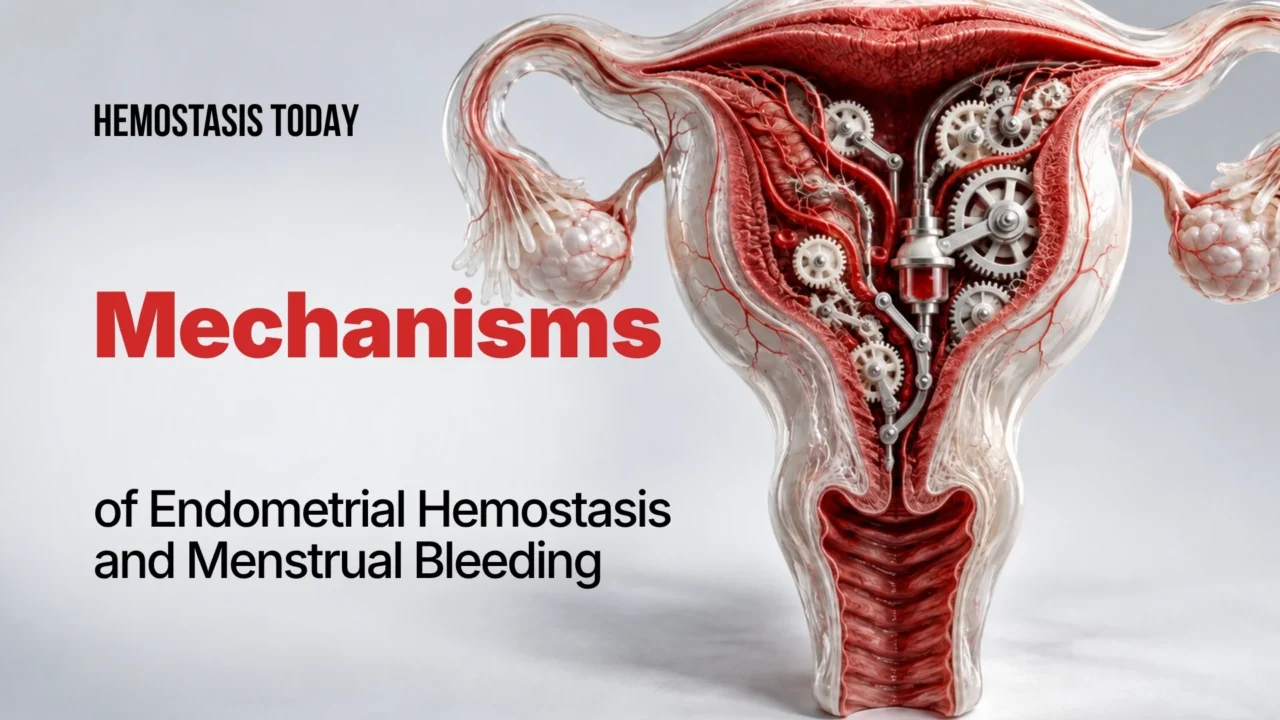
Mechanisms of Endometrial Hemostasis and Menstrual Bleeding
Menstruation is a unique physiological process: each month, the endometrium undergoes controlled inflammation, tissue breakdown, and bleeding—yet this bleeding is normally self-limited and followed by rapid, scar-free repair. This balance depends on precise interactions among ovarian hormones, endometrial blood vessels, platelets, coagulation proteins, fibrinolysis, and immune cells.
When any part of this system is disturbed, menstrual bleeding may become heavy, prolonged, or irregular. Understanding these mechanisms is therefore essential for recognizing and managing abnormal uterine bleeding (AUB), including heavy menstrual bleeding (HMB).
The Endometrial Cycle
The endometrium consists of a superficial functional layer, which proliferates and is shed during menstruation, and a deeper basal layer, which remains intact and supports regeneration. It contains epithelial cells, stromal cells, immune cells, and a specialized vascular network supplied by spiral arterioles.
During the proliferative phase, estradiol promotes endometrial and vascular growth. After ovulation, progesterone transforms the estradiol-primed endometrium into a secretory, decidualized tissue through a process called decidualization, preparing it for possible embryo implantation.
If pregnancy does not occur, the corpus luteum regresses and progesterone levels fall sharply. Progesterone withdrawal is the key trigger for menstruation, initiating inflammation, vascular changes, matrix degradation, and shedding of the functional endometrial layer.
How Menstrual Bleeding Begins
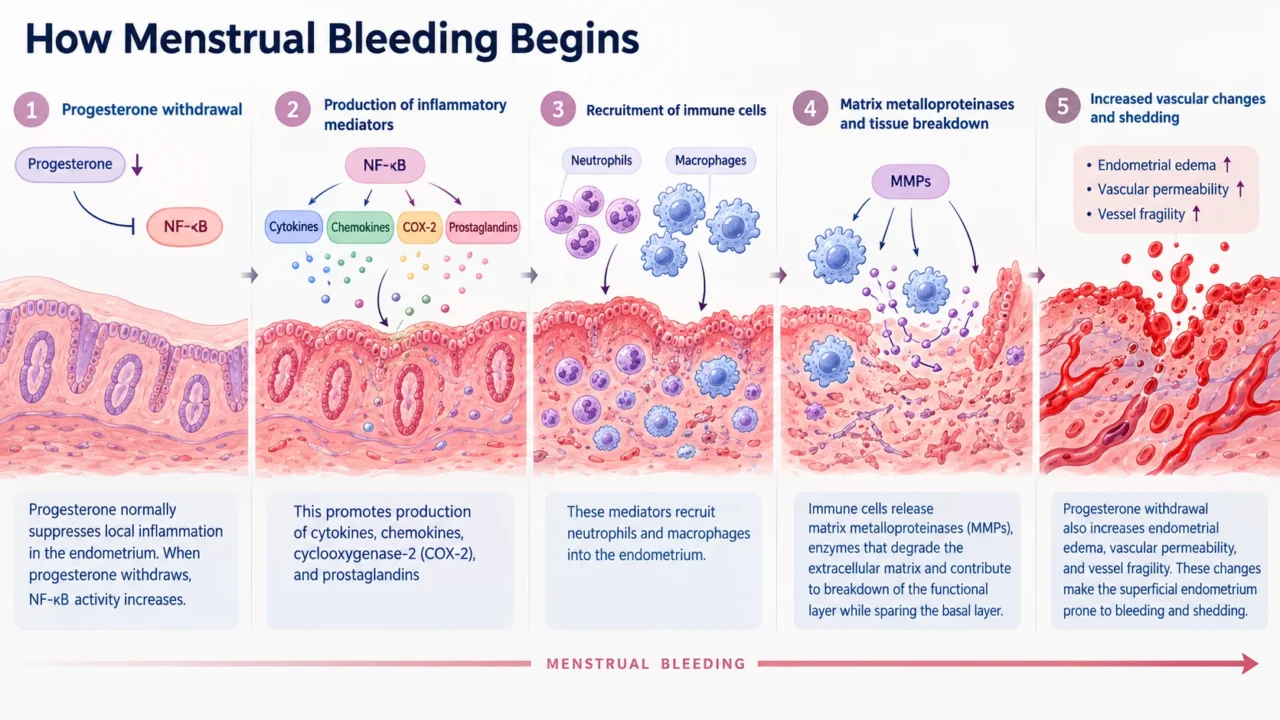
Progesterone normally suppresses local inflammation in the endometrium. When progesterone withdraws, nuclear factor kappa B (NF-κB) activity increases, promoting production of cytokines, chemokines, cyclooxygenase-2 (COX-2), and prostaglandins.
These mediators recruit neutrophils and macrophages into the endometrium. Immune cells release matrix metalloproteinases (MMPs), enzymes that degrade the extracellular matrix and contribute to breakdown of the functional layer while sparing the basal layer.
Progesterone withdrawal also increases endometrial edema, vascular permeability, and vessel fragility. These changes make the superficial endometrium prone to bleeding and shedding.
Vasoconstriction Limits Blood Loss
Spiral arterioles are central to menstrual bleeding control. After progesterone withdrawal, transient but intense vasoconstriction of these vessels reduces blood flow to the superficial endometrium and limits hemorrhage.
Prostaglandin F2α and endothelin-1 promote vasoconstriction, whereas prostaglandin E2 promotes vasorelaxation. Women with heavy menstrual bleeding tend to have a lower PGF2α/PGE2 ratio and reduced FP receptor expression, favoring vasodilation and greater blood loss.
Because vascular resistance depends strongly on vessel radius, even modest failure of arteriolar constriction can substantially increase menstrual blood loss.
Endometrial Hemostasis
Once endometrial vessels are disrupted, hemostasis must rapidly prevent excessive bleeding. The process involves platelet adhesion and aggregation, activation of coagulation, thrombin generation, and formation of a fibrin-rich clot that stabilizes the platelet plug.
Decidualized endometrial stromal cells contribute to this response by producing tissue factor (TF), the principal initiator of coagulation. TF activates factor VII/VIIa, triggering the coagulation cascade and fibrin formation.
Thus, cessation of menstrual bleeding is not due to one mechanism alone; it reflects coordinated platelet plug formation, coagulation activation, fibrin deposition, and vascular constriction.
Fibrinolysis: Preventing Excessive Clotting
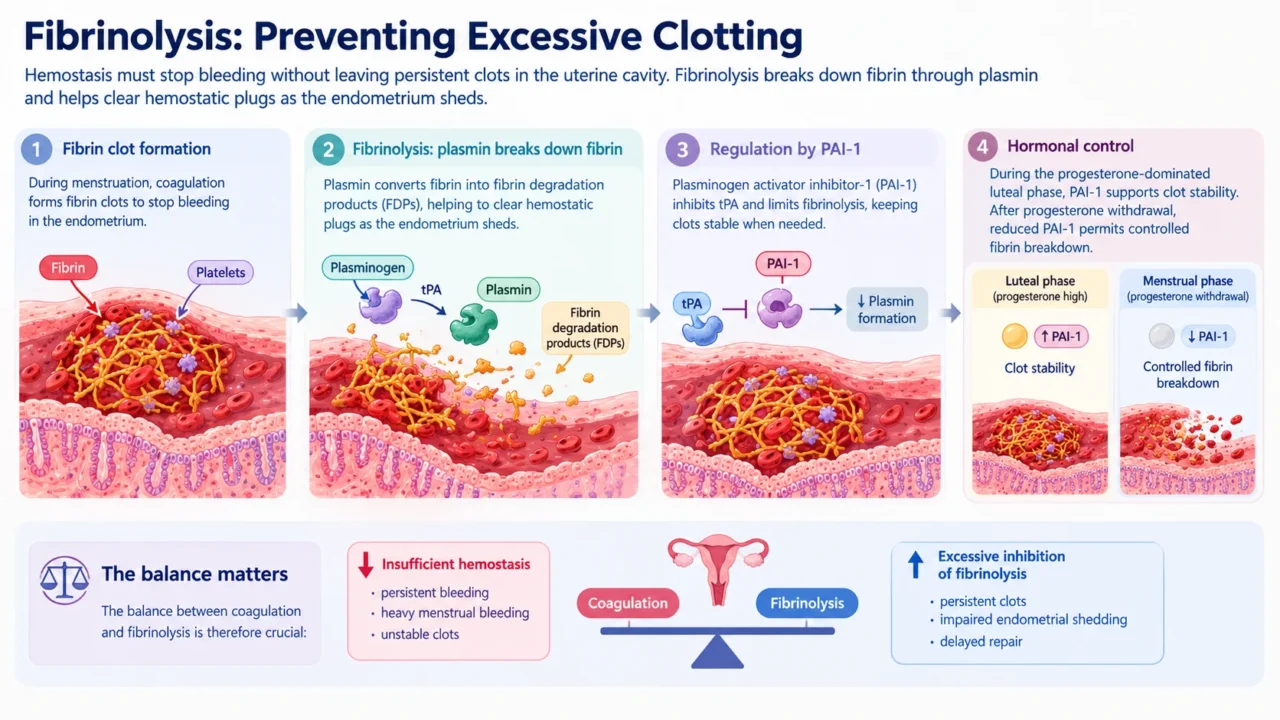
Hemostasis must stop bleeding without leaving persistent clots in the uterine cavity. Fibrinolysis breaks down fibrin through plasmin and helps clear hemostatic plugs as the endometrium sheds.
This system is regulated by inhibitors, especially plasminogen activator inhibitor-1 (PAI-1). During the progesterone-dominated luteal phase, PAI-1 supports clot stability; after progesterone withdrawal, reduced PAI-1 permits controlled fibrin breakdown.
The balance between coagulation and fibrinolysis is therefore crucial: insufficient hemostasis leads to heavy bleeding, while excessive inhibition of fibrinolysis may impair normal endometrial shedding and repair.
Inflammation and Rapid Repair
Menstruation is best viewed as a tightly regulated model of inflammation and tissue repair. Neutrophils increase markedly in the perimenstrual endometrium and contribute to matrix breakdown, while macrophages participate in tissue remodeling and clearance of cellular debris.
Importantly, this inflammatory response is self-limiting. Local glucocorticoid generation, resolution mediators, and regulated leukocyte apoptosis help prevent prolonged tissue injury. Excessive or poorly resolved inflammation has been associated with heavy menstrual bleeding.
Repair begins rapidly after shedding. Endometrial progenitor cells in the basal layer contribute to regeneration of glands and stroma, while angiogenesis and re-epithelialization restore the luminal surface—normally without scarring or loss of function.
Why Abnormal Bleeding Occurs
Heavy menstrual bleeding can arise from systemic coagulation disorders, anovulation, iatrogenic causes, structural uterine pathology, or primary disorders of endometrial hemostasis.
Coagulation disorders, such as von Willebrand disease, impair platelet adhesion or clot formation and can amplify normal menstrual blood loss. Anovulatory cycles, common in polycystic ovary syndrome and perimenopause, lack progesterone, reducing TF and PAI-1 while increasing MMP activity and angiogenesis.
Progestin-only contraceptives may cause local hypoxia and oxidative stress, promoting fragile endometrial vessels despite preserved TF expression. Fibroids, polyps, and adenomyosis can disrupt vascular architecture and promote aberrant angiogenesis, vascular dilation, and focal bleeding.
Primary endometrial dysfunction (AUB-E) involves dysregulated vasoconstriction, hemostasis, inflammation, or repair and is diagnosed after excluding other causes. Heavy menstrual bleeding affects approximately one in four women of reproductive age and can cause iron deficiency, anemia, reduced quality of life, and substantial socioeconomic burden.
Current Guidelines
The most current and widely used clinical guidance for heavy menstrual bleeding (HMB) and abnormal uterine bleeding (AUB) comes from the National Institute for Health and Care Excellence (NICE), the American College of Obstetricians and Gynecologists (ACOG), and the International Federation of Gynecology and Obstetrics (FIGO).
NICE guideline NG88, Heavy Menstrual Bleeding: Assessment and Management, remains the principal active guideline. It was published in 2018, last updated in 2021, and reviewed in 2024. It defines HMB as excessive menstrual blood loss that interferes with a woman’s physical, social, emotional, or material quality of life and recommends a focused history, assessment of anemia and iron status, exclusion of pregnancy, and targeted investigation for structural pathology.
For women with suspected or confirmed submucosal fibroids, polyps, or other focal endometrial pathology, NICE recommends outpatient hysteroscopy. The levonorgestrel-releasing intrauterine system is recommended as first-line pharmacological treatment for women with no identified pathology or with small fibroids that do not distort the uterine cavity.
ACOG guidance is based on the FIGO PALM-COEIN classification. ACOG Practice Bulletin No. 128, Diagnosis of Abnormal Uterine Bleeding in Reproductive-Aged Women, was originally published in 2012 and reaffirmed in 2024. It provides a structured approach to identifying structural causes—polyps, adenomyosis, leiomyomas, and malignancy or hyperplasia—as well as nonstructural causes, including coagulopathy, ovulatory dysfunction, endometrial mechanisms, iatrogenic factors, and unclassified entities.
ACOG Committee Opinion No. 557, Management of Acute Abnormal Uterine Bleeding in Nonpregnant Reproductive-Aged Women, addresses acute, heavy bleeding in hemodynamically stable patients and recommends medical management as the preferred approach when possible.
FIGO’s PALM-COEIN system, introduced by Munro and colleagues in 2018, remains the international standard for classifying AUB in reproductive-aged women. It separates structural from nonstructural causes and provides a practical framework for diagnosis, research, and treatment planning.
Clinical Relevance
These mechanisms explain why treatments for heavy menstrual bleeding often target prostaglandin signaling, fibrinolysis, or progesterone-mediated endometrial stabilization. Nonsteroidal anti-inflammatory drugs reduce prostaglandin-mediated vasodilation and bleeding, while tranexamic acid reduces fibrinolysis.
The FIGO PALM-COEIN system classifies AUB into structural causes—polyps, adenomyosis, leiomyomas, and malignancy or hyperplasia—and nonstructural causes, including coagulopathy, ovulatory dysfunction, endometrial mechanisms, iatrogenic factors, and unclassified entities.
Key Takeaway
Normal menstruation is a controlled, self-limited injury. Progesterone withdrawal initiates endometrial breakdown, while platelet plug formation, coagulation, fibrin deposition, spiral arteriole constriction, and regulated fibrinolysis prevent excessive blood loss. Disruption of these mechanisms can transform physiological menstruation into abnormal uterine bleeding.
Frequently Asked Questions
- Why does the endometrium bleed during menstruation?
Progesterone withdrawal destabilizes the functional endometrial layer, triggering inflammation, matrix breakdown, vascular fragility, and tissue shedding. - What stops menstrual bleeding?
Platelet aggregation, coagulation activation, fibrin formation, and constriction of spiral arterioles work together to limit blood loss. - What is the role of tissue factor in menstrual hemostasis?
Tissue factor initiates coagulation by activating factor VII/VIIa, leading to thrombin generation and fibrin clot formation. - Why is progesterone important for bleeding control?
Progesterone promotes decidualization and supports hemostatic proteins such as tissue factor and PAI-1, helping stabilize the endometrium. - What happens to PAI-1 during menstruation?
PAI-1 decreases after progesterone withdrawal, allowing regulated fibrinolysis and preventing excessive clot persistence. - Why are spiral arterioles important?
They regulate endometrial blood flow; their constriction reduces perfusion to the shedding tissue and helps limit menstrual blood loss. - Can a bleeding disorder cause heavy periods?
Yes. Conditions such as von Willebrand disease can impair platelet function and clot formation, increasing menstrual blood loss. - Why does anovulation cause heavy or irregular bleeding?
Without ovulation, progesterone is not produced; the endometrium remains unstable, poorly hemostatic, and prone to irregular breakdown. - How does the endometrium repair after menstruation?
Basal-layer progenitor cells regenerate glands and stroma, while angiogenesis and re-epithelialization restore the endometrial surface without scarring. - When should heavy menstrual bleeding be evaluated?
When bleeding is heavy, prolonged, irregular, interferes with daily life, or causes anemia symptoms such as fatigue, dizziness, or shortness of breath.
Written by Anna Stepanyan, MD
Stay updated with Hemostasis Today.
-
Oct 21, 2026, 16:19Vanessa Carvalho: New Research on Platelet-Derived Extracellular Vesicles in Preeclampsia
-
Oct 21, 2026, 15:41Women and Hemostasis Across Hormonal Transition
-
Oct 21, 2026, 15:35Danny Hsu: Pharma’s 2025 Blockbusters Through a Hematologist’s Lens
-
Oct 21, 2026, 15:12Yue Zhang: Flow Cytometry for Translational Immunology and Cancer Research
-
Oct 21, 2026, 14:58Radoš Stefanović: How Red Blood Cells Adapt After Exercise
-
Oct 21, 2026, 14:08Vera Ghali: The Role of Hepcidin Assays in Diagnosing Iron Disorders
-
Oct 21, 2026, 13:52Negar Asdaghi: Could Cilostazol Improve Hematoma Clearance After ICH
-
Oct 21, 2026, 10:33Karen Schreiber: Beyond Clinical Outcomes – The Voices of Women with APS
-
Oct 21, 2026, 10:11Tau Braun: Clots Through the Copper-Zinc Model