


10 Posts Not to Miss This Week
This week’s highlights spotlight advances shaping the future of thrombosis and hemostasis, from expanding access to bleeding disorder care to new evidence influencing clinical decisions and patient outcomes.
Explore the latest developments in hemophilia treatment and scientific recognition, the evolving role of prothrombin complex concentrate in cardiac surgery, and the complex relationship between anticancer therapies and thrombotic complications.
Expert perspectives also examine anticoagulation strategies for unusual-site thrombosis and the growing evidence informing DOAC selection in acute venous thromboembolism.
Beyond clinical practice, this edition features a call for collaboration on tranexamic acid in traumatic brain injury, a global contribution to sickle cell disease education, and new insights into managing rare coagulation disorders around surgery.
Discover 10 posts worth your attention this week, bringing together influential research, practical clinical insights and perspectives advancing the fields of thrombosis, hemostasis and bleeding disorders.
Cristina Figueroa Villalba, Assistant Professor at University of Washington Department of Laboratory Medicine and Pathology:
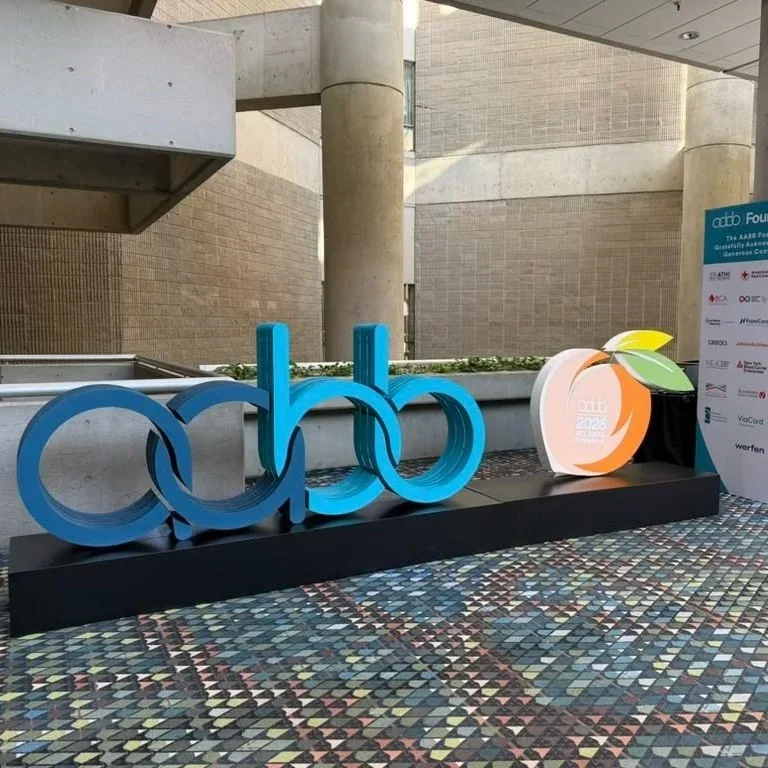
“That’s a wrap on AABB2026!
Incredible days filled with learning, reconnecting with lifelong friends and colleagues, and building new professional connections across transfusion medicine and biotherapies!
A few highlights from this year’s AABB meeting:
Honored to participate in both the Spanish and Pediatric Subsections meetings, and thrilled to be invited to join the Cell Therapy one!
Had a fantastic experience moderating a session with Dr. Gandhi, as well as speaking at the AABB/THOR session focused on ECMO anticoagulation.
So deeply proud of our UW Transfusion Medicine team and trainees for multiple outstanding presentations!
Immensely inspiring to see my first mentor, Meghan Delaney receive the prestigious President’s Award—so well-deserved!
Huge congratulations as well to Don Siegel on receiving the Emily Cooley Memorial Award!
So happy to catch up with my friends from Goodlabs —I remember when it was just Grant’s idea born from his personal experience living with hemochromatosis. The growing impact and innovative drive during their 2nd year with an exhibit booth at AABB is truly motivating and deeply rewarding!
As a proud Argentinian, I couldn’t miss the chance to catch Lionel Messi with a great group of colleagues —watching him play and score 2 goals was an unforgettable team building activity!
Thank you to everyone who made this year’s conference so memorable. Looking forward to continuing these collaborations throughout the year!”
Matthew Hazell, Consultant Clinical Scientist at NHS Blood and Transplant:
“A slightly different AABB 2026 update… this time it was my turn to present!
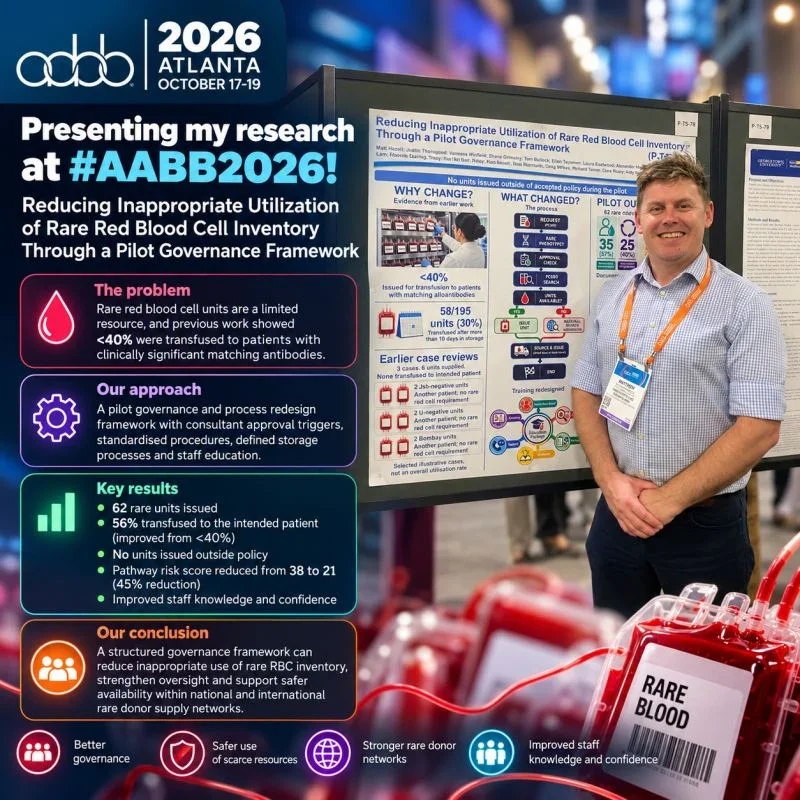
Really pleased to have presented our poster in Atlanta:
‘Reducing Inappropriate Utilization of Rare Red Blood Cell Inventory Through a Pilot Governance Framework’
Rare red cell units are an incredibly valuable and finite resource. Earlier work within NHS Blood and Transplant identified opportunities to improve how some of these units were being requested, allocated and managed.
Rather than simply accepting that as a stock management problem, we redesigned the pathway. We introduced clearer governance, consultant approval triggers, structured clinical discussion, revised processes and targeted staff education.
And the pilot produced some encouraging results:
- 62 rare red cell units issued during the evaluation period
- 56 percent transfused to the intended patient, improving from less than 40 percent previously
- No units issued outside accepted policy
- 25 units successfully reallocated through approved pathways
- Process risk score reduced from 38 to 21, a 45 percent reduction
- Improvements in staff knowledge, process understanding and confidence
For me, the important message is that stewardship of rare blood isn’t simply about having enough units in the refrigerator.
It is about having the governance, clinical oversight, education and processes around those units to make sure that an exceptionally scarce resource is available for the patient who genuinely needs it.
It was great to have the opportunity to share the work internationally at AABB and to discuss how we can continue strengthening rare blood inventory management and resilience.
And, of course, particularly nice to finally stand next to the poster after all the work that went into getting it there!”
Divyaswathi Citla-Sridhar, Associate Professor of Pediatrics and Associate Director at Arkansas Center for Bleeding Disorders:
“Pleased to share our publication in Blood on high-titer FVIII inhibitor formation in 2 patients following AAV gene therapy for hemophilia A.
This highlights a critical lesson: prior FVIII exposure does not guarantee immune tolerance to bioengineered FVIII transgenes.
As gene therapy advances, careful assessment of transgene immunogenicity remains essential.”
Stacy E. Croteau, Medical Director, Boston Bleeding Disorders Center at Boston Children’s Hospital:
“Excited to be kicking off another Haemophilia Academy.
This year marks the 18th annual Haemophilia Academy, bringing together expert faculty and junior physician delegates representing 33 countries around the globe focused on deepening their clinical knowledge base in bleeding disorders and sharing global experiences of the opportunities and challenges in providing and ensuring access to bleeding disorder care.”
Zena Vexler, Professor, Dept of Neurology at University of California, San Francisco:
“Delighted to share that our manuscript was published in Brain:
It has been known for a long time that common infections can trigger arterial ischemic stroke in children.
Unfortunately, there have been no murine models for investigating the underlying mechanisms of this phenomenon.
To examine the consequences of viral priming for childhood arterial ischemic stroke, we first developed a novel model that simulates virus-induced childhood cerebral arteriopathy by administering viral mimetic/TLR3-agonist Poly-IC in juvenile mice and subsequently combined Poly-IC priming with transient middle cerebral artery occlusion three days later.
We first showed that Poly-IC administration rapidly and transiently altered gene expression in brain microvascular cells, priming endothelial and inflammatory responses in juvenile mice before stroke.
This priming led to increased neutrophil accumulation in the brain, neutrophil elastase activation, and NETosis in injured regions after stroke, resulting in marked hemorrhagic transformation.
Poly-IC priming altered the neutrophil phenotypes and caused long-term changes of vascular networks after stroke in juvenile mice.
Inhibiting NE at the time of middle cerebral artery occlusion significantly reduced hemorrhagic transformation and overall injury by attenuating the initiation of the peripheral inflammatory response and limiting neutrophil elastase-mediated NETosis formation in the injured brain. Neutrophil elastase inhibition also altered neutrophil-monocyte interactions in injured juvenile brain.
Together, these findings identify neutrophil elastase/NETosis inhibition as a potential strategy to minimize injury induced by TLR3-mediated viral priming in childhood arterial ischemic stroke.”
Christopher Pittman, Founder and Executive Chairman and Fellowship Program Director at Vein911 Vein Treatment Centers:
“Blood clot prevention cannot end at hospital discharge.
Florida’s first statewide surveillance report identified 96,416 health care encounters involving venous blood clots in a single year.
Behind Florida’s effort is a heartbreaking loss. Emily Adkins was just 23 when she died from a blood clot after an ankle fracture. Her family’s advocacy helped bring about the Emily Adkins Family Protection Act.
As a physician leader specializing in venous and lymphatic medicine, I welcome this progress. Better data should lead to consistent risk assessment, individualized prevention and clear instructions patients can use at home.
Before discharge, every patient and family should be able to answer three questions:
- What is my blood clot risk?
- What is my prevention or treatment plan?
- Which symptoms require urgent action?
Explore the Caprini Risk Score and discuss your results with your health care professional.
New, unexplained leg swelling, pain or warmth needs prompt evaluation. Sudden shortness of breath or chest pain requires emergency care—call 911.
Thank you to the Adkins family for turning their loss into action that can protect others.
Know your risk. Recognize the signs. Have a plan.”
Andrew Choong, Founder and Medical Director of Andrew Choong Vascular Surgery:
“Today is World Thrombosis Day – October 13.
Thrombosis means blood clots.
Blood clotting is normal, essential, and protective: it stops bleeding after cuts, injury, surgery, or trauma.
The danger starts when a clot forms inside a blood vessel where it should not, blocks blood flow, or breaks off and travels to another organ.
Thrombosis contributes to 1 in 4 deaths worldwide.
Arterial clots form in arteries.
They can block oxygen-rich blood to the brain, heart, or leg – causing stroke, heart attack, acute limb ischaemia, or limb-threatening vascular emergencies.
Venous clots form in veins.
The key condition to recognise is deep vein thrombosis, or DVT, usually in the leg.
Signs of DVT:
- One-sided leg swelling
- Calf pain, tenderness, tightness, or cramping
- Warmth, redness, or a heavy painful leg
The major danger is pulmonary embolism, or PE – when part of a clot breaks off and travels to the lungs.
PE can be life-threatening.
Signs of PE – emergency:
- Sudden shortness of breath
- Sharp chest pain, especially on breathing in
- Fast heart rate, collapse, coughing blood, or feeling faint
Risk is higher after surgery, long flights, prolonged sitting or bed rest, cancer, pregnancy, hormone therapy, smoking, obesity, dehydration, previous clots, or inherited clotting conditions.
Prevention starts with movement, hydration, and knowing your risk.
On long flights or after surgery, calf exercises, walking when safe, and medical advice about compression or blood thinners may reduce risk in selected patients.
Seek urgent medical help for PE symptoms.
Get checked early for one-sided leg swelling or calf pain, especially if you have risk factors.
Blood clotting is normal.
Abnormal clotting can be deadly.
Know the signs.
Neda Horvacki, Blood Transfusion Medicine Specialist at the Clinical Transfusion and Blood Bank Service, University Clinical Centre of Serbia:
“Proud to share our recently published research in Vox Sanguinis.
Our study, ‘Rotational thromboelastometry-guided transfusion in acute trauma: Less plasma, greater precision,’ explores the role of ROTEM-guided transfusion in acute trauma and its potential to support a more precise and targeted approach to haemostatic management.
In acute trauma, where every minute and every transfusion decision matters, optimizing blood component therapy is essential.
I’m grateful to have contributed to this work alongside my colleagues and proud to see our research published in Vox Sanguinis.”
Kathleen Freson, Professor at KU Leuven, Chair of the International Society on Thrombosis and Haemostasis (ISTH):
“Kato Ramaekers ‘s review is just out in Haematologica Journal !
This work evaluates the indispensable role of human cell-based platforms in studying megakaryopoiesis and platelet formation to understand rare platelet disorders.
As we navigate a growing landscape of novel genetic variants, these models are vital for establishing clear genotype-phenotype relationships. A perfect model doesn’t exist but we get closer!”
Chaza Alaji, Medical Laboratory Specialist and Supervisor at Privat university-private laboratory-general hospital:
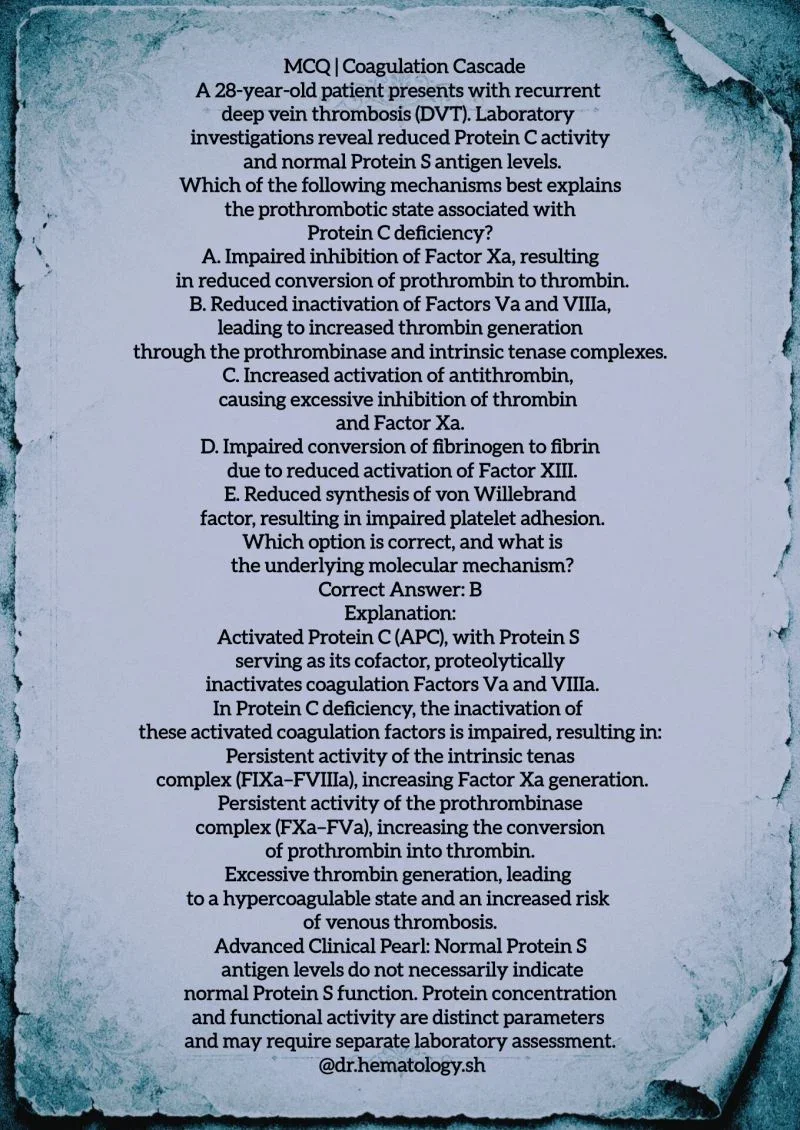
“Protein C and Protein S: Laboratory Assessment and Genetic Diagnosis of Inherited Deficiency:
The balance between coagulation and anticoagulation is essential for preventing pathological thrombosis. Protein C and Protein S are central to this balance, and understanding their biology is critical for accurate thrombophilia assessment.
How Do They Work?
Thrombin bound to endothelial thrombomodulin activates Protein C, with support from the endothelial protein C receptor (EPCR). Activated Protein C (APC), assisted by Protein S, inactivates factors Va and VIIIa, reducing thrombin generation and fibrin formation.
Inherited Deficiency: PROC and PROS1
Pathogenic variants in PROC may cause Protein C deficiency, while variants in PROS1 may cause Protein S deficiency.
Both conditions increase susceptibility to venous thromboembolism, including deep vein thrombosis (DVT) and pulmonary embolism (PE). Severe Protein C deficiency can cause neonatal purpura fulminans.Protein C deficiency is classified as:
Type I: Reduced antigen concentration and activity.
Type II: Reduced functional activity despite a potentially normal antigen concentration.
Protein S deficiency requires careful interpretation of free antigen, total antigen when indicated, and functional activity.
Laboratory Diagnosis: Function First
Assessment may include:
Protein C activity and antigen.
Free Protein S antigen, with total antigen and activity when appropriate.
Acquired conditions can mimic inherited deficiency. Liver disease, vitamin K deficiency, pregnancy, estrogen exposure, and anticoagulant therapy may alter results. Testing must therefore be timed and interpreted according to the clinical context.
Molecular Diagnostics: Beyond Conventional Testing
Modern genetic approaches can clarify selected cases:
- Sanger sequencing: Analysis of specific gene regions.
- Next-generation sequencing (NGS): Assessment of PROC, PROS1, or broader thrombophilia panels.
- MLPA: Detection of certain deletions and duplications that sequencing alone may miss.
- Variant interpretation using ACMG/AMP criteria must be integrated with the patient’s clinical and laboratory findings.
An Important Diagnostic Principle
A genetic variant does not automatically establish disease. A variant of uncertain significance (VUS) is not diagnostic on its own.
Genetic testing complements, rather than replaces, functional and antigenic assays. It is most useful when the clinical presentation, laboratory phenotype, or family history justifies further investigation and when the result may influence management or family assessment.
The Laboratory Take-Home Message
Accurate diagnosis of Protein C and Protein S deficiency requires integration of functional assays, antigen measurements, genetic findings, and clinical context.
The goal is not merely to identify an abnormal result, but to establish whether it represents a genuine inherited deficiency with clinical significance.”
Stay updates with Hemostasis Today.
-
Oct 25, 2026, 13:02Thomas Dayspring: Advancing Cardiovascular Risk Assessment Through Multidisciplinary Lipid Care
-
Oct 25, 2026, 12:46Ahmar U. Zaidi: RISE UP Study on Sickle Cell Disease
-
Oct 25, 2026, 10:32Jan Sloves: Advanced Venous Ultrasound Training in Poland
-
Oct 25, 2026, 10:20Jeff Sternlicht: Rethinking Cardiovascular Prevention Through Atherosclerosis Imaging
-
Oct 25, 2026, 10:12Dino Mehic: PhD Opportunity in Platelet Biology and Bleeding Disorders
-
Oct 25, 2026, 10:00Advancing Hemophilia Care Through Collaboration – WFH
-
Oct 25, 2026, 09:25Blood-Induced Joint Damage in Hemophilia: Beyond Recurrent Hemarthrosis
-
Oct 25, 2026, 05:30Denis Oduor: Whole Blood and Component Therapy in Clinical Practice
-
Oct 25, 2026, 02:18Dai H. Chung: Delivering Lyfgenia to Pediatric Patients With Sickle Cell Disease