

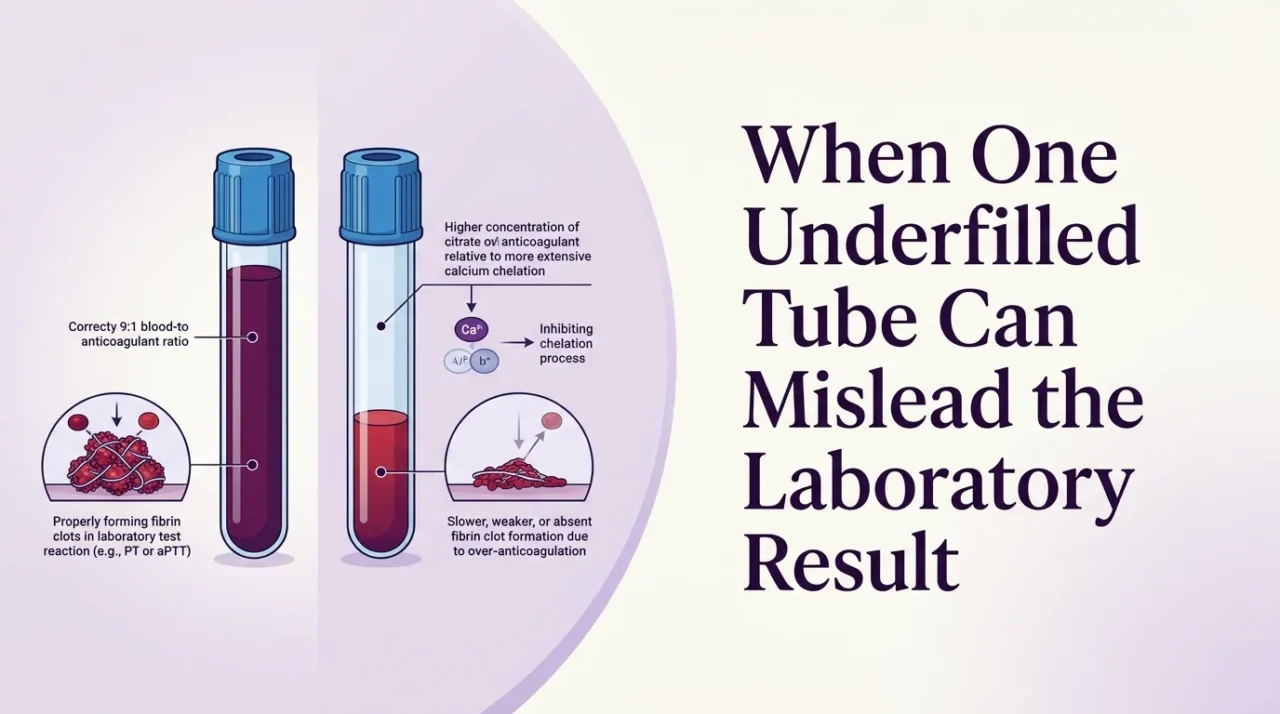
Aisha Suala: When One Underfilled Tube Can Mislead the Entire Laboratory Result
Aisha Suala, Medical Laboratory Scientist at Pediatric Hospital, shared a post on LinkedIn:
“Haematology insights | how underfilled blood collection tubes can distort laboratory results.
An underfilled tube is more than a collection error. Depending on the additive and test, it can distort cell indices, dilute analytes, or interfere with coagulation testing.
The key principle: correct blood volume and the blood to additive ratio matter.
1. Light Blue Top Sodium Citrate (PT INR and aPTT)
Sodium citrate reversibly binds calcium (Ca²⁺), which is essential for coagulation.
Correct ratio: 9 parts blood to 1 part 3.2 percent sodium citrate.
During testing, calcium is added back to initiate clotting.
When the tube is underfilled, excess citrate remains relative to the blood volume.
It can bind some of the calcium added during testing, potentially causing falsely prolonged PT INR and aPTT results.
Check fill volume and reject unacceptable specimens according to laboratory SOPs.
2. Lavender Top — EDTA (Haematology)
EDTA prevents clotting by binding calcium and is used for CBC testing.
Significant underfilling may expose cells to excess EDTA relative to blood volume, potentially affecting RBC size, cell morphology and some automated measurements.
Check specimen acceptability before interpreting unexpected CBC results.
3. Black Top Sodium Citrate (ESR)
Some ESR methods use a 4:1 blood to citrate ratio.
Underfilling increases the proportion of liquid anticoagulant, diluting the specimen and potentially altering sedimentation results.
Follow the specified method and tube fill requirements.
4. Green Top Heparin (Chemistry and Blood Gases)
Excess liquid heparin, particularly in an underfilled blood gas syringe, may dilute the specimen and affect measured analytes. Excess heparin can also lower ionised calcium results.
Use appropriately prepared collection devices and collect the recommended blood volume.
5. Red Gold Top Serum Tubes
Incorrect filling or inadequate clotting may compromise specimen quality.
Residual fibrin can interfere with analyser sampling, while collection related haemolysis may falsely increase potassium, LDH and AST.
Allow adequate clotting before centrifugation and inspect specimen quality.
Final distinction worth remembering
An underfilled tube does not affect every test in the same way.
The impact depends on the additive, specimen volume and analytical method.”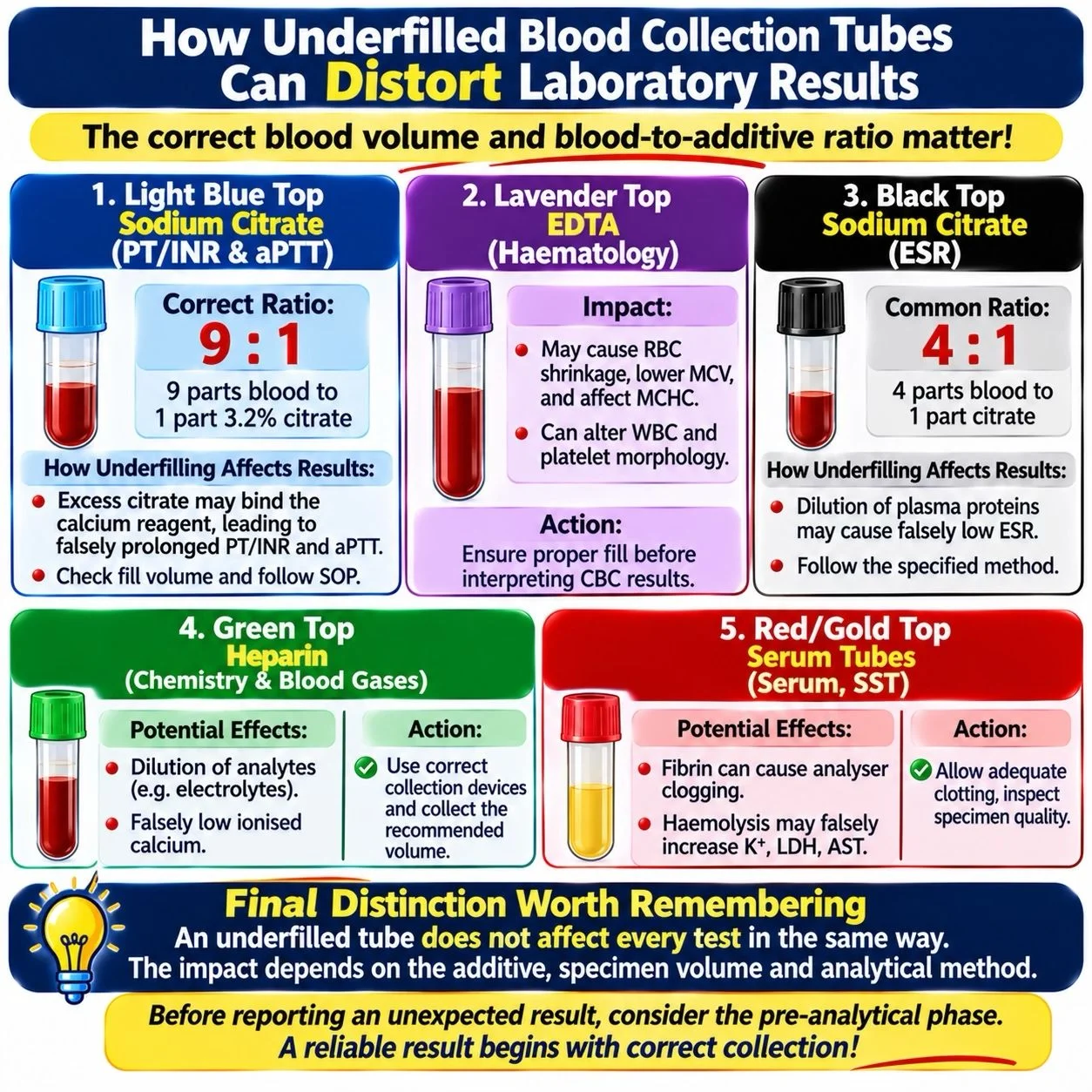
Stay updated with Hemostasis Today.
-
Oct 27, 2026, 04:56Ayodeji Olayanju: Why Choose between a Transfusion and Haemoglobinopathy CPD When You Can Do Both?
-
Oct 27, 2026, 04:34Incremental Mobility and Venous Thromboembolism Risk in Hospitalized Medical Patients – JTH
-
Oct 27, 2026, 04:29Matthew Hazell: From Rare Blood to AI – Reflecting on Three Days of Innovation at AABB 2026
-
Oct 27, 2026, 04:24Khairul Missa Mohd Amin: Highlights from RANZCR ASM 2026 and Building Stronger PE Care
-
Oct 27, 2026, 04:14Pedro Perez: Why the Future of PE Care Demands Individualized Strategy
-
Oct 27, 2026, 04:09Hari Trivedi: Real-World AI Performance in PE Detection
-
Oct 27, 2026, 03:50Nathalie Conrad: Uncovering 30-Year Sex Differences Across 55 ESC Nations
-
Oct 27, 2026, 03:45Melissa Barlow: Cancer Risk After Platelet Count and CRP Testing
-
Oct 27, 2026, 03:38Nnadozie Gabriel C.: What Everyone Needs to Know about BE FAST