

Alok Khorana: The Role of Platelets in Immune Suppression in Primary Brain Tumors
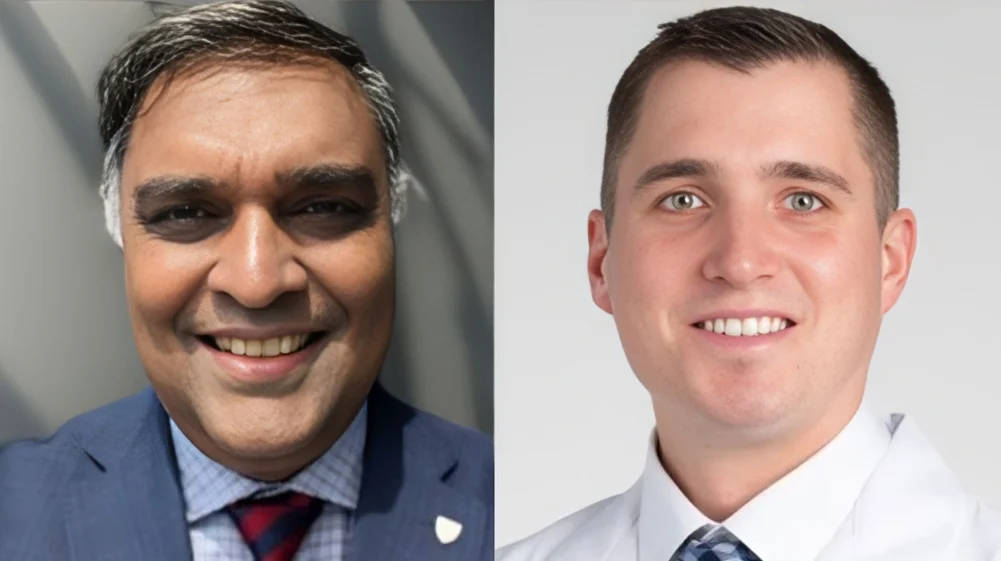
Alok Khorana, Vice Chair of the Taussig Cancer Institute at Cleveland Clinic, shared Anthony R. Sloan‘s post on X:
“Excited for our new paper in Cancer Cell led by Anthony R. Sloan and Justin Lathia demonstrating role of platelets in immune suppression of primary brain tumors, reconceptualizing cancer thrombosis as having an active role in malignancy via immune regulation.”
Anthony R. Sloan, Postdoctoral Fellow at Cleveland Clinic Lerner Research Institute, shared a post on X about a recent article he and his colleagues co-authored, published in Cancer Cell, adding:
“We are excited to share our work recently published in Cancer Cell.
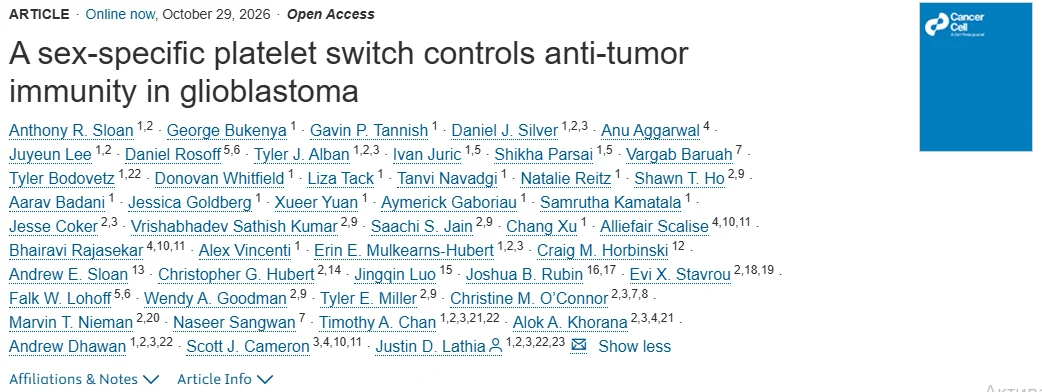
A sex-specific platelet switch controls anti-tumor immunity in glioblastoma: Cancer Cell
his was truly a team effort and I am beyond grateful and blessed to learn and work with such a great team of colleagues and collaborators.
The problem: GBM patients have dramatically elevated platelet reactivity compared to healthy controls and our data show this is driven specifically by PAR4 signaling.
This isn’t just a clotting problem. Platelets are actively suppressing the immune system inside the tumor.
Blocking PAR4 — pharmacologically or genetically — significantly extends survival in female GBM-bearing mice. Zero benefit in males.
The effect is estrogen-dependent: it is preserved in chromosomal male or hormonal female mice and rescued after ovariectomy.
How does it work?
PAR4 inhibition enhances calcium signaling in platelets through a previously unknown interaction with estrogen receptor β (ERβ). This releases the brake on CD8⁺ T cells in the tumor. Deplete those CD8⁺ T cells and the survival benefit disappears entirely.
In human GBM tissue, thrombotic tumor regions show elevated CD11b⁺ myeloid infiltration and an increased CD4⁺:CD8⁺ ratio — a signature of immune suppression. The clot is not just a complication. It is building an immunosuppressive niche.
This work reframes how we think about thrombosis in cancer not as a bystander, but as an active driver of immune suppression.
It also opens a new question: does the PAR4-ERβ axis explain sex differences in platelet biology and cardiovascular disease more broadly?
Stay tuned.”
Title: A sex-specific platelet switch controls anti-tumor immunity in glioblastoma
Authors: Anthony R. Sloan, George Bukenya, Gavin P. Tannish, Daniel J. Silver, Anu Aggarwal, Juyeun Lee, Daniel Rosoff, Tyler J. Alban, Ivan Juric, Shikha Parsai, Vargab Baruah, Tyler Bodovetz, Donovan Whitfield, Liza Tack, Tanvi Navadgi, Natalie Reitz, Shawn T. Ho, Aarav Badani, Jessica Goldberg, Xueer Yuan, Aymerick Gaboriau, Samrutha Kamatala, Jesse Coker, Vrishabhadev Sathish Kumar, Saachi S. Jain, Chang Xu, Alliefair Scalise, Bhairavi Rajasekar, Alex Vincenti, Erin E. Mulkearns-Hubert, Craig M. Horbinski, Andrew E. Sloan, Christopher G. Hubert, Jingqin Luo, Joshua B. Rubin, Evi X. Stavrou, Falk W. Lohoff, Wendy A. Goodman, Tyler E. Miller, Christine M. O’Connor, Marvin T. Nieman, Naseer Sangwan, Timothy A. Chan, Alok A. Khorana, Andrew Dhawan, Scott J. Cameron, Justin D. Lathia
Stay updated on all scientific advances with Hemostasis Today.
-
Oct 30, 2026, 23:56Laboratory Testing and Interpretation in Modern Haemophilia Care – South African Haemophilia Foundation
-
Oct 30, 2026, 23:45Jesus Ardila Novoa: Why HbF Levels and Hydroxyurea Absorption Matter in Children With SCA
-
Oct 30, 2026, 23:41Ana Paula Tagliari: Presenting a First-in-Human Experience With Mechanical Thrombectomy at TCT 2026
-
Oct 30, 2026, 23:34W. Alberto Sifuentes Giraldo: Temporal Structure of Cardiovascular and Thromboembolic Risk in AAV
-
Oct 30, 2026, 23:33Obi Light Ogbonnia: I Gifted Him My Isi Agu, and He Gifted My Family the Sun
-
Oct 30, 2026, 17:43Santagata Davide: Can Targeting Inflammation Help Prevent Thrombosis?
-
Oct 30, 2026, 17:38Patrick Ellsworth: Supporting Patients and Families Through Bleeding Disorders Awareness and Community Initiatives
-
Oct 30, 2026, 17:33Ed Shovelin: Comparative Hemostatic Performance of CRP-A and Equine Fibrillar Collagen
-
Oct 30, 2026, 16:52Tosin Ola: A New Era in Sickle Cell Disease Treatment and the Question of Access