


Octavio Marques Pontes-Neto: Intensive Blood-Pressure Control Reduces Cardiovascular Events After Ischemic Stroke
Octavio Marques Pontes-Neto, Professor at Ribeirão Preto School of Medicine, shared a post on LinkedIn about a recent article he and his colleagues co-authored, published in The New England Journal of Medicine, adding:
“Proud to have contributed to Optimal-Stroke, presented today at the American Heart Association Scientific Sessions in Chicago and published simultaneously in The New England Journal of Medicine.
Among 4,368 participants with elevated blood pressure and a prior ischemic stroke or TIA, targeting systolic blood pressure below 120 mm Hg rather than below 140 mm Hg reduced the hazard of major cardiovascular events by 21% over a median follow-up of 3.9 years (10.9% vs. 13.5%, HR 0.79, 95% CI 0.67–0.94).
Recurrent stroke, a secondary outcome, was also less frequent with intensive treatment (4.7% vs. 6.4%, HR 0.73). Serious adverse events were similar overall, while kidney outcomes were worse with intensive treatment, underscoring the importance of monitoring renal function.
Many thanks to Gisele Sampaio Silva, Otavio Berwanger for their leadership and to the investigators and research teams across all 30 Brazilian sites. Above all, thank you to the participants who made this trial possible. A proud moment for Brazilian clinical research and an important advance in secondary stroke prevention.”
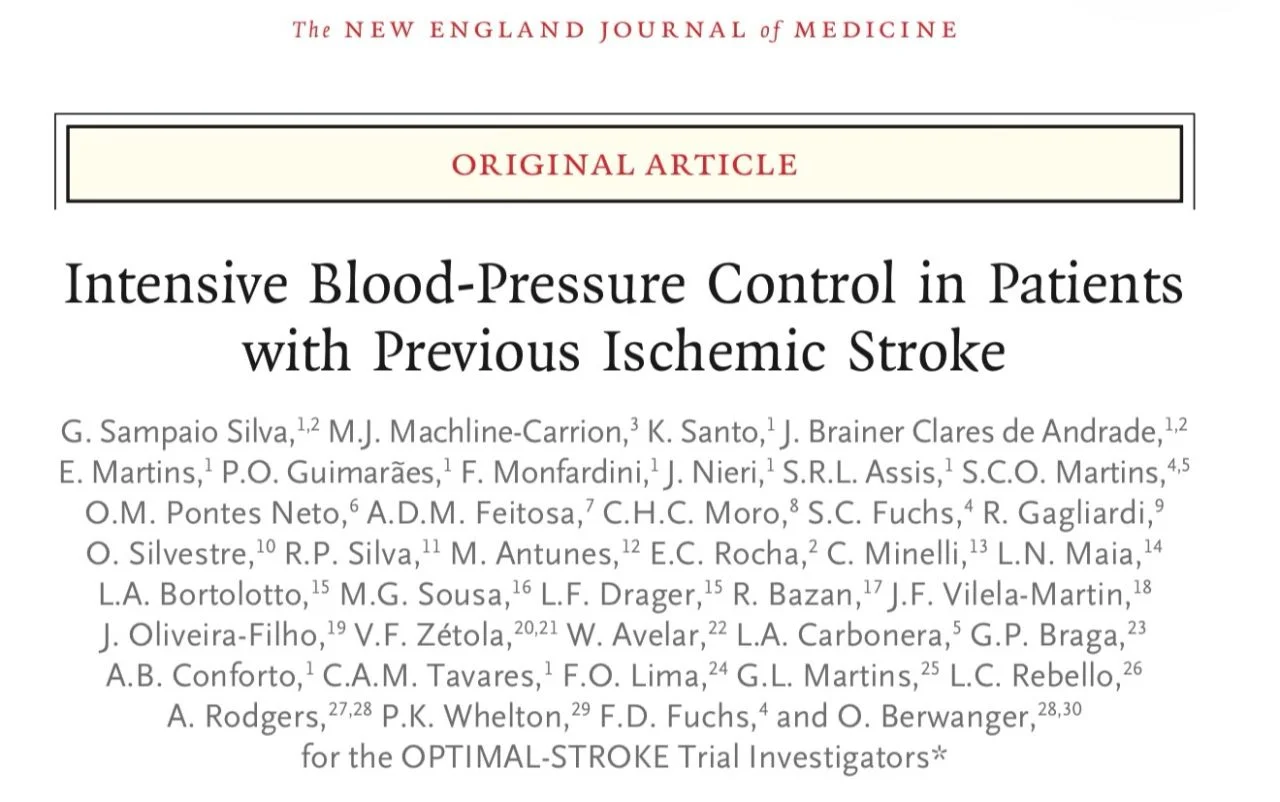
Title: Intensive Blood-Pressure Control in Patients with Previous Ischemic Stroke
Authors: Gisele Sampaio Silva, M. Julia Machline-Carrion, Karla Santo, João Brainer Clares de Andrade, Eduardo Martins, Patrícia Oliveira Guimarães, Frederico Monfardini, Josué Nieri, Silvia Assis, Sheila Cristina Ouriques Martins, Octávio Marques Pontes Neto, Audes Feitosa, Carla Heloisa Cabral Moro, Sandra Fuchs, Rubens Gagliardi, Odilson Silvestre, Ricardo Pereira Silva, Murillo Antunes, Eva Carolina Rocha, Cesar Minelli, Lilia Nigro Maia, Luiz Bortolotto, Marcio Gonçalves Sousa, Luciano Drager, Rodrigo Bazan, José Vilela-Martin, Jamary Oliveira-Filho, Viviane Flumignan Zétola, Wagner Avelar, Leonardo Augusto Carbonera, Gabriel Pereira Braga, Adriana Bastos Conforto, Caio Tavares, Fabrício Oliveira Lima, Gladys Martins, Letícia Costa Rebello, Anthony Rodgers, Paul Whelton, Flavio Fuchs, Otavio Berwanger
Find more posts featuring Octavio Marques Pontes-Neto on Hemostasis Today.
-
Nov 9, 2026, 13:48PF4-ELISA–Negative HIT: Are We Missing a New Class of Anti-PF4 Immunothrombotic Disease?
-
Nov 9, 2026, 13:07Nandini Sadasivam: Gene Therapy for Sickle Cell Disease and Thalassaemia
-
Nov 9, 2026, 13:04Raising Awareness of Bleeding Disorders in Women and Girls – EHC
-
Nov 9, 2026, 12:59Rahul Bohra: Exploring the Complex Mechanisms of Sickle Cell Disease
-
Nov 9, 2026, 12:53Three Years of Movement and Thrombosis Awareness in the Czech Republic – World Thrombosis day
-
Nov 9, 2026, 12:49Irma Bagdoniene: What Really Makes Us Live Longer
-
Nov 9, 2026, 12:47Imo Akpan: Announcing the 2027 Women’s Hematology Summit
-
Nov 9, 2026, 12:45Shadi Yaghi: Rethinking Antithrombotic Therapy After Stroke
-
Nov 9, 2026, 12:40Dimpy Modi: Pilot Trial Protocol Investigates Liberal vs. Restrictive Red Blood Cell Transfusion in Leukemia