


PF4-ELISA–Negative HIT: Are We Missing a New Class of Anti-PF4 Immunothrombotic Disease?
When doctors suspect heparin-induced thrombocytopenia (HIT), the first step is usually a blood test called PF4 ELISA.
But what happens when a patient’s symptoms strongly suggest HIT, yet the test comes back negative?
New research suggests there may be a rare but dangerous form—PF4-ELISA–negative HIT—that standard tests fail to detect.
What is HIT and Why is it Dangerous?
HIT is not a simple allergy to heparin. It is an immune reaction in which the body produces antibodies against platelet factor 4 (PF4) bound to heparin.
These antibodies activate platelets, causing platelet counts to drop and the risk of thrombosis to rise sharply.The surprising part is that in HIT, patients may not bleed—they may actually develop clots in veins or arteries.
That is what makes this condition particularly dangerous.
What Does ELISA-Negative HIT Mean?
Normally, when PF4 ELISA is negative, doctors tend to rule out HIT and may resume heparin if needed.
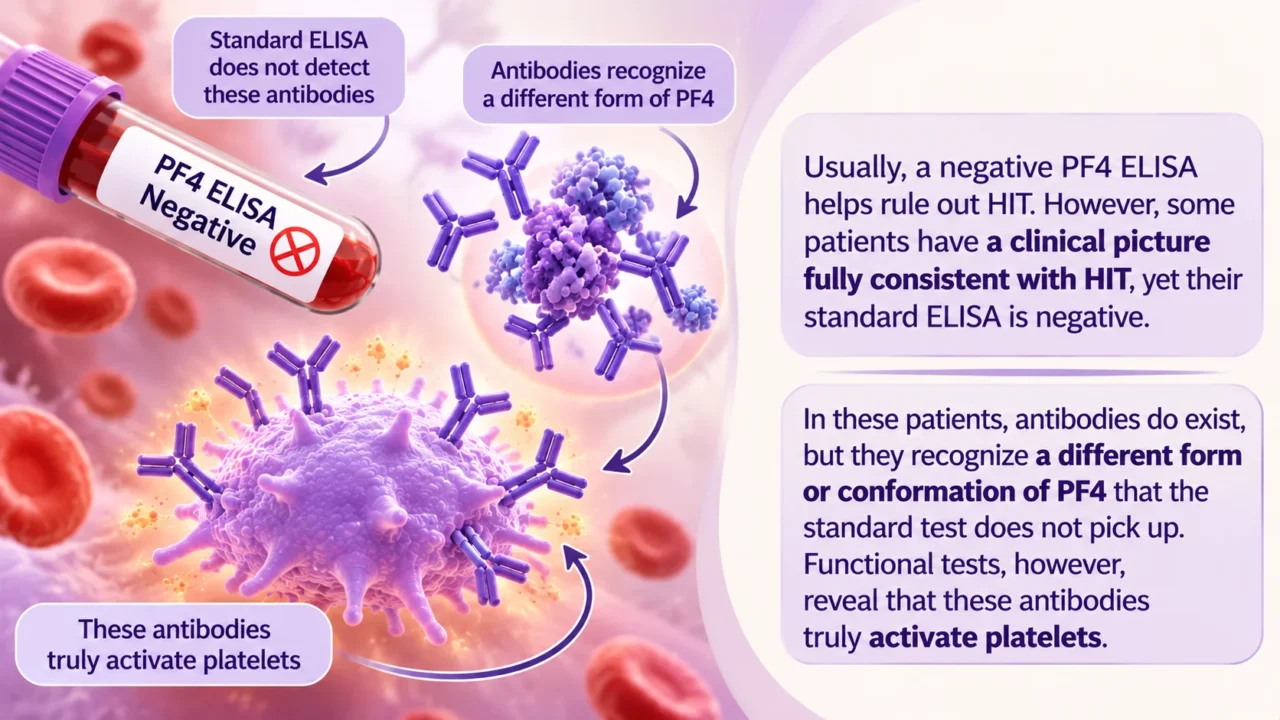
But a recent study showed that there are patients whose clinical picture fully matches HIT, yet their standard ELISA is negative.
In these patients, antibodies do exist, but they recognize a different form or conformation of PF4 that the standard test does not pick up.
Functional tests, however, reveal that these antibodies truly activate platelets.
Why This Matters
If a doctor mistakenly concludes that HIT is absent because ELISA is negative, they may resume heparin.
But in the reported cases, re-exposure to heparin caused a renewed drop in platelets and, in some cases, new thrombosis.
This means that a “negative test” does not necessarily mean “heparin is safe.”
When clinical suspicion is high, deeper testing is needed rather than relying on a single ELISA result.
What Does This Change in Medicine?
This discovery shows that anti-PF4 disorders are more diverse than previously thought.
Beyond classic HIT, there are VITT, autoimmune HIT-like forms, and now a new group: ELISA-negative but functionally positive HIT.
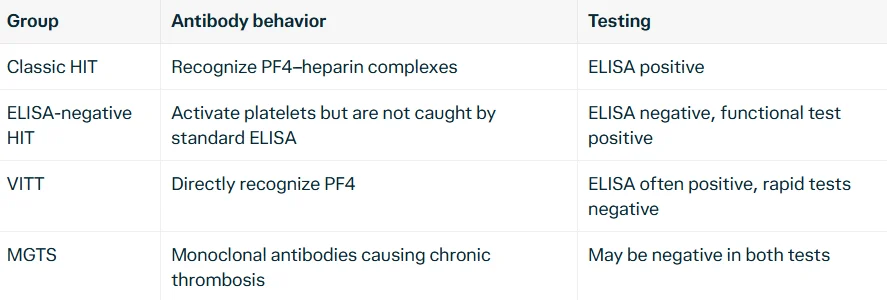
In that case, functional tests such as SRA, HIPA, or PF4-dependent P-selectin expression assay (PEA) can be used.
Until the diagnosis is clarified, heparin should not be resumed based solely on a negative ELISA.
Future Outlook
This finding forces medicine to rethink how HIT is diagnosed.
In the future, more sensitive tests may be needed to catch these “hidden” antibodies.
Until then, it is important to remember: a negative ELISA does not always mean absence of HIT.
The clinical picture must always be considered alongside test results.
Conclusion
PF4-ELISA–negative HIT is rare but can have serious consequences if unrecognized.
It shows that the world of anti-PF4 disorders is more complex than we thought, and that a single test is not enough for diagnosis.
In the future, new, more sensitive tests will be needed to detect these hidden forms and prevent misdiagnosis.
FAQs
- What is PF4-ELISA–negative HIT?
It is a form of heparin-induced thrombocytopenia (HIT) where the standard PF4 ELISA test is negative, but the patient still has pathogenic antibodies that activate platelets. - Why is it called “ELISA-negative”?
Because the usual PF4/polyanion ELISA test does not detect these antibodies, even though they are present and harmful. - How is it different from classic HIT?
In classic HIT, antibodies bind PF4–heparin complexes and are detected by ELISA. In ELISA-negative HIT, antibodies recognize a different form of PF4 that standard tests miss. - Why is this dangerous?
Because doctors may wrongly conclude HIT is absent and resume heparin, which can trigger renewed platelet drop or new thrombosis. - What tests can detect it?
Functional tests like SRA, HIPA, or PF4-dependent P-selectin expression assay (PEA) can reveal platelet activation even when ELISA is negative. - How common is it?
It appears to be rare—about 0.6 percent in one screened cohort—but clinically important because it can be missed. - What should doctors do if they suspect it?
Use clinical scoring (4Ts), consider functional testing, and avoid heparin re-exposure until the diagnosis is clear. - Can it coexist with other anti-PF4 disorders?
Yes. It may overlap with VITT, autoimmune HIT-like syndromes, or monoclonal gammopathy of thrombotic significance (MGTS). - Why does standard ELISA miss it?
The antibodies may recognize a different conformation or epitope of PF4 not reproduced by the PF4/PVS antigen used in routine ELISA. - What is the future outlook?
New, more sensitive assays are needed to detect these hidden antibodies and prevent misdiagnosis. Until then, clinical judgment must guide testing and treatment.
Written by Anna Stepanyan, MD
Stay updated with Hemostasis Today.
-
Nov 9, 2026, 13:07Nandini Sadasivam: Gene Therapy for Sickle Cell Disease and Thalassaemia
-
Nov 9, 2026, 13:04Raising Awareness of Bleeding Disorders in Women and Girls – EHC
-
Nov 9, 2026, 12:59Rahul Bohra: Exploring the Complex Mechanisms of Sickle Cell Disease
-
Nov 9, 2026, 12:53Three Years of Movement and Thrombosis Awareness in the Czech Republic – World Thrombosis day
-
Nov 9, 2026, 12:51Octavio Marques Pontes-Neto: Intensive Blood-Pressure Control Reduces Cardiovascular Events After Ischemic Stroke
-
Nov 9, 2026, 12:49Irma Bagdoniene: What Really Makes Us Live Longer
-
Nov 9, 2026, 12:47Imo Akpan: Announcing the 2027 Women’s Hematology Summit
-
Nov 9, 2026, 12:45Shadi Yaghi: Rethinking Antithrombotic Therapy After Stroke
-
Nov 9, 2026, 12:40Dimpy Modi: Pilot Trial Protocol Investigates Liberal vs. Restrictive Red Blood Cell Transfusion in Leukemia