


Saji Kumar: The Role of Agentic AI in Blood Bank Inventory Coordination
Saji Kumar, Chief Technology Officer and Data Analyst at aTeamIndia, Emerging Techs, shared a post on LinkedIn:
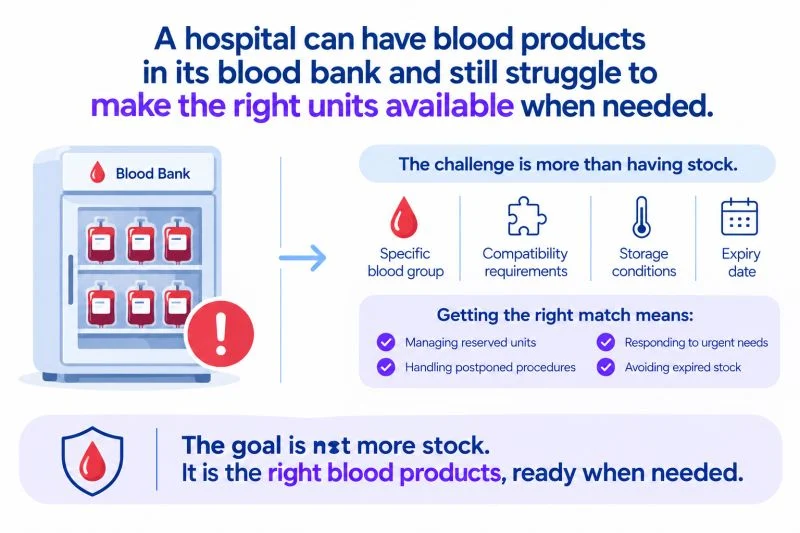
“A hospital can have blood products in its blood bank and still struggle to make the right units available when a patient needs them.
Blood inventory is different from ordinary inventory.
Every unit has a specific blood group, compatibility requirements, storage conditions and expiry date. Units cannot simply be treated as interchangeable stock.
Consider a hospital preparing for several scheduled operations.
Blood units are requested in advance. Some are crossmatched for specific patients. Then procedures are postponed, or patients no longer require transfusion.
Meanwhile, another department urgently needs blood products.
The blood bank may have stock, but some units are reserved, others are approaching expiry, and not all are suitable for the patient who needs them.
This creates a difficult balance:
Maintain emergency readiness without unnecessarily tying up or wasting valuable blood products.
A 2026 study of blood-bank operations at King Fahad Medical City in Riyadh offers a useful local example.
Analysing 2022–2023 inventory data, researchers reported that 4.2% of issued blood products had expired, while 3.8% were returned in acceptable condition.
The study also examined ordering efficiency through indicators such as the crossmatch-to-transfusion ratio and issuable stock index.
These are more than laboratory performance measures.
They reveal how effectively a hospital connects clinical demand with blood-bank availability.
A governed Agentic AI system could support this coordination by:
- Monitoring reserved, available and near-expiry units.
- Identifying blood products allocated to postponed procedures.
- Flagging opportunities for authorised reassessment and release of unused units.
- Tracking urgent requests and pending crossmatches.
- Highlighting demand patterns that could improve inventory planning.
However, AI must never make transfusion decisions, determine compatibility or release blood products independently. Those decisions must remain with qualified transfusion professionals under approved protocols.
The goal is not simply to maintain more blood stock. It is to make the right blood products safely available at the right time.
Because in blood-bank management, inventory visibility is important. But readiness, compatibility and timely availability are what ultimately matter.”
Stay updated with Hemostasis Today.
-
Nov 14, 2026, 00:04Carlos A. Metidieri Menegozzo: The First Priority in Trauma Transfusion May Be Time to First Blood Product
-
Nov 13, 2026, 23:43Alamgir Hosen Ronit: Corrected Platelet Count in EDTA Induced Platelet Aggregation
-
Nov 13, 2026, 23:32Evi Loos: Can PRP Improve Pain in Thumb Base Osteoarthritis?
-
Nov 13, 2026, 23:10Cesar de Almeida Neto: Digital Connectivity Can Transform Plateletpheresis Practice
-
Nov 13, 2026, 23:10Chien-Wen Liew: Where PRP Actually Sits in the Evidence
-
Nov 13, 2026, 23:08Erika Koppers: Continuing the Collaborative Journey Towards Equitable Haemophilia Care in South Africa
-
Nov 13, 2026, 23:06Büşra Ece Günaydın: A New Approach to Factor VIII Gene Insertion for Hemophilia A
-
Nov 13, 2026, 22:57Rolf Bekendam: Moderating a Conversation With Experts on Rare Bleeding Disorders
-
Nov 13, 2026, 16:17Shailendra Singh: Bombay Hospital Jaipur Inaugurates New Facility with Voluntary Blood Donation Camp