


Abdul Mannan: Explaining the Molecular Mechanism Behind VITT
Abdul Mannan, Consultant Hematologist at Betsi Cadwaladr University Health Board, shared a post on LinkedIn about a recent article by Jore Van Wauwe et al, published in The New England Journal of Medicine:
“VITT is rare. But now we finally know exactly WHY.
A paper just published in NEJM 2026 (Wang JJ et al. 394:669-683) explains the molecular mechanism behind Vaccine-Induced Immune Thrombocytopenia and Thrombosis.
And honestly, it’s one of the most elegant pieces of immunology I’ve read in years.
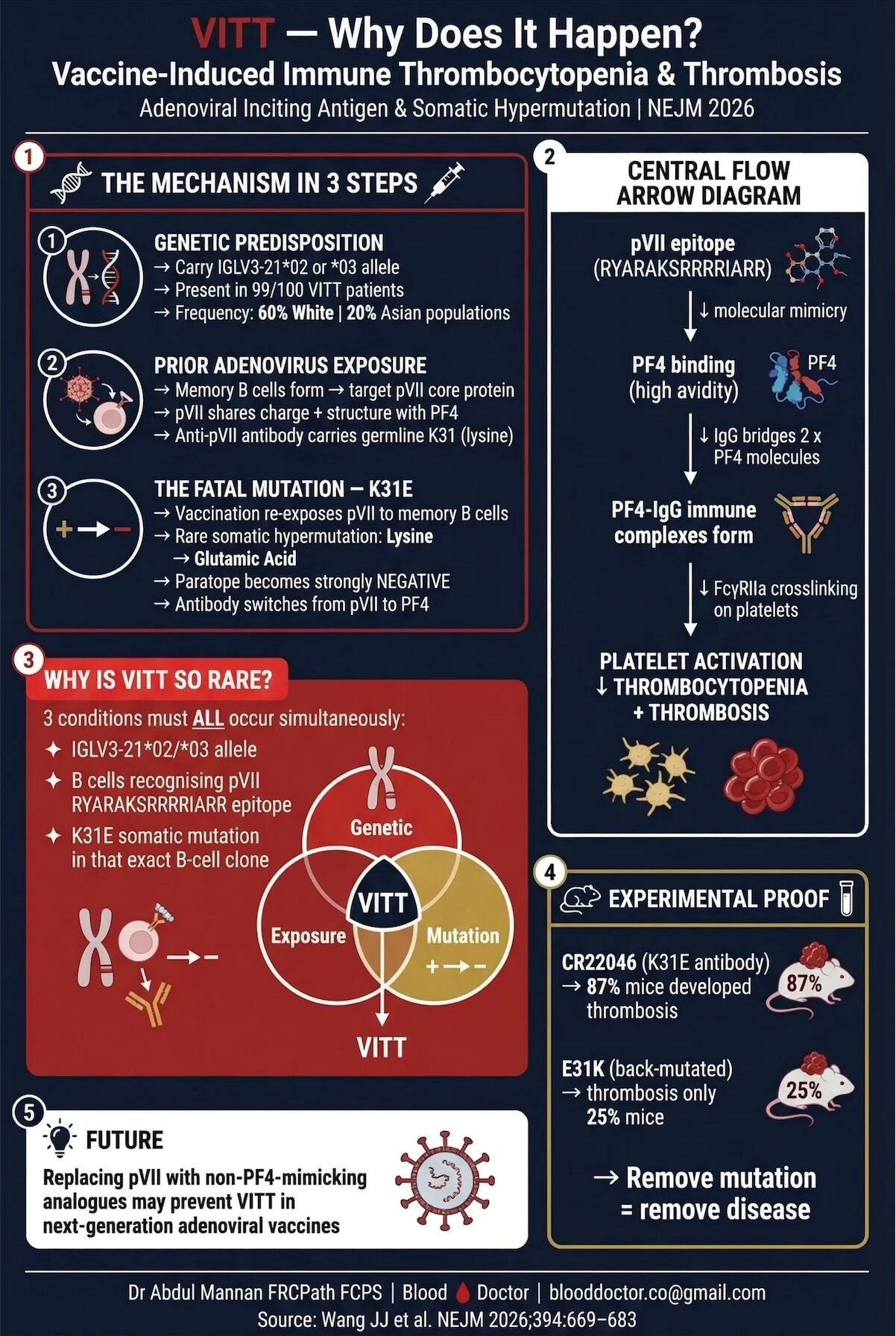
Three things must ALL happen at the same time:
- You carry the IGLV3-21*02 or *03 allele (found in 99/100 VITT patients)
- Your B cells recognise the pVII epitope RYARAKSRRRRIARR
- A rare K31E somatic mutation occurs in that exact B-cell clone
Miss any one of these? No VITT.
Here’s the clever part. The adenoviral pVII protein shares charge and structure with Platelet Factor 4 (PF4).
After vaccination, memory B cells re-encounter pVII.
In rare cases, a single mutation flips Lysine to Glutamic Acid at position 31.
The antibody paratope turns strongly negative. It stops targeting pVII and locks onto PF4 instead.
PF4-IgG complexes form. Platelets activate via FcγRIIa crosslinking.
Thrombocytopenia and thrombosis follow.
The experimental proof is striking.
The K31E antibody (CR22046) caused thrombosis in 87% of mice.
Back-mutate it to E31K, and that figure drops to 25%.
Remove the mutation. Remove the disease.
The future direction?
Replace pVII with non-PF4-mimicking analogues in next-generation adenoviral vaccines.
This is how rare drug reactions get solved. Step by step.
One mutation at a time.
What do you think this means for future vaccine design?”
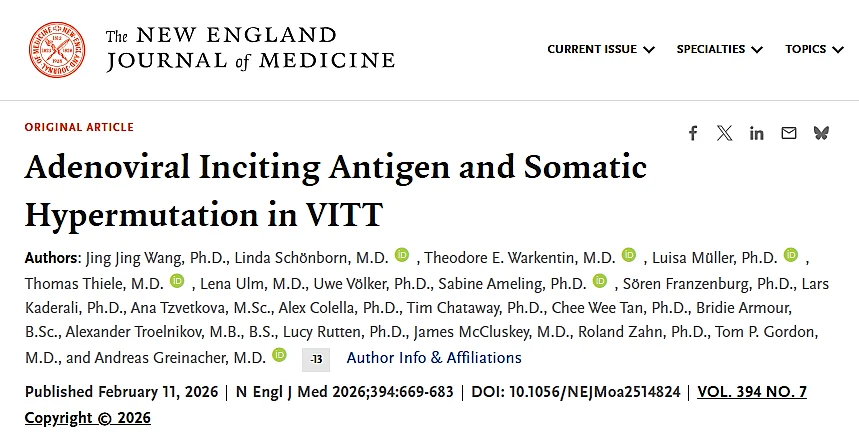
Tilte: Adenoviral Inciting Antigen and Somatic Hypermutation in VITT
Authors: Jing Jing Wang, Linda Schönborn, Theodore E Warkentin, Luisa Müller, Thomas Thiele, Lena Ulm, Uwe Völker, Sabine Ameling, Sören Franzenburg, Lars Kaderali, Ana Tzvetkova, Alex Colella, Tim Chataway, Chee Wee Tan, Bridie Armour, Alexander Troelnikov, Lucy Rutten, James McCluskey, Roland Zahn, Tom P Gordon, Andreas Greinacher
Read the Full Article on The New England Journal of Medicine
Other posts featuring Abdul Mannan on Hemostasis Today.
-
Sep 17, 2026, 16:30Daria Camilli: Empowering Bleeding Disorder Advocacy Through Health Economics
-
Sep 17, 2026, 16:17Mehran Ghasemzadeh: Platelet NK Cell Crosstalk in Advanced Coronary Artery Disease
-
Sep 17, 2026, 16:16Barbara Adams Krolak: Do GLP-1s Affect Blood Clot Risk?
-
Sep 17, 2026, 15:46Heghine Khachatryan: Clinical Context at the Core of Thrombosis and Thrombophilia Management
-
Sep 17, 2026, 15:33Alexandros Makis: When Microcytic Anemia Has an Inherited Cause
-
Sep 17, 2026, 15:22α2-Antiplasmin Inhibition and the Future of Thrombolysis
-
Sep 17, 2026, 15:20Fatma M. Attia: Expanding the Evidence Base for Therapeutic Plasma Exchange Across Multiple Indications
-
Sep 17, 2026, 15:19Conan McIlwrath: The Haemophilia Society Engages With IBCA
-
Sep 17, 2026, 15:06Eleftheria Hatzimichael: A Contemporary Diagnostic Approach to Inherited Microcytic Anemias