


Abdul Mannan: Recognition and Management of Febrile Non-Haemolytic Transfusion Reactions in Clinical Practice
Abdul Mannan, Consultant Hematologist at Betsi Cadwaladr University Health Board, shared a post on LinkedIn:
“FNHTR is the most common transfusion reaction — but its real danger is that it can mimic the early signs of a haemolytic transfusion reaction (HTR), which is life-threatening.
The hook should create that tension: common but terrifying until proven otherwise.
Fever during a blood transfusion.
Every junior doctor freezes.
Is this dangerous?
Do I stop the blood?
Is my patient haemolysing?
Most of the time? It’s FNHTR.
But you can’t assume that.
Here’s the framework:
What’s happening:
- Recipient antibodies attack donor white cells
- Or cytokines accumulate in the stored bag
- Result: fever ≥38°C or a ≥1°C rise, with chills and rigors
The diagnosis is by exclusion:
- No hypotension
- No respiratory distress
- No haemolysis
If ANY of these are present — think harder.
What to do:
- STOP the transfusion immediately
- Send blood for labs (FBC, DAT, repeat group and screen)
- Give paracetamol
- Only RESTART slowly once you’ve ruled out something serious
Prevention:
- Leucodepletion of blood components
- All UK blood products are now leucodepleted — this has cut FNHTR rates dramatically
The 2023 SHOT report still lists FNHTR as the most reported transfusion complication in the UK.
Common doesn’t mean trivial.
When you stop that bag — you’re not overreacting.
You’re doing exactly the right thing.
What’s the most challenging transfusion reaction you’ve managed?”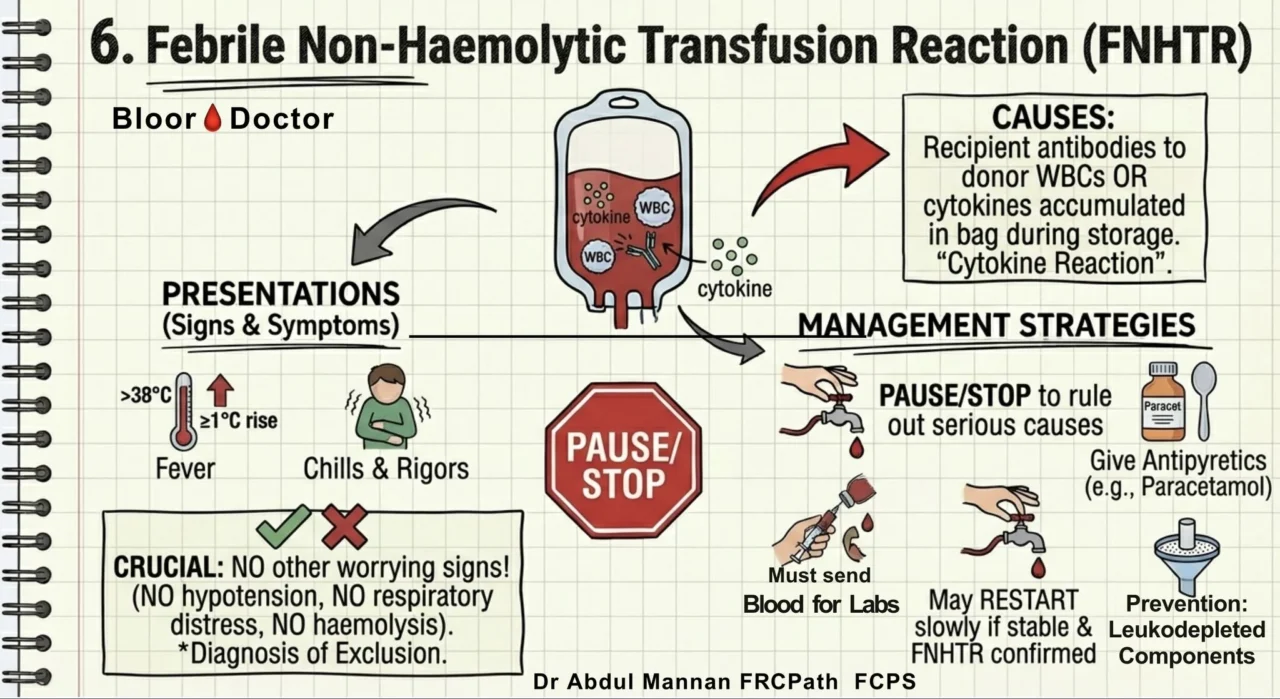
Other posts from Abdul Mannan on Hemostasis Today.
-
Sep 23, 2026, 16:04Monia Ezzalfani: Advancing Patient-Centered Care in Hemophilia A and B
-
Sep 23, 2026, 15:49Bilge Başak: How Activated PRP Modulates Osteoarthritic Chondrocyte Function
-
Sep 23, 2026, 14:50Mbonjo Bitsie Dora: Strengthening Sickle Cell Care Through Education, Awareness and Innovation
-
Sep 23, 2026, 13:58The New B12 Diagnostic Algorithm: From Serum Cobalamin to Functional Deficiency
-
Sep 23, 2026, 13:56Noha Soror: Preparing for Hematology and Medical Oncology Board Certification
-
Sep 23, 2026, 13:46Ugochi Ogu: What Can Platelet Proteomics Reveal about Pain and Neurocognitive Vulnerability in Sickle Cell Disease?
-
Sep 23, 2026, 13:42Melissa Hollo: Connecting Obesity and Anemia for Earlier Maternal Risk Intervention
-
Sep 23, 2026, 13:16Beverley Hunt: Advances in Haemostatic Management of Postpartum Haemorrhage
-
Sep 23, 2026, 13:13Ioanna Mela: Recruiting a Research Associate on DNA nanotechnology