


Abdulla A. Damluji: Key Points from Newly Published DAPT-MVD Trial
Abdulla A. Damluji, Director of the Cardiovascular Center on Aging at Cleveland Clinic, shared on LinkedIn about a recent article by Jinwei Tian et al, published in NEJM, adding:
”DAPT-MVD trial was published – here is my summary with key points helpful for clinical practice and key market implications!
The optimal duration of antiplatelet treatment after coronary stenting in patients with multivessel coronary artery disease has remained an unresolved question in cardiovascular medicine.
Patients with multivessel disease at low risk for bleeding routinely receive 12 months of dual antiplatelet therapy after implantation of a drug-eluting stent to reduce the risk of ischemic events.
Ischemic events in these patients arise not only from previously treated lesions but also from untreated segments of the coronary tree, which sustains an ongoing risk of myocardial infarction and death.
Whether extending dual antiplatelet therapy beyond 12 months in patients who remain free of ischemic and bleeding events provides a net benefit was uncertain, and prior trial evidence has been difficult to apply to this specific population.
The Dual Antiplatelet Therapy in Patients with Coronary Multivessel Disease trial was designed to address this question directly.
The trial was an open-label, assessor-blinded, randomized study conducted at 97 centers in China.
Eligible patients were 18 to 75 years of age, had multivessel coronary artery disease defined as at least two major epicardial coronary arteries with a diameter stenosis of at least 50 percent, and had remained in stable condition for 12 months after implantation of a drug-eluting stent without any major ischemic or bleeding event.
A total of 8250 patients were randomly assigned in a one to one ratio to receive an additional 12 months of clopidogrel plus aspirin or aspirin alone, with 4125 patients in each group.
The primary efficacy endpoint was a composite of death from cardiovascular causes, nonfatal myocardial infarction, or nonfatal stroke.
The primary safety endpoint was clinically relevant or major bleeding, defined as a bleeding event of Bleeding Academic Research Consortium type 2 or higher.
The median follow-up was 34.3 months.
The two groups were well balanced at baseline.
The mean patient age was 61 years, 30.3 percent of patients were female, and 28.2 percent had diabetes.
Nearly all patients, 98.3 percent, had presented with an acute coronary syndrome before the index procedure, and 34.0 percent had had a myocardial infarction.
This profile describes a population at relatively high ischemic risk but low bleeding risk, since all patients had already tolerated one year of dual antiplatelet therapy without a major event.
A primary efficacy endpoint event occurred in 222 patients in the dual antiplatelet therapy group and in 266 patients in the aspirin monotherapy group, corresponding to a 36 month cumulative incidence of 5.8 percent versus 6.8 percent (hazard ratio, 0.82; 95 percent confidence interval, 0.69 to 0.98; P value, 0.03).
This represents an 18 percent lower relative risk of the composite ischemic outcome with extended therapy over a median of 34.3 months.
The covariate adjusted analysis was consistent with the primary result, and a hierarchical win ratio analysis was also concordant.
The reduction in ischemic events was driven mainly by a lower rate of myocardial infarction.
Nonfatal myocardial infarction occurred in 67 patients in the dual antiplatelet therapy group and in 97 patients in the aspirin monotherapy group, corresponding to a 36 month cumulative incidence of 1.8 percent versus 2.5 percent (hazard ratio, 0.68; 95 percent confidence interval, 0.50 to 0.93), a 32 percent lower risk.
Nonfatal stroke occurred in 97 patients versus 120 patients, corresponding to a 36 month cumulative incidence of 2.5 percent versus 3.1 percent (hazard ratio, 0.80; 95 percent confidence interval, 0.61 to 1.04).
Extended therapy did not reduce mortality.
Death from any cause occurred in 120 patients in the dual antiplatelet therapy group and in 116 patients in the aspirin monotherapy group, and death from cardiovascular causes occurred in 73 patients versus 75 patients, with no difference between the groups.
The reduction in ischemic events occurred without an increase in bleeding.
Clinically relevant or major bleeding occurred in 51 patients in the dual antiplatelet therapy group and in 57 patients in the aspirin monotherapy group, corresponding to a 36 month cumulative incidence of 1.4 percent versus 1.5 percent (hazard ratio, 0.89; 95 percent confidence interval, 0.61 to 1.30; P value, 0.54).
Major bleeding occurred in 29 patients versus 33 patients, corresponding to a 36 month cumulative incidence of 0.8 percent versus 0.9 percent. Serious adverse events were also similar between groups, occurring in 27.7 percent of patients in the dual antiplatelet therapy group and 28.0 percent of patients in the aspirin monotherapy group.
The benefit of extended therapy was consistent across most prespecified subgroups, with a possible exception among patients with a high body mass index, a known predictor of reduced clopidogrel response.
The clinical benefit became apparent after the sixth month of extended therapy and was sustained for 12 months after treatment cessation.
The reduction in myocardial infarction arose mainly from events in nontarget coronary segments rather than from stented target sites, a pattern consistent with stabilization of untreated vulnerable plaque during the high risk period that follows an acute coronary syndrome.
Several limitations warrant attention.
The open label design could have introduced bias, although this possibility was mitigated by blinded endpoint adjudication.
The cohort was exclusively Chinese, and obesity was uncommon, which restricts generalizability.
Loss of function alleles of the gene encoding the enzyme responsible for clopidogrel bioactivation are prevalent among East Asian patients and reduce the activation of clopidogrel, so the balance of ischemic benefit and bleeding risk may differ in Western populations.
The trial compared clopidogrel plus aspirin with aspirin alone and therefore does not inform the relative merits of alternative regimens such as those using a more potent platelet inhibitor or a single agent strategy.
Finally, the cumulative incidence of an ischemic event was still 5.8 percent among patients receiving extended therapy, which indicates that substantial residual risk persists even with prolonged treatment.
Taken together, these findings suggest that for patients with multivessel coronary artery disease who present with an acute coronary syndrome and remain event free at 12 months, a standard 12 month duration of dual antiplatelet therapy may be insufficient.
Extending clopidogrel plus aspirin for an additional 12 months reduced ischemic events without an increase in bleeding, and this favorable balance was possible because the trial selected a population at high ischemic risk and low bleeding risk.
The result should be applied with attention to the individual patient’s bleeding profile and to the population differences that limit direct extrapolation to other groups.
Key Points Helpful for Clinical Practice
- Among patients with multivessel coronary artery disease who were event free 12 months after drug-eluting stent implantation, extending dual antiplatelet therapy with clopidogrel plus aspirin for an additional 12 months reduced the composite of cardiovascular death, nonfatal myocardial infarction, or nonfatal stroke by 18 percent relative to aspirin alone.
- The benefit was driven mainly by a 32 percent lower risk of myocardial infarction, with most events arising from untreated coronary segments rather than previously stented sites.
- Extended therapy did not increase clinically relevant or major bleeding, and rates of major bleeding, serious adverse events, and death did not differ between groups.
- The favorable balance applies to a population at high ischemic risk and low bleeding risk, specifically nonelderly patients who tolerated one full year of dual antiplatelet therapy without an event; patients at higher bleeding risk or lower ischemic risk were not represented.
- The benefit emerged after the sixth month of extended therapy, which supports counseling patients that the advantage of continued treatment accrues over time rather than immediately.
- Reduced clopidogrel response should be considered in patients with a high body mass index, and the results may not extend directly to Western populations given differences in the genetics of clopidogrel activation.
Key Market Implications
- The trial supports continued and potentially expanded use of generic clopidogrel and aspirin, both low cost and widely available, which favors a cost effective secondary prevention strategy rather than a shift toward higher priced antiplatelet agents.
- A demonstrated ischemic benefit without excess bleeding in a large population may increase demand for extended dual antiplatelet therapy in patients with multivessel disease, with modest volume implications for generic clopidogrel manufacturers and limited pricing power given the mature generic status of both drugs.
- The finding that a substantial residual ischemic risk of 5.8 percent persists despite extended therapy identifies a continuing commercial opportunity for adjunctive strategies, including more potent platelet inhibitors, anti-inflammatory agents, and lipid lowering therapies aimed at further risk reduction.
- Guideline committees may revisit recommendations on antiplatelet duration for patients with multivessel disease and acute coronary syndromes, and any change would influence prescribing patterns, quality metrics, and payer coverage decisions across cardiovascular care.
- Because the population was exclusively Chinese and clopidogrel activation differs by genetic background, the commercial and clinical applicability to Western markets is uncertain and may require confirmatory data before broad adoption.”
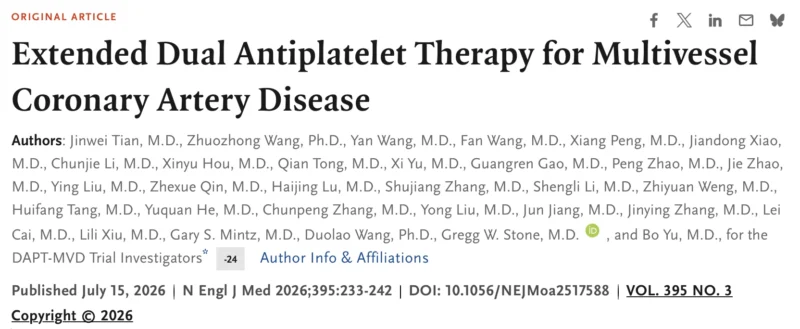
Title: Extended Dual Antiplatelet Therapy for Multivessel Coronary Artery Disease
Authors: Jinwei Tian, Zhuozhong Wang, Yan Wang, Fan Wang, Xiang Peng, Jiandong Xiao, Chunjie Li, Xinyu Hou, Qian Tong, Xi Yu, Guangren Gao, Peng Zhao, Jie Zhao, Ying Liu, Zhexue Qin, Haijing Lu, Shujiang Zhang, Shengli Li, Zhiyuan Weng, Huifang Tang, Yuquan He, Chunpeng Zhang, Yong Liu, Jun Jiang, Jinying Zhang, Lei Cai, Lili Xiu, Gary S. Mintz, Duolao Wang, Gregg W. Stone, Bo Yu
Stay updated on all scientific advances with Hemostasis Today.
-
Oct 18, 2026, 07:05Behnood Bikdeli: Vasculearn Network Highlights Expert Perspectives on PE Risk Stratification and Advanced Therapies
-
Oct 18, 2026, 06:27Gregory Makris: NEJM Study Supports Earlier Catheter-Directed Intervention in Intermediate-High–Risk PE
-
Oct 18, 2026, 06:26Danny Hsu: BLOOD 2026 Return to Aotearoa
-
Oct 18, 2026, 02:43Priya Sriskandarajah: Diagnosis and Management of PV and JAK2-Unmutated Erythrocytosis
-
Oct 18, 2026, 02:41C. Michael Gibson: A Meta-Analysis of DOACs and DAPT After Left Atrial Appendage Closure
-
Oct 18, 2026, 02:27What Hematologists Should Remember About the Person Behind the Platelet Count – ASH
-
Oct 18, 2026, 01:44Marta Velia Antonini: How to Deliver CRRT during ECMO?
-
Oct 18, 2026, 01:19Aamir Saeed: Anticoagulation, Cirrhosis, and Other Risk Factors for Post-ERCP Bleeding
-
Oct 18, 2026, 00:33Elad Asher: Does Opening the Clot Change How a Patient Feels Three Months Later?