


Armghan Ans: How to Implement the 2026 Extended-Window Stroke IVT Guideline
Armghan Ans, Assistant Professor and Director of Stroke at UPMC Washington, Founder of MDAdopt, shared on LinkedIn:
”The most useful thing you could hand a stroke clinician right now is not the trial data for the 2026 extended window IVT.
It is not the forty-page protocol.
It is one page.
Printed on both sides.
Answering only the handful of questions that actually decide the case.
Who is eligible?
Which clock to use?
What does the imaging need to show?
What to do when the pieces are not in place?
Not the evidence.
But the decision support.
Because the goal is not to make a new guideline easy to remember.
The goal is to make it impossible to forget.
This week’s TAIN is about what the right knowledge actually looks like at the bedside.
The 2026 AHA/ASA guideline now supports IV thrombolysis from 4.5 to 9 hours, and in wake-up strokes, when advanced imaging shows salvageable tissue.
The recommendation carries a Class 2a designation, backed by WAKE-UP, EXTEND, and TRACE-III.
The evidence is settled.
The harder question is the one that comes next.
How does a guideline like this actually become routine practice?
Most implementation advice assumes we are adding something new. A new drug, a new procedure, a new pathway. But that is not what this guideline does. Thrombolysis is not new. It is one of the most established things we do in stroke. What changes is who we offer it to. The guideline asks us to treat a patient who, under the old rules, we would have turned away.
That distinction matters more than it looks.
Adding a new behavior is one thing. Changing an established one is harder. A new behavior has nothing competing against it. A changed behavior has to overcome years of reinforced habit, built into our protocols, our order sets, and our reflexes. For years the rule was simple. Past the window, we did not treat. That reflex is fast, it is automatic, and it is exactly what the guideline now asks us to interrupt.
We are not teaching a new skill. We are overwriting an old instinct.
So if we want this guideline to land, we should treat it as a behavior change problem, not just a knowledge or operational one.
That framing has a practical consequence. The first instinct is to call this an imaging problem. Access to advanced imaging is uneven, and that gap is real. But it sits downstream of a behavioral one. An institution funds the imaging, the software, and the staffing once it believes these patients should be treated. Belief does not erase a genuine funding constraint, but without it, the resources rarely get built, even when they are affordable. Fix the behavior, and the operational fixes tend to follow.
So the real question is how to change a behavior on purpose, rather than by chance.
Why We Need a Framework
Usually, we go with instinct. Send an email. Give a talk. Update the protocol. Sometimes it works. Often it does not, and we are left guessing why.
There is a better way.
The Theoretical Domains Framework, developed by Cane, O’Connor, and Michie, pulls together 33 theories of behavior change into one validated structure of 14 domains. Each domain names one reason a person does or does not do a specific thing. It is one of the most widely used tools in implementation science, and it has been applied directly to stroke care and the thrombolysis decision.
The 14 domains sit under a simpler map called COM-B: Capability, Opportunity, and Motivation.
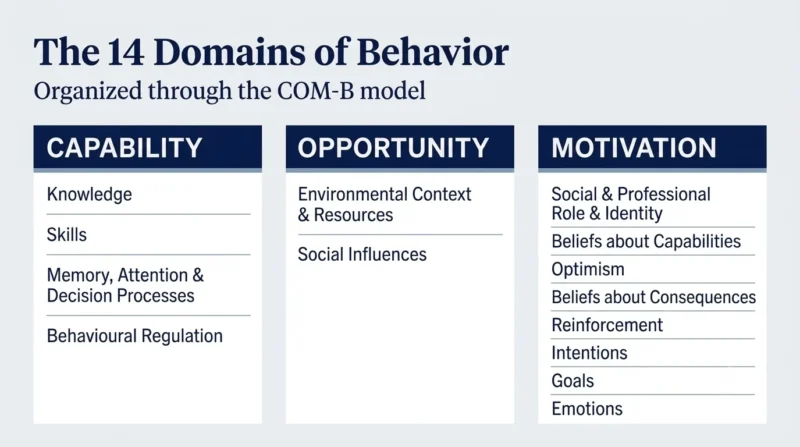
The 14 Domains of Behavior, Organized Under the COM-B Model
The value is simple. Instead of reaching for the one lever we always reach for, more education, the framework makes us look at every possible barrier, and then match each one to the right fix.
There are 14 domains.
In this piece, we are going to look at just one.
Knowledge.
It is the one we reach for first, and the one we most often get wrong.
The Trap With Education and Knowledge
When a guideline does not get adopted, the natural reach is for more education. More references. More nuance. A denser protocol. It makes sense. We are trained that the answer to uncertainty is more information, so we send the email, we add the slides, we circulate the long protocol, and we run the journal club.
But here is the thing.
Our clinicians are not failing for lack of knowledge.
They are capable, and they are informed.
The long protocol does not help the person standing at the bedside with the clock running.
The dense slide deck is not open in front of them at the moment of decision. More evidence, delivered this way, adds load.
It does not lift it.
And when the load is too high, people fall back on what they already know. The old reflex wins.
The patient does not get treated. Not because the clinician lacked the information, but because the information was not in a form they could use in the moment that mattered.
The problem is not education itself.
It is education designed as content delivery rather than decision support.
So the issue is not that we need more knowledge.
It is that we need the right knowledge, in the right form, at the right time.
What Right Knowledge Looks Like
The right knowledge is not the full body of trial data.
It is the specific set of questions a clinician has to answer, fast, to make this decision.
For extended-window IVT, that set is finite and predictable.
It falls into three groups.
Eligibility Criteria
Who exactly is eligible for extended-window thrombolysis?
This is the single most important question right now. The word is out that the window has expanded from 4.5 to 9 hours.
But who exactly is eligible is surprisingly less known. A single page that lays out the inclusion criteria clearly and simply would be the most useful thing we could hand a clinician today.
What time window applies: last known well, wake-up stroke, or midpoint of sleep?
This is part of eligibility, and the confusion around which clock to use is a real barrier to implementation.
The rule has to be unambiguous because the clinician is calculating it under pressure.
What counts as a disabling deficit when the NIHSS is low?
It sounds obvious, but defining what is disabling in a low-NIHSS patient is genuinely hard.
And it matters most at exactly the wrong moment: when time is short, information is scarce, and family is not at the bedside to help.
Imaging Criteria
What imaging is required to establish eligibility?
‘Favorable imaging’ is a vague phrase when it comes to implementation.
The imaging choices have to be spelled out against what is actually available at the local facility, so there is no confusion about what to order.
What exact criteria, on CT perfusion or MRI, define a favorable mismatch?
This is where I see the most confusion, and it is worth being precise about.
One of the real pleasures in this field is sitting in a room with people who have spent their entire careers on stroke.
And when those experts say a core volume anywhere less than 70 mL is favorable, or that any mismatch ratio from 1.2 to 1.8 will do, or that we should not treat core volume and mismatch ratio as fixed numbers at all but read the whole picture and decide from there, it sounds reasonable.
It sounds sophisticated. And in their hands, it is.
But picture a general neurologist covering stroke in South Dakota, where the nearest thrombectomy center is 200 miles away.
Expecting that clinician to hold every trial in their head, to know which study used which ratio and which volume and why each one enrolled the patients it did, is a clear barrier to implementation.
So what happens?
They do not treat.
They fall back to the old, pre-extended-window reflex.
The patient does not get the drug.
Giving that clinician a single, agreed-upon operational threshold, an exact mismatch ratio, and core volume the institution has committed to, is one of the most useful things we can do to actually implement these guidelines
. The trials offer a range.
The implementation work is choosing a clear number within it and making it the local standard, so the clinician at the bedside is not left to adjudicate the literature in real time.
The guidelines do not arrive as directives.
They give us the data and tell us what looks favorable.
Turning that into a concrete, usable rule is the work of implementation.
Logistics
Is consent the same as for standard-window thrombolysis, or different?
For now, it appears to be different, given the different benefit-risk profile of these patients. That difference needs to be stated, not assumed.
What happens when the pieces are not in place: no advanced imaging on site, or a large vessel occlusion with no thrombectomy center nearby?
Does the facility transfer, or treat where they are? When is transfer appropriate, and where does the patient go?
These are the cases that stall.
They matter most at community hospitals, where on-site neurology, let alone vascular neurology, is not available around the clock.
Telestroke helps, but policies vary, and each institution has to set its own clear pathway, so the answer is known before the patient arrives, not scrambled for in the moment.
The Principle
That is the knowledge that decides the case. The full evidence base has its place, and we draw on it when we need it.
But it is not what determines the decision at the bedside.
This is the part worth sitting with.
Right knowledge simplifies.
It does not overload.
The goal is not to make the guideline easy to remember.
The goal is to make it impossible to forget.
One of Fourteen
Knowledge is one domain. There are 13 more, who owns the decision, the fear of causing harm, what gets rewarded, and how the practice spreads.
Each one is a real barrier, and each one has its own fix.
We will get to them.
But knowledge (and education) is where most implementation efforts start, and where most of them go wrong, by reaching for more when the answer is the right less.
What It Looks Like Done Right
So what does getting this one domain right actually look like?
One page, printed on both sides, that answers these questions clearly.
An operational manual for the bedside.
Not the evidence.
The decision.
When extended-window thrombolysis does not happen, we tend to assume the problem is evidence, imaging, staffing, or technology.
Often, it is none of those.
Often, it is simply that the clinician at the bedside cannot answer the handful of questions that decide the case fast enough to override a decade of learned behavior.
That is where implementation begins.
Not with more knowledge.
With the right knowledge.”
Stay updated on all scientific advances with Hemostasis Today.
-
Sep 17, 2026, 10:08WFH 2027 Comprehensive Care Summit Opens Abstract Submissions – World Federation of Hemophilia
-
Sep 17, 2026, 09:56Marianne Yee: MySCDstory Expands Access to Multilingual Sickle Cell Education
-
Sep 17, 2026, 09:36Enewa Onoja: Platelet Satellitism Phenomenon, Three Misleading Counts
-
Sep 17, 2026, 09:22Emmanuel J Favaloro: Hemostasis and Thrombosis in Exercise and Athletes
-
Sep 17, 2026, 09:18Updated Iron Deficiency Diagnostic Guidelines – American Society of Hematology
-
Sep 17, 2026, 09:14Angela Weyand: ASH 2026 Iron Deficiency Guidelines
-
Sep 17, 2026, 08:18Anirban Sen Gupta: From Flow to Clot Insights Into Hemostasis and Thrombosis
-
Sep 17, 2026, 08:03Aya Sherif: HEMO COP – Building a Collaborative Future for Hemophilia Care
-
Sep 17, 2026, 07:50Applications Are Now Open for the 2026 WFH IHTC Fellowships