

The Brain After iTTP Uncovering Hidden Cognitive Damage Through MRI
Immune-mediated thrombotic thrombocytopenic purpura (iTTP) has evolved from a frequently fatal thrombotic microangiopathy into a highly treatable disease, with the majority of patients achieving long-term clinical remission.
However, increasing evidence suggests that recovery after iTTP extends beyond normalization of platelet counts and ADAMTS13 activity.
Many survivors continue to experience cognitive difficulties, including impaired memory, reduced concentration, and executive dysfunction, even years after successful treatment. These symptoms may significantly affect daily functioning, professional performance, and quality of life.
At the ISTH 2026 Congress Addolorata Truma, Research Fellow at the University of Milan, Department of Pathophysiology and Transplantation, presented new findings investigating the relationship between persistent cognitive impairment and magnetic resonance imaging (MRI) markers of cerebral small vessel disease (cSVD) in patients with iTTP in clinical remission.
The study provides important evidence that hematologic remission does not necessarily represent complete neurological recovery.
MRI Provides New Insights Into Persistent Cognitive Dysfunction
Neurological manifestations are among the most common complications during acute iTTP, resulting from widespread microvascular thrombosis affecting the cerebral circulation. Although these acute neurological symptoms often improve with treatment, subtle cognitive abnormalities may persist despite apparent clinical recovery.
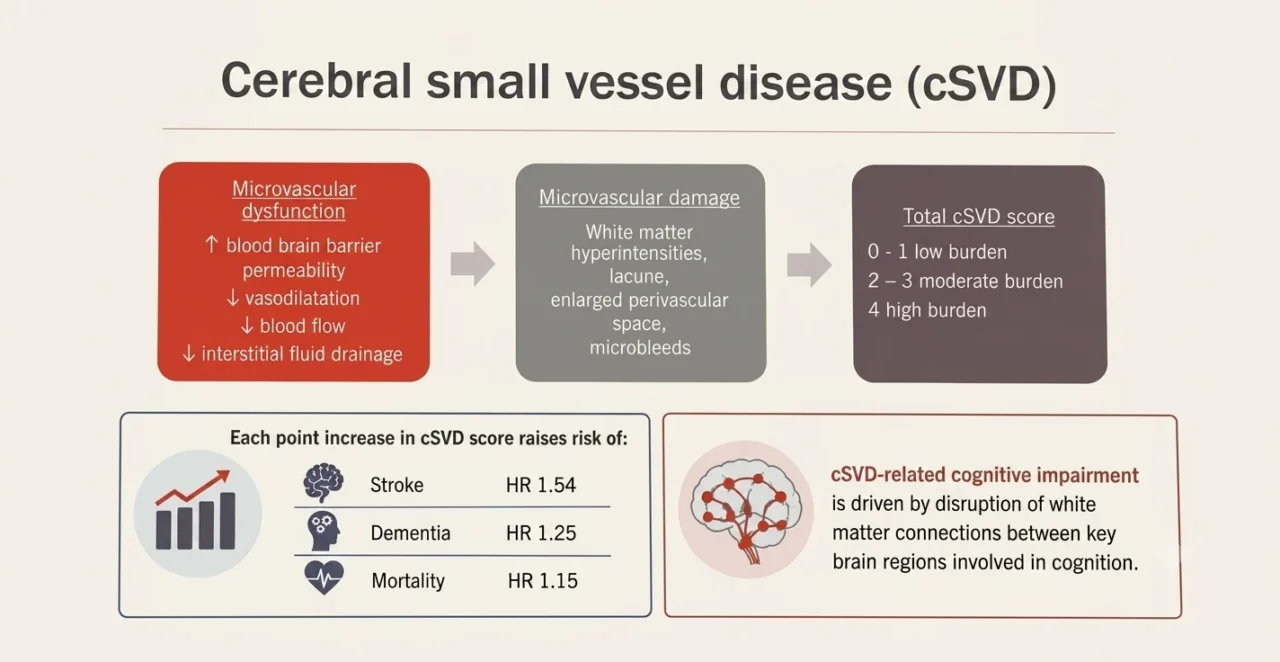
One possible mechanism underlying these long-term effects is chronic cerebral small vessel disease. cSVD reflects structural injury of small cerebral vessels and can be detected on MRI through characteristic abnormalities, including white matter hyperintensities (WMH), cerebral microbleeds (CMB), lacunes and enlarged perivascular spaces (EPVS).
In the general population, these MRI markers are associated with cognitive decline, stroke, dementia, and increased mortality.
However, their contribution to cognitive impairment among iTTP survivors has remained poorly understood.
To investigate this question, researchers conducted a cross-sectional study involving 51 adults with iTTP who had remained in clinical remission for at least 12 months after their last acute episode.
Participants underwent detailed neuropsychological assessment evaluating global cognition, attention, logical reasoning, language, memory, working memory, and prefrontal executive function. Brain MRI was performed to assess individual cSVD markers and calculate the composite cSVD score ranging from 0 to 4.
The study also evaluated associations between cognitive outcomes and clinical characteristics, including relapse history, disease duration, and longitudinal ADAMTS13 activity.
Selective Cognitive Deficits Persist Despite Preserved Global Function
The study population was predominantly female (76%) with a median age of 58 years.
Overall cognitive performance appeared reassuring, with global cognition, attention, logical reasoning and language remaining largely preserved compared with the general population.
However, more detailed testing revealed specific areas of vulnerability.
Patients demonstrated impairment in working memory, reflected by reduced performance on forward and backward digit span tests, indicating difficulty temporarily storing and processing information.
Deficits were also observed in prefrontal executive function, including reduced performance in cognitive estimation tasks and the Tower of London test, which assess planning, organization, problem-solving, and higher-order cognitive abilities.
These findings suggest that standard cognitive screening may fail to identify the subtle neurological consequences experienced by patients after iTTP.
Cerebral Microbleeds and Lacunes Identify Patients at Higher Risk
A key finding of the study was the association between specific MRI abnormalities and cognitive impairment.
After adjustment for age and hypertension, patients with cerebral microbleeds had an approximately eight-fold higher likelihood of memory impairment (adjusted OR 8.0; 95% CI 1.5–44.1; p=0.02).
Similarly, the presence of lacunes was associated with nearly a nine-fold increased risk of language impairment (adjusted OR 8.7; 95% CI 1.1–70.7; p=0.04).
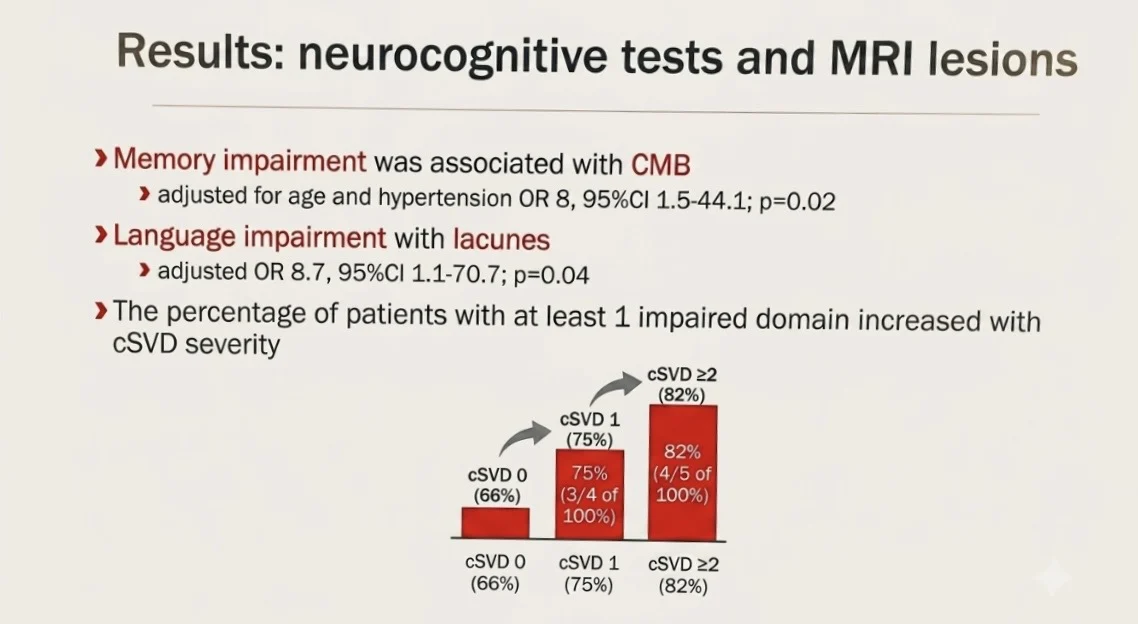
Although cognitive impairment became more frequent with increasing overall cSVD burden – affecting 66% of patients with a cSVD score of 0, 75% with a score of 1, and 82% with scores ≥2 – the composite score did not demonstrate consistent associations with specific cognitive domains.
Instead, individual MRI findings, particularly cerebral microbleeds and lacunes, appeared to provide greater clinical value in identifying patients at risk of cognitive dysfunction. 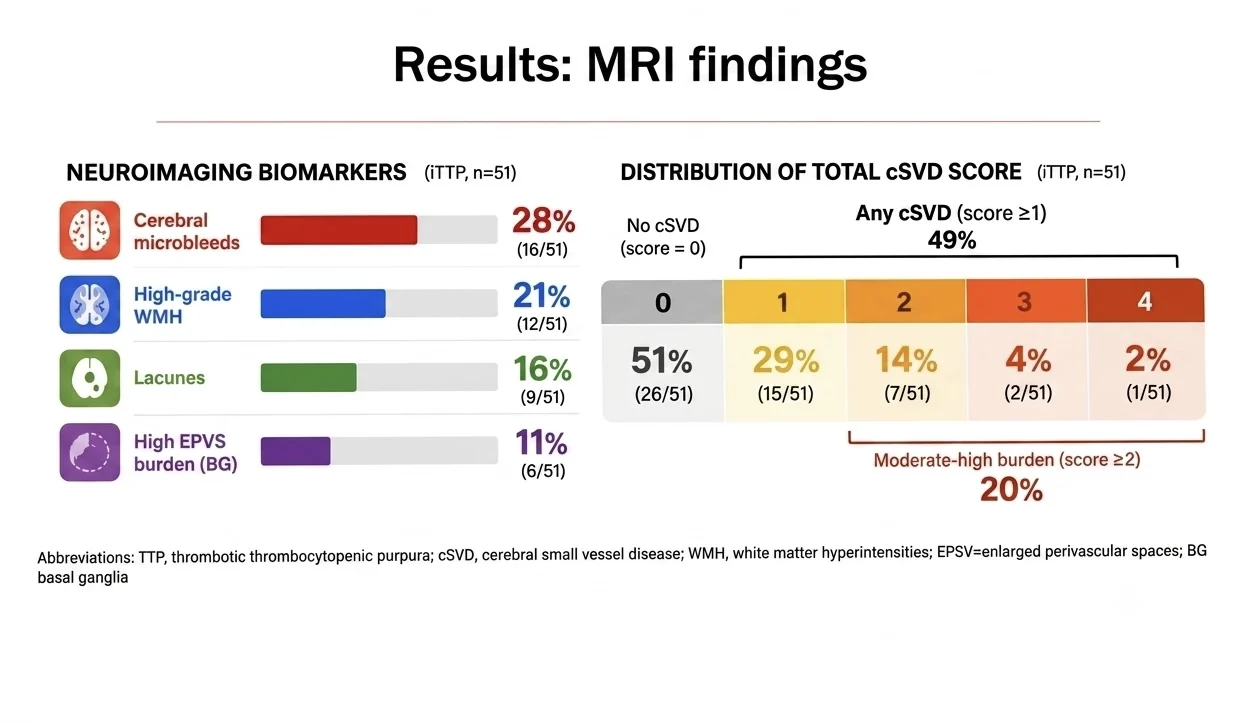
Rethinking Long-Term Follow-Up After iTTP
Interestingly, cognitive impairment was not associated with several traditional indicators of iTTP severity.
No significant relationship was identified between cognitive dysfunction and the number of relapses, time since the first acute episode, or longitudinal ADAMTS13 activity during follow-up.
These findings suggest that persistent cognitive impairment may represent a consequence of chronic microvascular brain injury rather than ongoing disease activity.
The results highlight an important shift in the long-term management of iTTP. While current follow-up strategies focus primarily on relapse prevention and hematologic monitoring, neurological outcomes should become an increasingly important component of survivorship care.
MRI-based assessment combined with neuropsychological evaluation may help identify patients at increased risk, allowing earlier recognition and supportive interventions aimed at preserving cognitive function and quality of life.
The Bottom Line
New data presented at the ISTH 2026 Congress demonstrate that persistent cognitive impairment remains an underrecognized consequence of iTTP, even among patients achieving sustained clinical remission.
Although global cognition is often preserved, selective deficits affecting working memory and executive function may persist. Importantly, specific MRI markers of cerebral small vessel disease – particularly cerebral microbleeds and lacunes – are strongly associated with cognitive impairment.
As survival after iTTP continues to improve, the concept of recovery must expand beyond hematologic remission.
Protecting long-term neurological health should become an essential component of comprehensive iTTP survivorship care.
Stay updated with Hemostasis Today.
-
Sep 21, 2026, 15:56Anita Zaidi: Why Only 2% of Health Research and Development Goes to Women’s Conditions
-
Sep 21, 2026, 15:49Omid Khalafi: Gating Strategy and How Do We Decide Which Cells to Analyze
-
Sep 21, 2026, 15:44Levacetylleucine: A New Therapeutic Approach to Ataxia Telangiectasia
-
Sep 21, 2026, 15:40Andreas Tridimas: The Diagnostic Traps of Lipaemic Blood – Why a Normal Amylase Can Mislead You
-
Sep 21, 2026, 15:33Arsene Mekinian: Exploring Cardiac Involvement in Behçet’s Disease
-
Sep 21, 2026, 15:23Anis Mahjoubi: MRI Findings of Krukenberg Tumors
-
Sep 21, 2026, 15:08Fikreab Tesfaye Tefera: 10 Practical Take-Home Points for Diagnosing Iron Deficiency Anemia
-
Sep 21, 2026, 14:10Aswin K Mohan: Lessons from TRANSCON 2026 – Building Resilient Blood Supply Systems Before Crisis Hits
-
Sep 21, 2026, 14:00Vincent Lu: Beyond PT and aPTT – How Hemostasis Evolves Across a Lifetime