


Augustina Isioma Ikusemoro: The Most Misunderstood Cause of a Prolonged APTT in the Laboratory
Augustina Isioma Ikusemoro, Hematology and Transfusion Medicine Specialist at Sharjah Blood Transfusion and Research Center, shared a post on LinkedIn:
” ‘Your mixing study corrected… so it’s a factor deficiency, right?’
Not always.
This is one of the most common – and dangerous – assumptions in coagulation.
Because sometimes… your mixing study is misleading.
Let’s break it down:
A standard mixing study involves:
- Patient plasma mixed with normal plasma in a one to one ratio
- Immediate testing of APTT or PT
Correction indicates factor deficiency
No correction indicates inhibitor
Simple?
Not quite.
The problem: Time-dependent inhibitors
Some inhibitors don’t act immediately.
They are slow-acting (time-dependent) — often Factor VIII inhibitors
So what happens?
You perform an immediate mix: The APTT corrects
Looks like a factor deficiency…
But give it time.
You incubate at 37°C for 1–2 hours
Repeat the APTT
Now suddenly…
The correction disappears: APTT becomes prolonged again
What’s really happening?
These inhibitors:
- Gradually neutralize clotting factors (especially Factor VIII)
- Require time and temperature to exert their effect
- This is why they’re called time- and temperature-dependent inhibitors
Clinical implications:
If you rely only on the immediate mix:
- You may miss an acquired inhibitor
- Delay diagnosis (e.g. acquired haemophilia)
- Put patients at serious bleeding risk
Best practice:
Always perform:
- Immediate mixing study
- Incubated mixing study at 37°C for one to two hours
- And interpret both together.
Key takeaway:
A correcting mixing study does Not always mean factor deficiency.
Sometimes, it just means you didn’t wait long enough.”
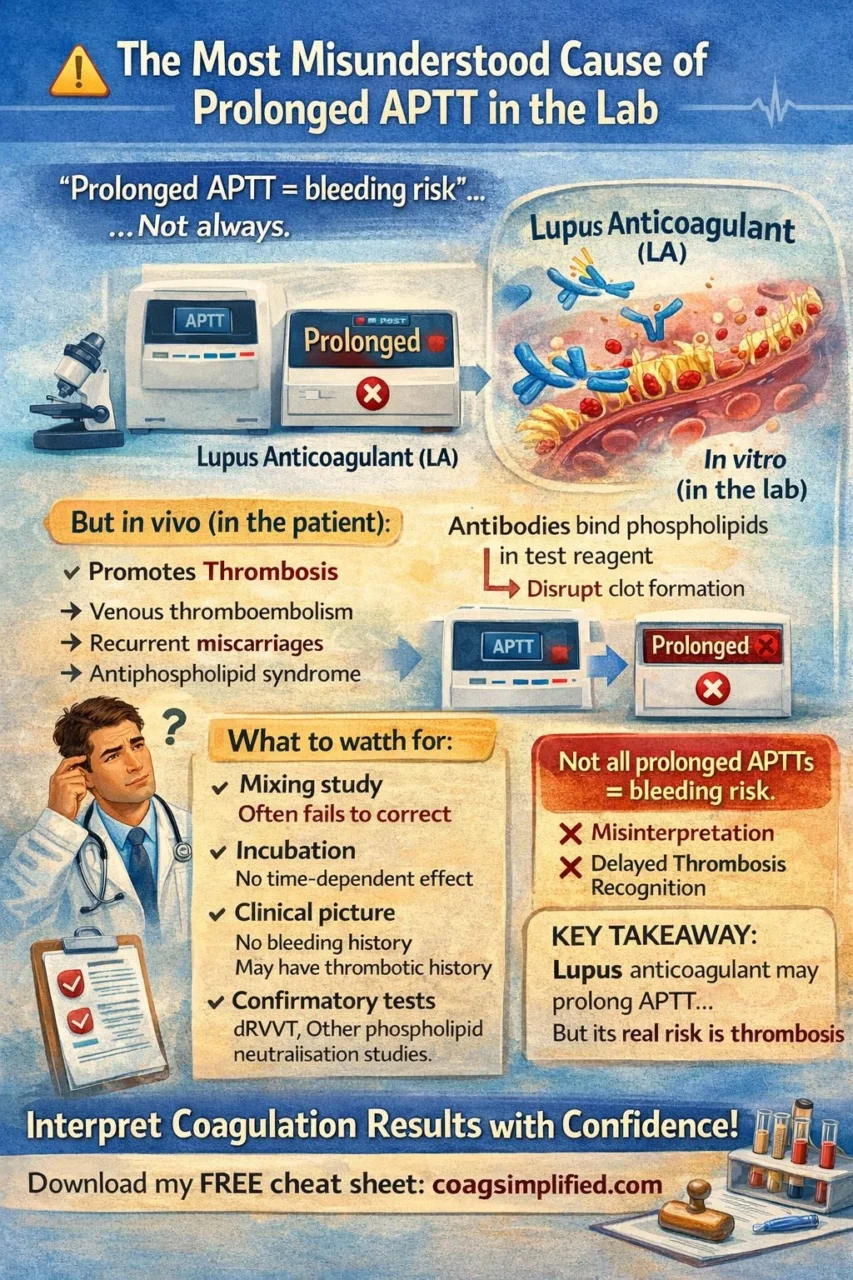
Other posts featuring Augustina Isioma Ikusemoro on Hemostasis Today.
-
Apr 15, 2026, 16:55Chokri Ben Lamine: VA-ECMO vs VV-ECMO Thromboembolic Events – Key Clinical Pearls
-
Apr 15, 2026, 16:53Sickle Cell Disease Care Varies by Region – ASH
-
Apr 15, 2026, 16:40Jorge Lima։ Understanding Recurrent Pregnancy Loss
-
Apr 15, 2026, 16:26Pregnancy-Induced Rise in FIX Activity – A Challenge to International Hemophilia Guidelines – JTH
-
Apr 15, 2026, 16:18Ken Checicki: How Restoring Blood Flow Can Solve Post – DVT Complications
-
Apr 15, 2026, 16:05Alisha Tuck: Navigating the First Trimester – Ultrasound and Anticoagulation Management
-
Apr 15, 2026, 15:59Filippo Cademartiri: Plaque Burden Is the Dominant Determinant of Long-Term Coronary Risk Beyond Stenosis
-
Apr 15, 2026, 15:33Peter Zdziarski: Will Glanzmann Thrombasthenia Patients Be Formally Recognized as Benefiting from SevenFACT?
-
Apr 15, 2026, 15:20Sonal Sonu: Blood Donation Myths in Rural Areas