

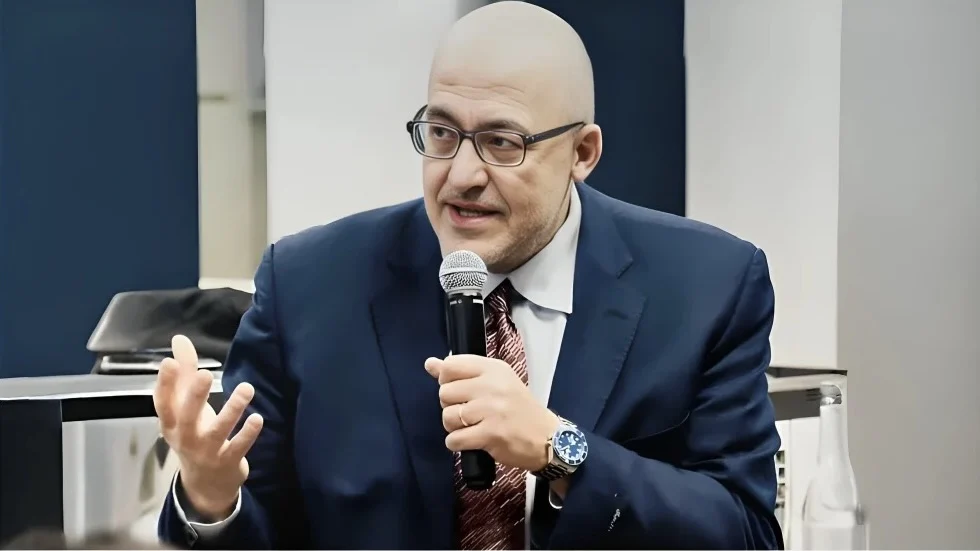
Filippo Cademartiri: Plaque Burden Is the Dominant Determinant of Long-Term Coronary Risk Beyond Stenosis
Filippo Cademartiri, Consultant Advanced Cardiovascular Imaging at UPMC Salvator Mundi International Hospital, shared on LinkedIn about a recent article by Ruurt A. Jukema et al, adding:
“Stenosis vs Plaque: We’ve been looking at the wrong winner.
Tackling stenosis above all does not make biological sense.
This study tackles a fundamental question in coronary artery disease:
- What really predicts outcomes over time?
- Is it how narrow the artery is… or how much disease is actually there?
Key message
The prognostic value of coronary disease is not static.
Early on: stenosis matters (flow limitation drives events)
Over time: plaque burden becomes dominant
Translation:
The more disease you carry, the more it matters than how tight a single lesion looks.
Why this is disruptive
For decades, cardiology has been built around:
- % stenosis
- ischemia
- revascularization decisions
But this paper reinforces something deeper:
Atherosclerosis is a diffuse, dynamic disease — not a focal narrowing problem.
The real shift
Plaque burden is:
- More stable as a biomarker
- More reflective of total disease biology
- More predictive in the long term
While stenosis?
- Fluctuates
- Is lesion-specific
- May miss the bigger picture
Clinical implications
If you focus only on stenosis:
- You treat lesions.
If you focus on plaque burden:
- You treat the disease.
That’s a completely different strategy.
Bottom line
We are moving from:
‘How tight is the blockage?’
to
‘How much disease is there overall?’
And that shift changes everything:
- Risk stratification
- Treatment intensity
- Prevention strategies
Final thought
- The artery doesn’t fail because of one stenosis.
- It fails because of the total plaque ecosystem.
And that’s where the future of imaging – and cardiology – is heading.”
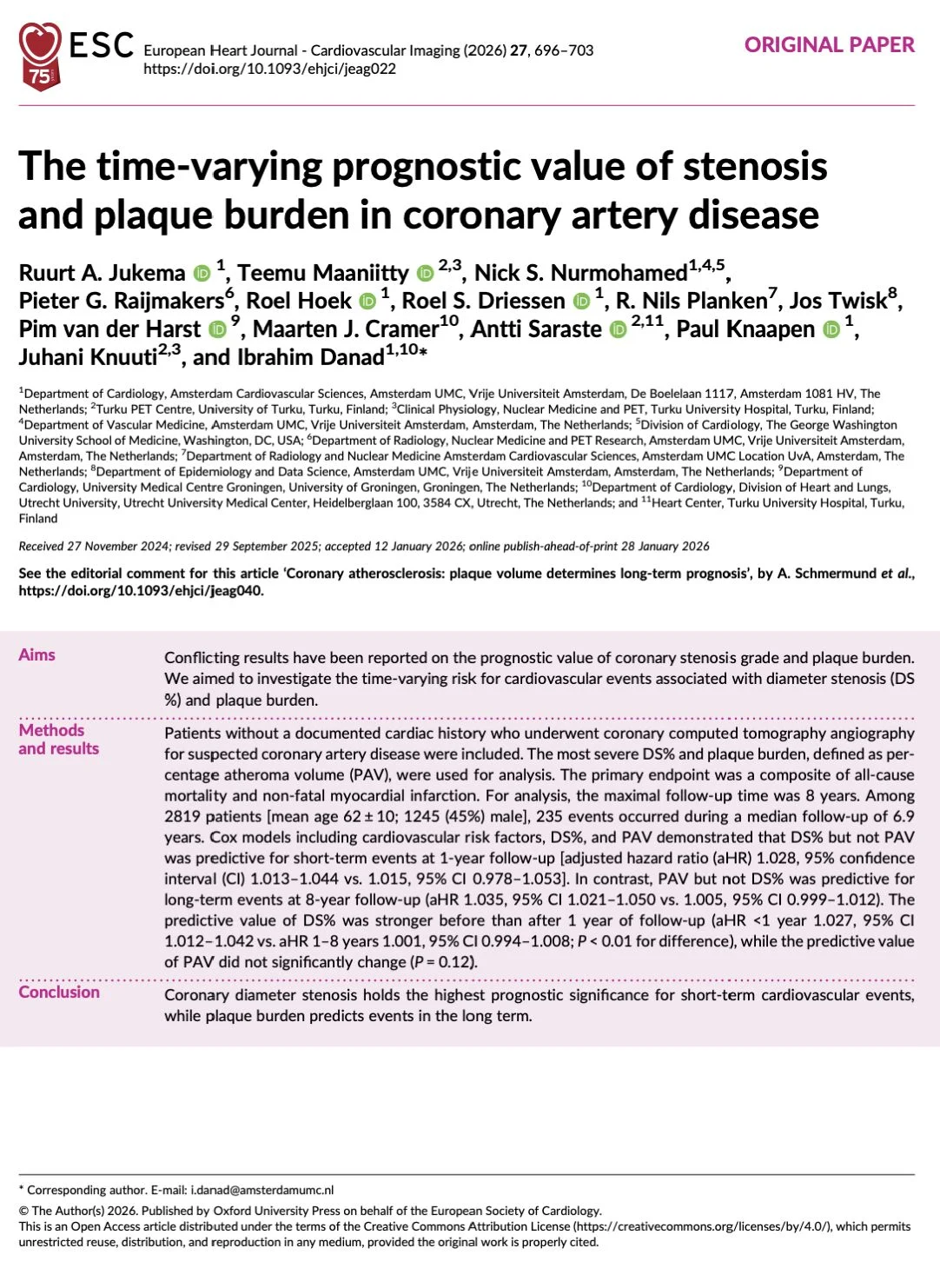
Title: The time-varying prognostic value of stenosis and plaque burden in coronary artery disease
Authors: Ruurt A. Jukema, Teemu Maaniitty, Nick S. Nurmohamed, Pieter G. Raijmakers, Roel Hoek, Roel S. Driessen, R. Nils Planken, Jos Twisk, Pim van der Harst, Maarten J. Cramer, Antti Saraste, Paul Knaapen, Juhani Knuuti, Ibrahim Danad

Stay updated on all scientific advances with Hemostasis Today.
-
Oct 20, 2026, 06:45Grant Garcia: Why Does a Blood Clot Diagnosis Immediately End an Athlete’s Season?
-
Oct 20, 2026, 06:35Parag Tamhankar: Landmark Study Reveals Genetic Spectrum and Targeted Therapies for ALPS in the Indian Population
-
Oct 20, 2026, 06:26Nina Houben: Neonatal Blood Transfusion Symposium and PhD Defense
-
Oct 20, 2026, 05:46Jan T. Kielstein: DNP Poisoning and Hemoadsorption The Limits of Rescue Therapy
-
Oct 20, 2026, 05:33Giulia Di Paolo: Connecting Plasma Donation to the Patients Who Depend on It
-
Oct 20, 2026, 05:20James Knowles: Exploring Plasma Manufacturing and Strengthening Industry Collaboration
-
Oct 20, 2026, 05:11Giuseppe Lippi։ Understanding Liver Test Abnormalities After AAV Gene Therapy
-
Oct 20, 2026, 05:02Sanam Loghavi: Test Your Hematology Knowledge at ASH 2026!
-
Oct 20, 2026, 04:13Ifeanyichukwu Ifechidere: DOACs Are Not the Answer to Every Anticoagulation Question